Thank you for visiting SNEWPapers!
Sign up free
Story
July 17, 1885
The Dallas Daily Herald
Dallas, Dallas County, Texas
What is this article about?
A Rome correspondent describes an exquisite 18th-century Rococo apartment in the Barberini Palace, once belonging to a canoness, featuring lavish Pompadour decorations. It deteriorated after the French Revolution but was recently restored by a wealthy American. (214 characters)
Clipping
OCR Quality
95%
Excellent
Full Text
A Beautiful Apartment.
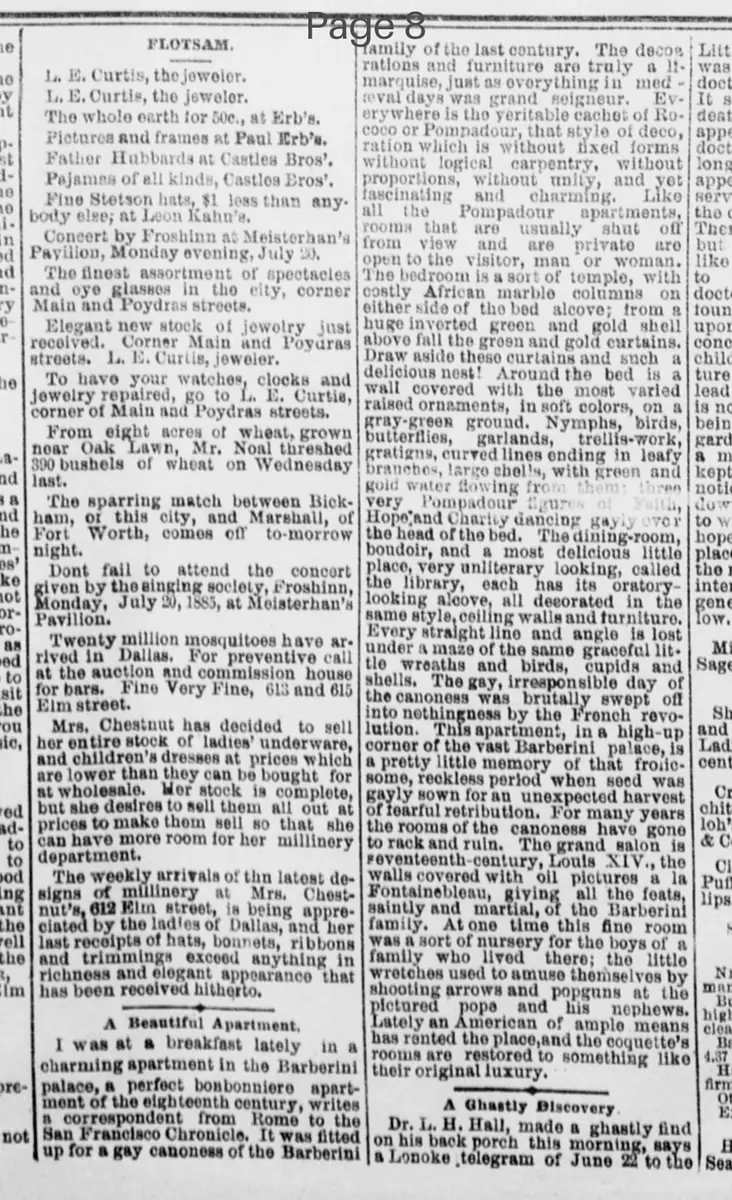
I was at a breakfast lately in a charming apartment in the Barberini palace, a perfect bonbonniere apartment of the eighteenth century, writes a correspondent from Rome to the San Francisco Chronicle. It was fitted up for a gay canoness of the Barberini family of the last century. The decorations and furniture are truly a la marquise, just as everything in medieval days was grand soigneur. Everywhere is the veritable cachet of Rococo or Pompadour, that style of decoration which is without fixed forms without logical carpentry, without proportions, without unity, and yet fascinating and charming. Like all the Pompadour apartments, rooms that are usually shut off from view and are private are open to the visitor, man or woman.
The bedroom is a sort of temple, with costly African marble columns on either side of the bed alcove; from a huge inverted green and gold shell above fall the green and gold curtains. Draw aside these curtains and such a delicious nest! Around the bed is a wall covered with the most varied raised ornaments, in soft colors, on a gray-green ground. Nymphs, birds, butterflies, garlands, trellis-work, gratings, curved lines ending in leafy branches, large shells, with green and gold water flowing from a very Pompadour figure—Love, Hope and Charity dancing gayly over the head of the bed. The dining-room, boudoir, and a most delicious little place, very unliterary-looking, called the library, each has its oratory-looking alcove, all decorated in the same style, ceiling walls and furniture. Every straight line and angle is lost under a maze of the same graceful little wreaths and birds, cupids and shells. The gay, irresponsible day of the canoness was brutally swept off into nothingness by the French revolution. This apartment, in a high-up corner of the vast Barberini palace, is a pretty little memory of that frolicsome, reckless period when seed was gayly sown for an unexpected harvest of fearful retribution. For many years the rooms of the canoness have gone to rack and ruin. The grand salon is seventeenth-century, Louis XIV., the walls covered with oil pictures a la Fontainebleau, giving all the feats, saintly and martial, of the Barberini family. At one time this fine room was a sort of nursery for the boys of a family who lived there; the little wretches used to amuse themselves by shooting arrows and popguns at the pictured pope and his nephews.
Lately an American of ample means has rented the place, and the coquette's rooms are restored to something like their original luxury.
I was at a breakfast lately in a charming apartment in the Barberini palace, a perfect bonbonniere apartment of the eighteenth century, writes a correspondent from Rome to the San Francisco Chronicle. It was fitted up for a gay canoness of the Barberini family of the last century. The decorations and furniture are truly a la marquise, just as everything in medieval days was grand soigneur. Everywhere is the veritable cachet of Rococo or Pompadour, that style of decoration which is without fixed forms without logical carpentry, without proportions, without unity, and yet fascinating and charming. Like all the Pompadour apartments, rooms that are usually shut off from view and are private are open to the visitor, man or woman.
The bedroom is a sort of temple, with costly African marble columns on either side of the bed alcove; from a huge inverted green and gold shell above fall the green and gold curtains. Draw aside these curtains and such a delicious nest! Around the bed is a wall covered with the most varied raised ornaments, in soft colors, on a gray-green ground. Nymphs, birds, butterflies, garlands, trellis-work, gratings, curved lines ending in leafy branches, large shells, with green and gold water flowing from a very Pompadour figure—Love, Hope and Charity dancing gayly over the head of the bed. The dining-room, boudoir, and a most delicious little place, very unliterary-looking, called the library, each has its oratory-looking alcove, all decorated in the same style, ceiling walls and furniture. Every straight line and angle is lost under a maze of the same graceful little wreaths and birds, cupids and shells. The gay, irresponsible day of the canoness was brutally swept off into nothingness by the French revolution. This apartment, in a high-up corner of the vast Barberini palace, is a pretty little memory of that frolicsome, reckless period when seed was gayly sown for an unexpected harvest of fearful retribution. For many years the rooms of the canoness have gone to rack and ruin. The grand salon is seventeenth-century, Louis XIV., the walls covered with oil pictures a la Fontainebleau, giving all the feats, saintly and martial, of the Barberini family. At one time this fine room was a sort of nursery for the boys of a family who lived there; the little wretches used to amuse themselves by shooting arrows and popguns at the pictured pope and his nephews.
Lately an American of ample means has rented the place, and the coquette's rooms are restored to something like their original luxury.
What sub-type of article is it?
Curiosity
Historical Event
What themes does it cover?
Social Manners
Fortune Reversal
What keywords are associated?
Barberini Palace
Rococo Decoration
Pompadour Style
Apartment Restoration
French Revolution Impact
What entities or persons were involved?
Barberini Canoness
American Renter
Where did it happen?
Barberini Palace, Rome
Story Details
Key Persons
Barberini Canoness
American Renter
Location
Barberini Palace, Rome
Event Date
Eighteenth Century
Story Details
A correspondent describes a charming eighteenth-century Rococo apartment in the Barberini palace, fitted for a gay canoness, with Pompadour-style decorations; it fell into ruin after the French Revolution but has been restored by an American.