Thank you for visiting SNEWPapers!
Sign up free
Nashville Union And American
Nashville, Davidson County, Tennessee
What is this article about?
A national convention of professional gamblers convenes in Chicago to revise game rules and avoid politics, causing sensation due to their appearance. The article condemns gambling as a vice, citing massive financial losses, ruined families, and historical prohibitions by governments worldwide to suppress it.
Clipping
OCR Quality
Full Text
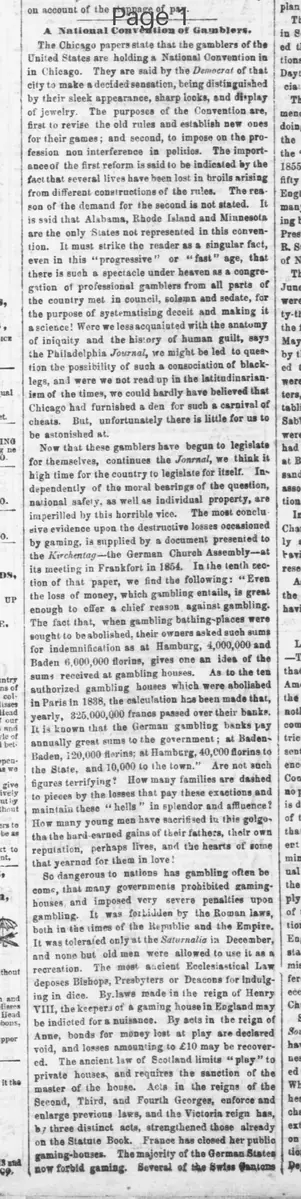
The Chicago papers state that the gamblers of the United States are holding a National Convention in Chicago. They are said by the Democrat of that city to make a decided sensation, being distinguished by their sleek appearance, sharp looks, and display of jewelry. The purposes of the Convention are, first to revise the old rules and establish new ones for their games; and second, to impose on the profession non interference in politics. The importance of the first reform is said to be indicated by the fact that several lives have been lost in broils arising from different constructions of the rules. The reason of the demand for the second is not stated. It is said that Alabama, Rhode Island and Minnesota are the only States not represented in this convention. It must strike the reader as a singular fact, even in this "progressive" or "fast" age, that there is such a spectacle under heaven as a congregation of professional gamblers from all parts of the country met in council, solemn and sedate, for the purpose of systematising deceit and making it a science! Were we less acquainted with the anatomy of iniquity and the history of human guilt, says the Philadelphia Journal, we might be led to question the possibility of such a consociation of blacklegs, and were we not read up in the latitudinarianism of the times, we could hardly have believed that Chicago had furnished a den for such a carnival of cheats. But, unfortunately there is little for us to be astonished at.
Now that these gamblers have begun to legislate for themselves, continues the Journal, we think it high time for the country to legislate for itself. Independently of the moral bearings of the question, national safety, as well as individual property, are imperilled by this horrible vice. The most conclusive evidence upon the destructive losses occasioned by gaming, is supplied by a document presented to the Kirchentag--the German Church Assembly--at its meeting in Frankfort in 1854. In the tenth section of that paper, we find the following: "Even the loss of money, which gambling entails, is great enough to offer a chief reason against gambling. The fact that, when gambling bathing-places were sought to be abolished, their owners asked such sums for indemnification as at Hamburg, 4,000,000 and Baden 6,000,000 florins, gives one an idea of the sums received at gambling houses. As to the ten authorized gambling houses which were abolished in Paris in 1838, the calculation has been made that, yearly, 325,000,000 francs passed over their banks. It is known that the German gambling banks pay annually great sums to the government; at Baden-Baden, 120,000 florins; at Hamburg, 40,000 florins to the State, and 10,000 to the town." Are not such figures terrifying? How many families are dashed to pieces by the losses that pay these exactions and maintain these "hells" in splendor and affluence? How many young men have sacrificed in this golgotha, the hard-earned gains of their fathers, their own reputation, perhaps lives, and the hearts of some that yearned for them in love!
So dangerous to nations has gambling often become, that many governments prohibited gaming-houses and imposed very severe penalties upon gambling. It was forbidden by the Roman laws, both in the times of the Republic and the Empire. It was tolerated only at the Saturnalia in December, and none but old men were allowed to use it as a recreation. The most ancient Ecclesiastical Law deposes Bishops, Presbyters or Deacons for indulging in dice. By laws made in the reign of Henry VIII, the keepers of a gaming house in England may be indicted for a nuisance. By acts in the reign of Anne, bonds for money lost at play are declared void, and losses amounting to £10 may be recovered. The ancient law of Scotland limits "play" to private houses, and requires the sanction of the master of the house. Acts in the reigns of the Second, Third, and Fourth Georges, enforce and enlarge previous laws, and the Victoria reign has, by three distinct acts, strengthened those already on the Statute Book. France has closed her public gaming-houses. The majority of the German States now forbid gaming. Several of the Swiss Cantons prohibit all gaming. Sardinia and Savoy have closed their gaming-houses. The laws of several of our own States and the municipal laws of some of our cities prohibit gaming.
And what do these facts prove? If anything, that a practice must be very bad, grossly evil, before a government would sacrifice a large revenue to put it down, as in the case of France. Surely, the fact that ancient Rome, a large portion of modern Europe and of America, have had to make laws to suppress gambling, sufficiently indicates its tendencies. The fearful demoralization that follows in the track of gambling everywhere, is evidence enough to condemn it as a curse and scourge of humanity.
What sub-type of article is it?
What themes does it cover?
What keywords are associated?
Where did it happen?
Story Details
Location
Chicago
Story Details
Gamblers from across the US, except Alabama, Rhode Island, and Minnesota, hold a convention in Chicago to revise game rules to prevent broils and impose non-interference in politics. The article decries this as systematizing deceit and urges national legislation against gambling, highlighting its financial devastation, family ruin, and historical suppressions by laws in Rome, England, France, Germany, and US states.