Thank you for visiting SNEWPapers!
Sign up free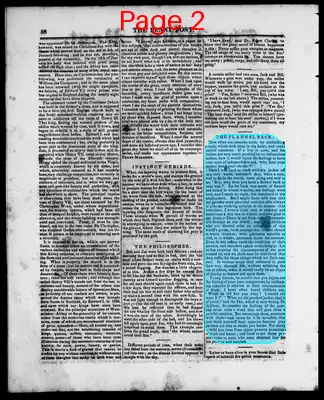
Story
May 3, 1834
The Penny Post
Providence, Providence County, Rhode Island
What is this article about?
A personal anecdote about a poor boy hurt by a wealthy man's insensitive comment on his clothing illustrates the need for empathy toward those in poverty, advising children to avoid mocking poor companions.
Clipping
OCR Quality
98%
Excellent
Full Text
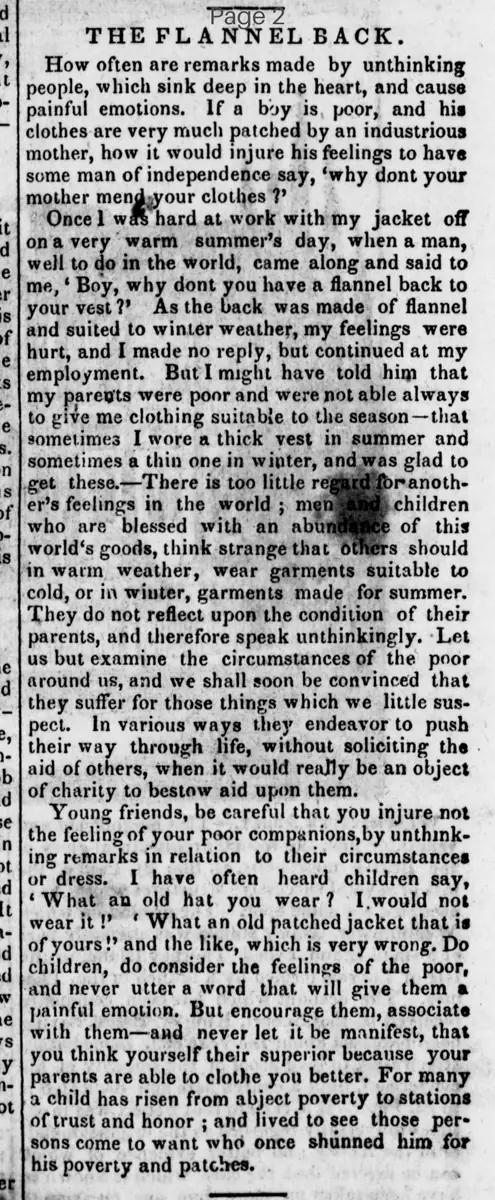
THE FLANNEL BACK.
How often are remarks made by unthinking people, which sink deep in the heart, and cause painful emotions. If a boy is poor, and his clothes are very much patched by an industrious mother, how it would injure his feelings to have some man of independence say, 'why dont your mother mend your clothes?'
Once I was hard at work with my jacket off on a very warm summer's day, when a man, well to do in the world, came along and said to me, 'Boy, why dont you have a flannel back to your vest?' As the back was made of flannel and suited to winter weather, my feelings were hurt, and I made no reply, but continued at my employment. But I might have told him that my parents were poor and were not able always to give me clothing suitable to the season—that sometimes I wore a thick vest in summer and sometimes a thin one in winter, and was glad to get these.—There is too little regard for another's feelings in the world; men and children who are blessed with an abundance of this world's goods, think strange that others should in warm weather, wear garments suitable to cold, or in winter, garments made for summer. They do not reflect upon the condition of their parents, and therefore speak unthinkingly. Let us but examine the circumstances of the poor around us, and we shall soon be convinced that they suffer for those things which we little suspect. In various ways they endeavor to push their way through life, without soliciting the aid of others, when it would really be an object of charity to bestow aid upon them.
Young friends, be careful that you injure not the feeling of your poor companions, by unthinking remarks in relation to their circumstances or dress. I have often heard children say, 'What an old hat you wear? I would not wear it!' 'What an old patched jacket that is of yours!' and the like, which is very wrong. Do children, do consider the feelings of the poor, and never utter a word that will give them a painful emotion. But encourage them, associate with them—and never let it be manifest, that you think yourself their superior because your parents are able to clothe you better. For many a child has risen from abject poverty to stations of trust and honor: and lived to see those persons come to want who once shunned him for his poverty and patches.
How often are remarks made by unthinking people, which sink deep in the heart, and cause painful emotions. If a boy is poor, and his clothes are very much patched by an industrious mother, how it would injure his feelings to have some man of independence say, 'why dont your mother mend your clothes?'
Once I was hard at work with my jacket off on a very warm summer's day, when a man, well to do in the world, came along and said to me, 'Boy, why dont you have a flannel back to your vest?' As the back was made of flannel and suited to winter weather, my feelings were hurt, and I made no reply, but continued at my employment. But I might have told him that my parents were poor and were not able always to give me clothing suitable to the season—that sometimes I wore a thick vest in summer and sometimes a thin one in winter, and was glad to get these.—There is too little regard for another's feelings in the world; men and children who are blessed with an abundance of this world's goods, think strange that others should in warm weather, wear garments suitable to cold, or in winter, garments made for summer. They do not reflect upon the condition of their parents, and therefore speak unthinkingly. Let us but examine the circumstances of the poor around us, and we shall soon be convinced that they suffer for those things which we little suspect. In various ways they endeavor to push their way through life, without soliciting the aid of others, when it would really be an object of charity to bestow aid upon them.
Young friends, be careful that you injure not the feeling of your poor companions, by unthinking remarks in relation to their circumstances or dress. I have often heard children say, 'What an old hat you wear? I would not wear it!' 'What an old patched jacket that is of yours!' and the like, which is very wrong. Do children, do consider the feelings of the poor, and never utter a word that will give them a painful emotion. But encourage them, associate with them—and never let it be manifest, that you think yourself their superior because your parents are able to clothe you better. For many a child has risen from abject poverty to stations of trust and honor: and lived to see those persons come to want who once shunned him for his poverty and patches.
What sub-type of article is it?
Biography
What themes does it cover?
Moral Virtue
Misfortune
Social Manners
What keywords are associated?
Poverty
Insensitive Remarks
Clothing
Empathy
Moral Lesson
Childhood Anecdote
Story Details
Story Details
A poor boy working on a hot summer day without his jacket is insulted by a wealthy man for not having a flannel back to his vest, which hurts his feelings given his family's poverty and mismatched seasonal clothing. The narrative urges empathy, warning against unthinking remarks about the poor's dress and encouraging association without superiority.