Thank you for visiting SNEWPapers!
Sign up free
Literary
October 25, 1809
The Rhode Island Republican
Newport, Newport County, Rhode Island
What is this article about?
An American traveler in Rome writes to his sister describing the city's topography, comparing modern Rome to ancient: same location and form, but with vast deserted areas inside walls, desolate suburbs, meandering Tiber, and focus on eastern bank; entered via Porta del Popolo; level surface with noble architecture and squares featuring fountains and obelisks; digression criticizing French taste.
Clipping
OCR Quality
95%
Excellent
Full Text
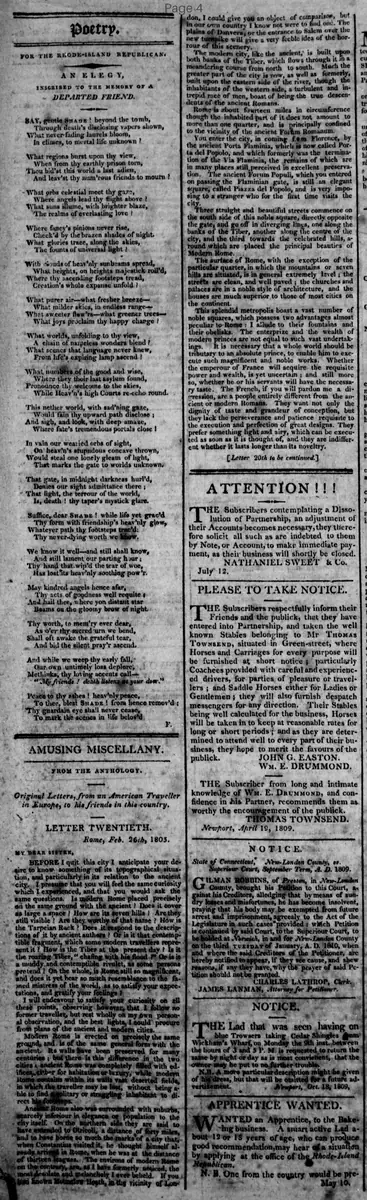
AMUSING MISCELLANY.
FROM THE ANTHOLOGY.
Original Letters, from an American Traveller
in Europe, to his friends in this country.
LETTER TWENTIETH
Rome, Feb. 26th, 1805.
MY DEAR SISTER
BEFORE I quit this city I anticipate your desire to know something of its topographical situation, and particularly in its relation to the ancient city. I presume that you will feel the same curiosity which I experienced, and that you would ask the same questions. Is modern Rome placed precisely on the same ground with the ancient? Does it cover as large a space? How are its seven hills; Are they still visible? Are they worthy of that name? How is the Tarpeian Rock? Does it respond to the descriptions of it by ancient authors? Or is it that contemptible fragment, which some modern travellers represent it? How is the Tiber at the present day? Is it the roaring Tiber, "chafing with his flood." Or is it a muddy and contemptible rivulet, as some persons pretend? On the whole, is Rome still so magnificent, and does it yet bear so much resemblance to the fabled mistress of the world, as to satisfy your expectations, and gratify your feelings? -
I will endeavour to satisfy your curiosity on all these points, observing however, that I follow no former traveller, but rely wholly on my own personal observation, and the best lights I could procure from plans of the ancient and modern cities.
Modern Rome is erected on precisely the same ground, and is of the same general form with the ancient. Its walls have been preserved for many centuries; but there is this difference in the two cities, and ancient Rome was completely filled with edifices, either for habitation or luxury, while modern Rome contains within its walls vast deserted fields in which the traveller may be lost, without being able to find solitary or straggling inhabitant to direct his footsteps:
Ancient Rome also was surrounded with suburbs, scarcely inferiour in elegance or population to the city itself. : On the northern side they are said to have extended to Otricoli, a distance of forty miles, and to have borne so much the marks of a city that, when Constantine visited it, he thought himself already arrived in Rome, when he was at the distance of thirteen leagues. The environs of modern Rome on the contrary, are, as I have formerly noticed, the most desolate and melancholy I ever beheld. If you knew Epping Forest, or Hounslow Heath, in the vicinity of London, I could give you an object of comparison, but in our own country I know not where to find one. The plains of Danvers or the entrance to Salem over the new turnpike will give a very feeble idea of the horror of this scenery.
The modern city, like the ancient, is built upon both banks of the Tiber which flows through it in meandering course from north to south. Much the greater part of the city is now, as well as formerly, built upon the eastern side of the river though inhabitants of the western side, a turbulent and intrepid race of men, boast of being the true descendants of the ancient Romans.
Rome is about fourteen miles in circumference though the inhabited part of it does not amount to more than one quarter, and is principally confined to the vicinity of the ancient Forum Romanum.
You enter the city, in coming from Florence, by the ancient Porta Flaminia, which is now called Porta del Popolo, and which formerly was the termination of the Via Flaminia, the remains of which are in many places still perceived in excellent preservation, The ancient Forum Populi, which you entered on passing the Flaminian gate, is still an elegant square, called Piazza del Popolo, and is very imposing to a stranger who for the first time visits the city.
Three straight and beautiful streets commence on the south side of this noble square, directly opposite the gate, and go off in diverging lines, one along the banks of the Tiber, another along the centre of the city, and the third towards the celebrated hills, around which are placed the principal beauties of Modern Rome.
The surface of Rome, with the exception of the particular quarter, in which the mountains or seven hills are situated, is in general extremely level; the streets are clean, and well paved; the churches and palaces are in a noble style of architecture, and the houses are much superior to those of most cities on the continent.
This splendid metropolis boasts a vast number of noble squares, which possess two advantages almost peculiar to Rome: I allude to their fountains and their obelisks. The enterprize and the wealth of modern princes are not equal to such vast undertakings. It is necessary that a whole world should be tributary to an absolute prince, to enable him to execute such magnificent and noble works. Whether the emperour of France will acquire the requisite power and wealth, is yet uncertain; and still more so, whether he or his servants will have the necessary taste. The French, if you will pardon me a digression, are a people entirely different from the ancient or modern Romans. They want not only the dignity of taste and grandeur of conception, but they lack the perseverance and patience requisite to the execution and perfection of great designs. They prefer something light and airy, which can be executed as soon as it is thought of, and they are indifferent whether it lasts longer than its novelty.
[Letter 20th to be continued.]
FROM THE ANTHOLOGY.
Original Letters, from an American Traveller
in Europe, to his friends in this country.
LETTER TWENTIETH
Rome, Feb. 26th, 1805.
MY DEAR SISTER
BEFORE I quit this city I anticipate your desire to know something of its topographical situation, and particularly in its relation to the ancient city. I presume that you will feel the same curiosity which I experienced, and that you would ask the same questions. Is modern Rome placed precisely on the same ground with the ancient? Does it cover as large a space? How are its seven hills; Are they still visible? Are they worthy of that name? How is the Tarpeian Rock? Does it respond to the descriptions of it by ancient authors? Or is it that contemptible fragment, which some modern travellers represent it? How is the Tiber at the present day? Is it the roaring Tiber, "chafing with his flood." Or is it a muddy and contemptible rivulet, as some persons pretend? On the whole, is Rome still so magnificent, and does it yet bear so much resemblance to the fabled mistress of the world, as to satisfy your expectations, and gratify your feelings? -
I will endeavour to satisfy your curiosity on all these points, observing however, that I follow no former traveller, but rely wholly on my own personal observation, and the best lights I could procure from plans of the ancient and modern cities.
Modern Rome is erected on precisely the same ground, and is of the same general form with the ancient. Its walls have been preserved for many centuries; but there is this difference in the two cities, and ancient Rome was completely filled with edifices, either for habitation or luxury, while modern Rome contains within its walls vast deserted fields in which the traveller may be lost, without being able to find solitary or straggling inhabitant to direct his footsteps:
Ancient Rome also was surrounded with suburbs, scarcely inferiour in elegance or population to the city itself. : On the northern side they are said to have extended to Otricoli, a distance of forty miles, and to have borne so much the marks of a city that, when Constantine visited it, he thought himself already arrived in Rome, when he was at the distance of thirteen leagues. The environs of modern Rome on the contrary, are, as I have formerly noticed, the most desolate and melancholy I ever beheld. If you knew Epping Forest, or Hounslow Heath, in the vicinity of London, I could give you an object of comparison, but in our own country I know not where to find one. The plains of Danvers or the entrance to Salem over the new turnpike will give a very feeble idea of the horror of this scenery.
The modern city, like the ancient, is built upon both banks of the Tiber which flows through it in meandering course from north to south. Much the greater part of the city is now, as well as formerly, built upon the eastern side of the river though inhabitants of the western side, a turbulent and intrepid race of men, boast of being the true descendants of the ancient Romans.
Rome is about fourteen miles in circumference though the inhabited part of it does not amount to more than one quarter, and is principally confined to the vicinity of the ancient Forum Romanum.
You enter the city, in coming from Florence, by the ancient Porta Flaminia, which is now called Porta del Popolo, and which formerly was the termination of the Via Flaminia, the remains of which are in many places still perceived in excellent preservation, The ancient Forum Populi, which you entered on passing the Flaminian gate, is still an elegant square, called Piazza del Popolo, and is very imposing to a stranger who for the first time visits the city.
Three straight and beautiful streets commence on the south side of this noble square, directly opposite the gate, and go off in diverging lines, one along the banks of the Tiber, another along the centre of the city, and the third towards the celebrated hills, around which are placed the principal beauties of Modern Rome.
The surface of Rome, with the exception of the particular quarter, in which the mountains or seven hills are situated, is in general extremely level; the streets are clean, and well paved; the churches and palaces are in a noble style of architecture, and the houses are much superior to those of most cities on the continent.
This splendid metropolis boasts a vast number of noble squares, which possess two advantages almost peculiar to Rome: I allude to their fountains and their obelisks. The enterprize and the wealth of modern princes are not equal to such vast undertakings. It is necessary that a whole world should be tributary to an absolute prince, to enable him to execute such magnificent and noble works. Whether the emperour of France will acquire the requisite power and wealth, is yet uncertain; and still more so, whether he or his servants will have the necessary taste. The French, if you will pardon me a digression, are a people entirely different from the ancient or modern Romans. They want not only the dignity of taste and grandeur of conception, but they lack the perseverance and patience requisite to the execution and perfection of great designs. They prefer something light and airy, which can be executed as soon as it is thought of, and they are indifferent whether it lasts longer than its novelty.
[Letter 20th to be continued.]
What sub-type of article is it?
Epistolary
Essay
What themes does it cover?
Political
What keywords are associated?
Rome
Ancient Modern
Tiber
Seven Hills
Porta Del Popolo
Travel Description
What entities or persons were involved?
An American Traveller
Literary Details
Title
Letter Twentieth
Author
An American Traveller
Subject
Topographical Situation Of Modern Rome In Relation To The Ancient City
Key Lines
Is Modern Rome Placed Precisely On The Same Ground With The Ancient? Does It Cover As Large A Space? How Are Its Seven Hills; Are They Still Visible? Are They Worthy Of That Name?
Modern Rome Is Erected On Precisely The Same Ground, And Is Of The Same General Form With The Ancient.
The Environs Of Modern Rome On The Contrary, Are, As I Have Formerly Noticed, The Most Desolate And Melancholy I Ever Beheld.
The French, If You Will Pardon Me A Digression, Are A People Entirely Different From The Ancient Or Modern Romans.