Thank you for visiting SNEWPapers!
Sign up free
Editorial
September 27, 1954
The Augusta Courier
Augusta, Richmond County, Georgia
What is this article about?
Editorial argues that a New Jersey ruling extending anti-discrimination laws to private schools foreshadows U.S. Supreme Court decision banning racial segregation in private schools nationwide, criticizing the Court and political parties for undermining Southern segregation traditions.
Clipping
OCR Quality
98%
Excellent
Full Text
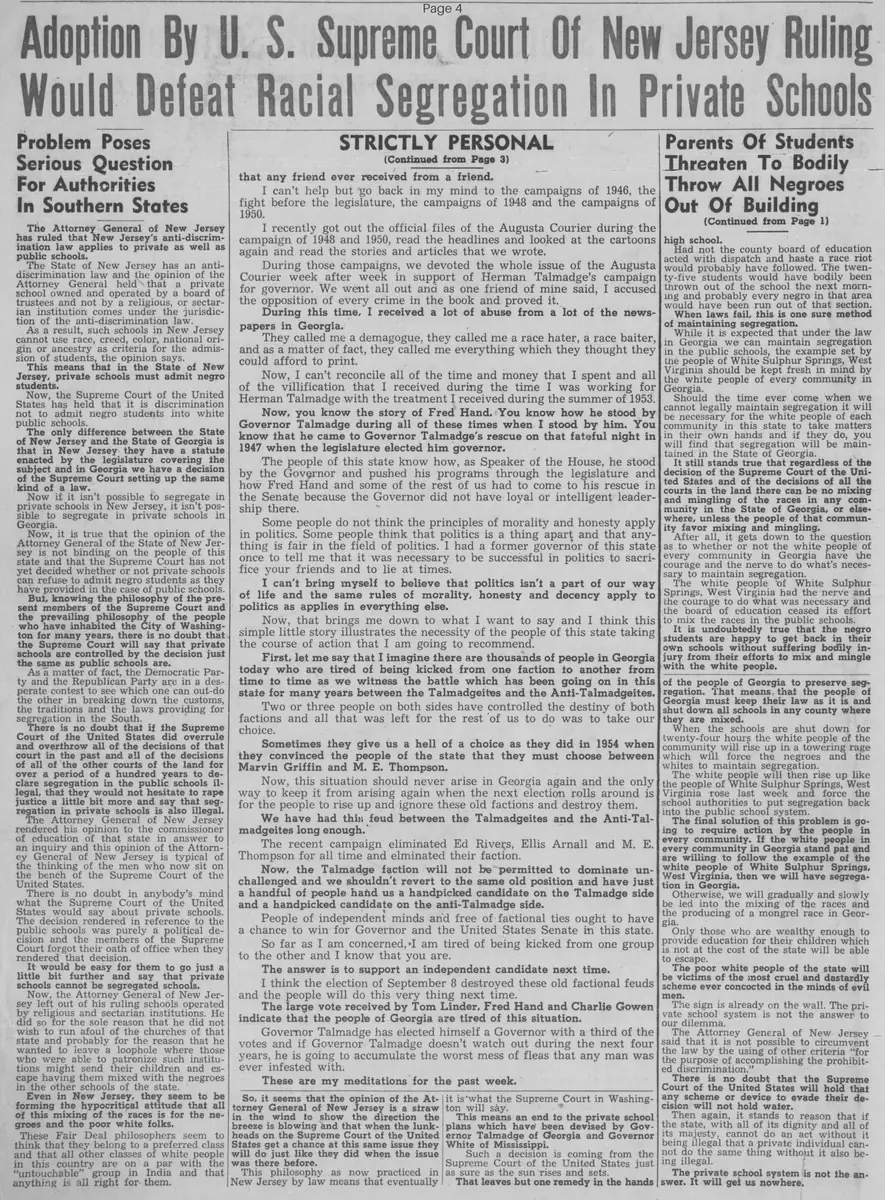
Adoption By U. S. Supreme Court Of New Jersey Ruling Would Defeat Racial Segregation In Private Schools
Problem Poses Serious Question For Authorities In Southern States
The Attorney General of New Jersey has ruled that New Jersey's anti-discrimination law applies to private as well as public schools.
The State of New Jersey has an anti-discrimination law and the opinion of the Attorney General held that a private school owned and operated by a board of trustees and not by a religious, or sectarian institution comes under the jurisdiction of the anti-discrimination law.
As a result, such schools in New Jersey cannot use race, creed, color, national origin or ancestry as criteria for the admission of students, the opinion says.
This means that in the State of New Jersey, private schools must admit Negro students.
Now, the Supreme Court of the United States has held that it is discrimination not to admit Negro students into white public schools.
The only difference between the State of New Jersey and the State of Georgia is that in New Jersey they have a statute enacted by the legislature covering the subject and in Georgia we have a decision of the Supreme Court setting up the same kind of a law.
Now if it isn't possible to segregate in private schools in New Jersey, it isn't possible to segregate in private schools in Georgia.
Now, it is true that the opinion of the Attorney General of the State of New Jersey is not binding on the people of this state and that the Supreme Court has not yet decided whether or not private schools can refuse to admit Negro students as they have provided in the case of public schools.
But, knowing the philosophy of the present members of the Supreme Court and the prevailing philosophy of the people who have inhabited the City of Washington for many years, there is no doubt that the Supreme Court will say that private schools are controlled by the decision just the same as public schools are.
As a matter of fact, the Democratic Party and the Republican Party are in a desperate contest to see which one can out-do the other in breaking down the customs, the traditions and the laws providing for segregation in the South.
There is no doubt that if the Supreme Court of the United States did overrule and overthrow all of the decisions of that court in the past and all of the decisions of all of the other courts of the land for over a period of a hundred years to declare segregation in the public schools illegal, that they would not hesitate to rape justice a little bit more and say that segregation in private schools is also illegal.
The Attorney General of New Jersey rendered his opinion to the commissioner of education of that state in answer to an inquiry and this opinion of the Attorney General of New Jersey is typical of the thinking of the men who now sit on the bench of the Supreme Court of the United States.
There is no doubt in anybody's mind what the Supreme Court of the United States would say about private schools.
The decision rendered in reference to the public schools was purely a political decision and the members of the Supreme Court forgot their oath of office when they rendered that decision.
It would be easy for them to go just a little bit further and say that private schools cannot be segregated schools.
Now, the Attorney General of New Jersey left out of his ruling schools operated by religious and sectarian institutions. He did so for the sole reason that he did not wish to run afoul of the churches of that state and probably for the reason that he wanted to leave a loophole where those who were able to patronize such institutions might send their children and escape having them mixed with the Negroes in the other schools of the state.
Even in New Jersey, they seem to be forming the hypocritical attitude that all of this mixing of the races is for the Negroes and the poor white folks.
These Fair Deal philosophers seem to think that they belong to a preferred class and that all other classes of white people in this country are on a par with the "untouchable" group in India and that anything is all right for them.
So, it seems that the opinion of the Attorney General of New Jersey is a straw in the wind to show the direction the breeze is blowing and that when the lunkheads on the Supreme Court of the United States get a chance at this same issue they will do just like they did when the issue was there before.
This philosophy as now practiced in New Jersey by law means that eventually it is what the Supreme Court in Washington will say.
This means an end to the private school plans which have been devised by Governor Talmadge of Georgia and Governor White of Mississippi.
Such a decision is coming from the Supreme Court of the United States just as sure as the sun rises and sets.
That leaves but one remedy in the hands
Problem Poses Serious Question For Authorities In Southern States
The Attorney General of New Jersey has ruled that New Jersey's anti-discrimination law applies to private as well as public schools.
The State of New Jersey has an anti-discrimination law and the opinion of the Attorney General held that a private school owned and operated by a board of trustees and not by a religious, or sectarian institution comes under the jurisdiction of the anti-discrimination law.
As a result, such schools in New Jersey cannot use race, creed, color, national origin or ancestry as criteria for the admission of students, the opinion says.
This means that in the State of New Jersey, private schools must admit Negro students.
Now, the Supreme Court of the United States has held that it is discrimination not to admit Negro students into white public schools.
The only difference between the State of New Jersey and the State of Georgia is that in New Jersey they have a statute enacted by the legislature covering the subject and in Georgia we have a decision of the Supreme Court setting up the same kind of a law.
Now if it isn't possible to segregate in private schools in New Jersey, it isn't possible to segregate in private schools in Georgia.
Now, it is true that the opinion of the Attorney General of the State of New Jersey is not binding on the people of this state and that the Supreme Court has not yet decided whether or not private schools can refuse to admit Negro students as they have provided in the case of public schools.
But, knowing the philosophy of the present members of the Supreme Court and the prevailing philosophy of the people who have inhabited the City of Washington for many years, there is no doubt that the Supreme Court will say that private schools are controlled by the decision just the same as public schools are.
As a matter of fact, the Democratic Party and the Republican Party are in a desperate contest to see which one can out-do the other in breaking down the customs, the traditions and the laws providing for segregation in the South.
There is no doubt that if the Supreme Court of the United States did overrule and overthrow all of the decisions of that court in the past and all of the decisions of all of the other courts of the land for over a period of a hundred years to declare segregation in the public schools illegal, that they would not hesitate to rape justice a little bit more and say that segregation in private schools is also illegal.
The Attorney General of New Jersey rendered his opinion to the commissioner of education of that state in answer to an inquiry and this opinion of the Attorney General of New Jersey is typical of the thinking of the men who now sit on the bench of the Supreme Court of the United States.
There is no doubt in anybody's mind what the Supreme Court of the United States would say about private schools.
The decision rendered in reference to the public schools was purely a political decision and the members of the Supreme Court forgot their oath of office when they rendered that decision.
It would be easy for them to go just a little bit further and say that private schools cannot be segregated schools.
Now, the Attorney General of New Jersey left out of his ruling schools operated by religious and sectarian institutions. He did so for the sole reason that he did not wish to run afoul of the churches of that state and probably for the reason that he wanted to leave a loophole where those who were able to patronize such institutions might send their children and escape having them mixed with the Negroes in the other schools of the state.
Even in New Jersey, they seem to be forming the hypocritical attitude that all of this mixing of the races is for the Negroes and the poor white folks.
These Fair Deal philosophers seem to think that they belong to a preferred class and that all other classes of white people in this country are on a par with the "untouchable" group in India and that anything is all right for them.
So, it seems that the opinion of the Attorney General of New Jersey is a straw in the wind to show the direction the breeze is blowing and that when the lunkheads on the Supreme Court of the United States get a chance at this same issue they will do just like they did when the issue was there before.
This philosophy as now practiced in New Jersey by law means that eventually it is what the Supreme Court in Washington will say.
This means an end to the private school plans which have been devised by Governor Talmadge of Georgia and Governor White of Mississippi.
Such a decision is coming from the Supreme Court of the United States just as sure as the sun rises and sets.
That leaves but one remedy in the hands
What sub-type of article is it?
Constitutional
Legal Reform
Social Reform
What keywords are associated?
Racial Segregation
Private Schools
Desegregation
Supreme Court
New Jersey Ruling
Southern States
Anti Discrimination Law
What entities or persons were involved?
U. S. Supreme Court
Attorney General Of New Jersey
Governor Talmadge Of Georgia
Governor White Of Mississippi
Democratic Party
Republican Party
Editorial Details
Primary Topic
Opposition To Extension Of Desegregation To Private Schools
Stance / Tone
Strongly Pro Segregation And Anti Supreme Court
Key Figures
U. S. Supreme Court
Attorney General Of New Jersey
Governor Talmadge Of Georgia
Governor White Of Mississippi
Democratic Party
Republican Party
Key Arguments
New Jersey's Anti Discrimination Law Applies To Private Schools, Requiring Admission Of Negro Students.
U.S. Supreme Court Will Likely Extend Public School Desegregation Ruling To Private Schools.
Political Parties Are Competing To Dismantle Southern Segregation Customs.
Supreme Court's Public School Decision Was Political And Violated Oaths.
New Jersey Ruling Exempts Religious Schools To Avoid Church Conflicts And Provide Loopholes For The Wealthy.
This Foreshadows End Of Private School Segregation Plans In Southern States Like Georgia And Mississippi.