Thank you for visiting SNEWPapers!
Sign up free
Winchester Gazette
Winchester, Virginia
What is this article about?
Report from Cartagena, Feb. 1, 1822, on post-war economic doldrums with reduced population and trade, high duties, and promising interior commerce. Politically, Royalists hold only Porto Cabello under siege; Panama joins Colombia; Bolivar advances to Quito and Panama, securing independence with no Spanish land left.
Clipping
OCR Quality
Full Text
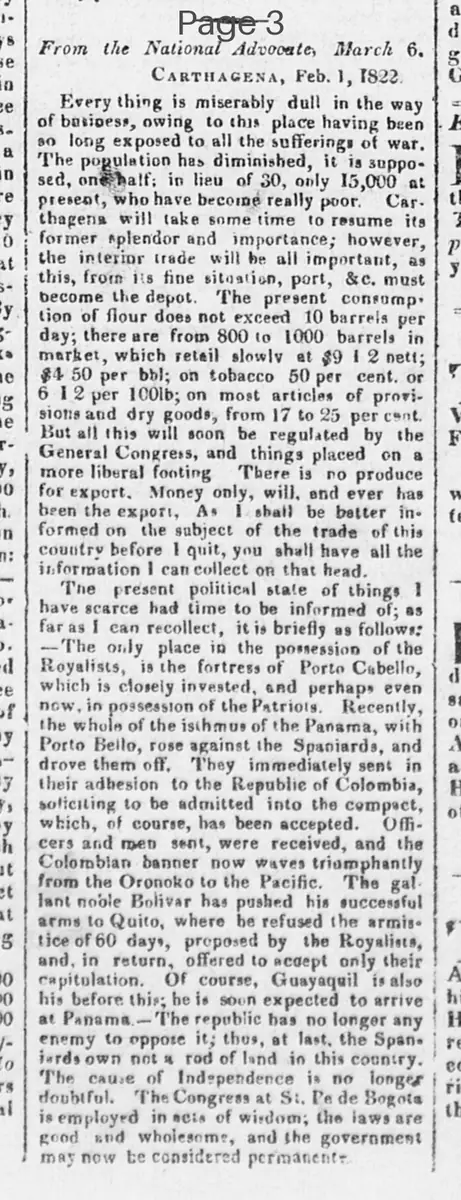
CARTHAGENA, Feb. 1, 1822.
Every thing is miserably dull in the way of business, owing to this place having been so long exposed to all the sufferings of war. The population has diminished, it is supposed, one half: in lieu of 30,000 only 15,000 at present, who have become really poor. Carthagena will take some time to resume its former splendor and importance; however, the interior trade will be all important, as this, from its fine situation, port, &c. must become the depot. The present consumption of flour does not exceed 10 barrels per day; there are from 800 to 1000 barrels in market, which retail slowly at $9 1/2 nett; $4 50 per bbl; on tobacco 50 per cent. or 6 1/2 per 100 lb; on most articles of provisions and dry goods, from 17 to 25 per cent. But all this will soon be regulated by the General Congress, and things placed on a more liberal footing. There is no produce for export, Money only, will, and ever has been the export. As I shall be better informed on the subject of the trade of this country before I quit, you shall have all the information I can collect on that head.
The present political state of things I have scarce had time to be informed of; as far as I can recollect, it is briefly as follows:—The only place in the possession of the Royalists, is the fortress of Porto Cabello, which is closely invested, and perhaps even now in possession of the Patriots. Recently, the whole of the isthmus of the Panama, with Porto Bello, rose against the Spaniards, and drove them off. They immediately sent in their adhesion to the Republic of Colombia, soliciting to be admitted into the compact, which, of course, has been accepted. Officers and men sent, were received, and the Colombian banner now waves triumphantly from the Orinoco to the Pacific. The gallant noble Bolivar has pushed his successful arms to Quito, where he refused the armistice of 60 days, proposed by the Royalists, and, in return, offered to accept only their Capitulation. Of course, Guayaquil is also his before this; he is soon expected to arrive at Panama.—The republic has no longer any enemy to oppose it; thus, at last, the Spaniards own not a rod of land in this country. The cause of Independence is no longer doubtful. The Congress at St. Fe de Bogota is employed in acts of wisdom; the laws are good and wholesome, and the government may now be considered permanent.
What sub-type of article is it?
What keywords are associated?
What entities or persons were involved?
Where did it happen?
Foreign News Details
Primary Location
Carthagena
Event Date
Feb. 1, 1822
Key Persons
Outcome
spaniards driven out with no land left; independence secured; porto cabello under siege; panama joins colombia; bolivar's forces advance to quito and expected at panama.
Event Details
Business in Carthagena is dull due to war effects, population halved to 15,000, poor conditions; low flour consumption, high duties on imports; future regulation by Congress expected; no exports except money. Politically, Royalists hold only Porto Cabello under investment; Panama isthmus rose against Spaniards and joined Republic of Colombia; Bolivar advanced to Quito, rejected armistice, took Guayaquil; Colombian banner from Orinoco to Pacific; Congress at St. Fe de Bogota enacts wise laws for permanent government.