Thank you for visiting SNEWPapers!
Sign up free
Editorial
June 25, 1898
The Freeman
Indianapolis, Marion County, Indiana
What is this article about?
Editorial by J. M. Henderson argues that the Black community is overly sensitive to perceived racial prejudices, which harms the race by exaggerating injustices and attributing personal failures to bias. It praises wise public figures like Bishops Grant and Derrick for leveraging public admiration to benefit the community, urging realism over imagination.
Clipping
OCR Quality
98%
Excellent
Full Text
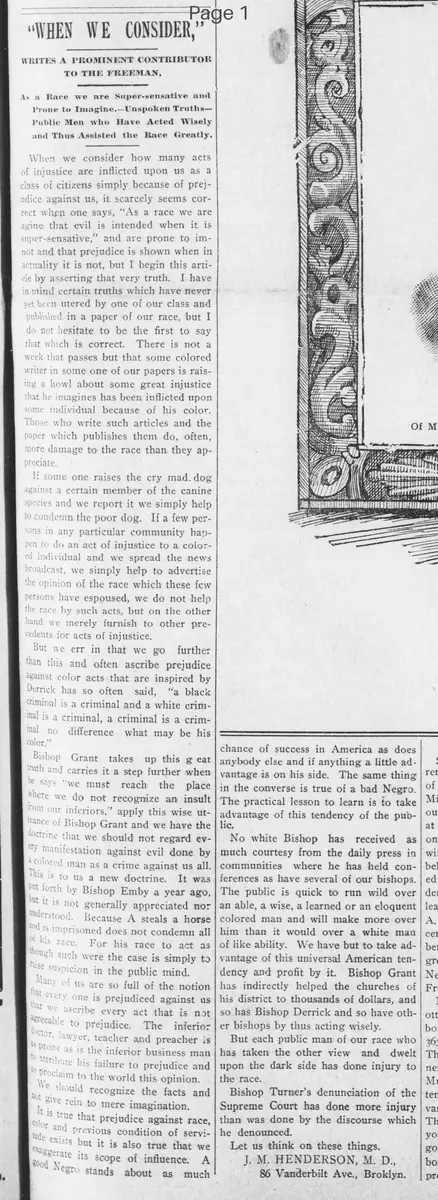
"WHEN WE CONSIDER," writes a prominent contributor to the Freeman, "As a Race we are Super-sensitive and Prone to Imagine."
-Unspoken Truths-
Public Men who Have Acted Wisely and Thus Assisted the Race Greatly.
When we consider how many acts of injustice are inflicted upon us as a class of citizens simply because of prejudice against us, it scarcely seems correct when one says, "As a race we are super-sensitive," and are prone to imagine that evil is intended when it is not and that prejudice is shown when in actuality it is not, but I begin this article by asserting that very truth. I have in mind certain truths which have never yet been uttered by one of our class and published in a paper of our race, but I do not hesitate to be the first to say that which is correct. There is not a week that passes but that some colored writer in some one of our papers is raising a howl about some great injustice that he imagines has been inflicted upon some individual because of his color. Those who write such articles and the paper which publishes them do, often, more damage to the race than they appreciate.
If some one raises the cry mad dog against a certain member of the canine species and we report it we simply help to condemn the poor dog. If a few persons in any particular community happen to do an act of injustice to a colored individual and we spread the news broadcast, we simply help to advertise the opinion of the race which these few persons have espoused, we do not help the race by such acts, but on the other hand we merely furnish to other precedents for acts of injustice.
But we err in that we go further than this and often ascribe prejudice against color acts that are inspired by other motives. As Prof. Derrick has so often said, "a black criminal is a criminal and a white criminal is a criminal, a criminal is a criminal no difference what may be his color."
Bishop Grant takes up this great truth and carries it a step further when he says "we must reach the place where we do not recognize an insult from our inferiors," apply this wise utterance of Bishop Grant and we have the doctrine that we should not regard every manifestation against evil done by a colored man as a crime against us all.
This is to us a new doctrine. It was put forth by Bishop Embry a year ago, but it is not generally appreciated nor understood. Because A steals a horse and is imprisoned does not condemn all of his race. For his race to act as though such were the case is simply to rouse suspicion in the public mind.
Many of us are so full of the notion that every one is prejudiced against us that we ascribe every act that is not agreeable to prejudice. The inferior doctor, lawyer, teacher and preacher is as prone as is the inferior business man to attribute his failure to prejudice and proclaim to the world this opinion.
We should recognize the facts and not give rein to mere imagination.
It is true that prejudice against race, color and previous condition of servitude exists but it is also true that we exaggerate its scope of influence. A good Negro stands about as much chance of success in America as does anybody else and if anything a little advantage is on his side. The same thing in the converse is true of a bad Negro.
The practical lesson to learn is to take advantage of this tendency of the public.
No white Bishop has received as much courtesy from the daily press in communities where he has held conferences as have several of our bishops. The public is quick to run wild over an able, a wise, a learned or an eloquent colored man and will make more over him than it would over a white man of like ability. We have but to take advantage of this universal American tendency and profit by it. Bishop Grant has indirectly helped the churches of his district to thousands of dollars, and so has Bishop Derrick and so have other bishops by thus acting wisely.
But each public man of our race who has taken the other view and dwelt upon the dark side has done injury to the race.
Bishop Turner's denunciation of the Supreme Court has done more injury than was done by the discourse which he denounced.
Let us think on these things.
J. M. HENDERSON, M. D.,
86 Vanderbilt Ave., Brooklyn.
-Unspoken Truths-
Public Men who Have Acted Wisely and Thus Assisted the Race Greatly.
When we consider how many acts of injustice are inflicted upon us as a class of citizens simply because of prejudice against us, it scarcely seems correct when one says, "As a race we are super-sensitive," and are prone to imagine that evil is intended when it is not and that prejudice is shown when in actuality it is not, but I begin this article by asserting that very truth. I have in mind certain truths which have never yet been uttered by one of our class and published in a paper of our race, but I do not hesitate to be the first to say that which is correct. There is not a week that passes but that some colored writer in some one of our papers is raising a howl about some great injustice that he imagines has been inflicted upon some individual because of his color. Those who write such articles and the paper which publishes them do, often, more damage to the race than they appreciate.
If some one raises the cry mad dog against a certain member of the canine species and we report it we simply help to condemn the poor dog. If a few persons in any particular community happen to do an act of injustice to a colored individual and we spread the news broadcast, we simply help to advertise the opinion of the race which these few persons have espoused, we do not help the race by such acts, but on the other hand we merely furnish to other precedents for acts of injustice.
But we err in that we go further than this and often ascribe prejudice against color acts that are inspired by other motives. As Prof. Derrick has so often said, "a black criminal is a criminal and a white criminal is a criminal, a criminal is a criminal no difference what may be his color."
Bishop Grant takes up this great truth and carries it a step further when he says "we must reach the place where we do not recognize an insult from our inferiors," apply this wise utterance of Bishop Grant and we have the doctrine that we should not regard every manifestation against evil done by a colored man as a crime against us all.
This is to us a new doctrine. It was put forth by Bishop Embry a year ago, but it is not generally appreciated nor understood. Because A steals a horse and is imprisoned does not condemn all of his race. For his race to act as though such were the case is simply to rouse suspicion in the public mind.
Many of us are so full of the notion that every one is prejudiced against us that we ascribe every act that is not agreeable to prejudice. The inferior doctor, lawyer, teacher and preacher is as prone as is the inferior business man to attribute his failure to prejudice and proclaim to the world this opinion.
We should recognize the facts and not give rein to mere imagination.
It is true that prejudice against race, color and previous condition of servitude exists but it is also true that we exaggerate its scope of influence. A good Negro stands about as much chance of success in America as does anybody else and if anything a little advantage is on his side. The same thing in the converse is true of a bad Negro.
The practical lesson to learn is to take advantage of this tendency of the public.
No white Bishop has received as much courtesy from the daily press in communities where he has held conferences as have several of our bishops. The public is quick to run wild over an able, a wise, a learned or an eloquent colored man and will make more over him than it would over a white man of like ability. We have but to take advantage of this universal American tendency and profit by it. Bishop Grant has indirectly helped the churches of his district to thousands of dollars, and so has Bishop Derrick and so have other bishops by thus acting wisely.
But each public man of our race who has taken the other view and dwelt upon the dark side has done injury to the race.
Bishop Turner's denunciation of the Supreme Court has done more injury than was done by the discourse which he denounced.
Let us think on these things.
J. M. HENDERSON, M. D.,
86 Vanderbilt Ave., Brooklyn.
What sub-type of article is it?
Social Reform
Moral Or Religious
What keywords are associated?
Racial Prejudice
Super Sensitivity
Black Community
Public Men
Imagined Injustices
Wise Bishops
Personal Failures
What entities or persons were involved?
Bishop Grant
Prof. Derrick
Bishop Embry
Bishop Turner
J. M. Henderson
Editorial Details
Primary Topic
Over Sensitivity To Racial Prejudice In The Black Community
Stance / Tone
Moral Exhortation For Realism And Restraint
Key Figures
Bishop Grant
Prof. Derrick
Bishop Embry
Bishop Turner
J. M. Henderson
Key Arguments
The Black Race Is Super Sensitive And Prone To Imagine Injustices Due To Prejudice
Publicizing Imagined Or Minor Injustices Harms The Race By Advertising Prejudice
Ascribe Acts To Other Motives Rather Than Color Prejudice, As Criminals Are Criminals Regardless Of Race
Do Not Recognize Insults From Inferiors Or View Individual Crimes As Racial Condemnations
Attribute Personal Failures To Shortcomings, Not Prejudice
Prejudice Exists But Is Exaggerated; Good Black Individuals Have Equal Or Better Chances Of Success
Wise Public Men Like Bishops Can Leverage Public Admiration To Benefit The Race
Denunciations Like Bishop Turner's Harm More Than The Original Offenses