Thank you for visiting SNEWPapers!
Sign up free
Domestic News
April 3, 1835
The Hillsborough Recorder
Hillsboro, Orange County, North Carolina
What is this article about?
Extract from Hon. James Graham's speech on the disposition of public lands, arguing against giving them exclusively to new states and advocating equal distribution among all states, highlighting North Carolina's contributions and lack of benefits.
Clipping
OCR Quality
85%
Good
Full Text
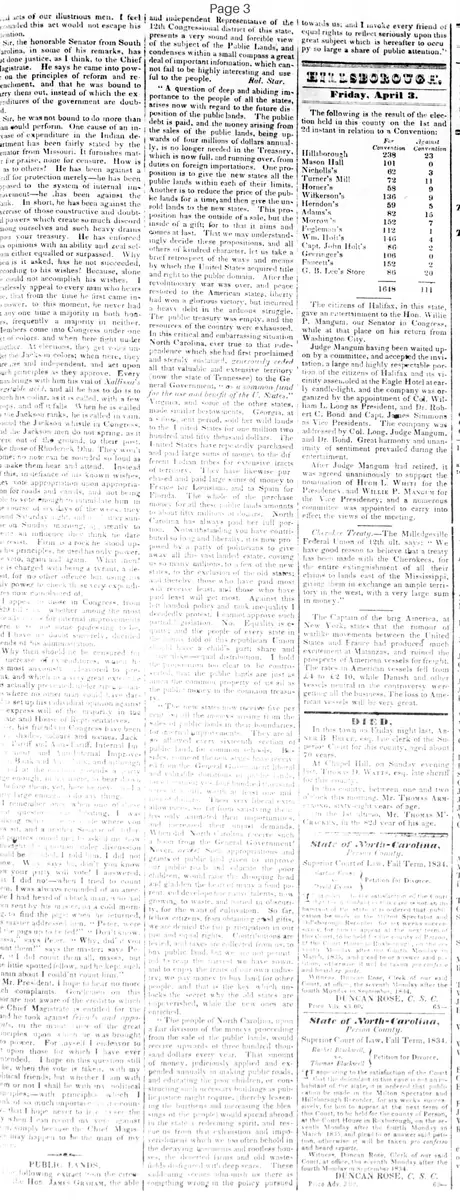
PUBLIC LANDS.
The following extract from the Hon. James Graham, the able and independent Representative of the 12th Congressional district of this state, presents a very sound and forcible view of the subject of the Public Lands, and condenses within a small compass a great deal of important information, which cannot fail to be highly interesting and useful to the people. Ral. Star.
"A question of deep and abiding importance to the people of all the states, arises now with regard to the future disposition of the public lands. The public debt is paid, and the money arising from the sales of the public lands, being upwards of four millions of dollars annually, is no longer needed in the Treasury, which is now full, and running over, from duties on foreign importations. One proposition is to give the new states all the public lands within each of their limits. Another is to reduce the price of the public lands for a time, and then give the unsold lands to the new states. This proposition has the outside of a sale, but the inside of a gift; for to that it aims and comes at last. That we may understandingly decide these propositions, and all others of kindred character, let us take a brief retrospect of the ways and means by which the United States acquired title and right to the public domain. After the revolutionary war was over, and peace restored to the American states, liberty had won a glorious victory, but incurred a heavy debt in the arduous struggle. The public treasury was empty, and the resources of the country were exhausted. In this critical and embarrassing situation North Carolina, ever true to that independence which she had first proclaimed and sternly sustained, generously ceded all that valuable and extensive territory (now the state of Tennessee) to the General Government, "as a common fund for the use and benefit of the U. States."
Virginia, and some of the other states, made similar bestowments. Georgia, at a subsequent period, sold her wild lands to the United States for one million two hundred and fifty thousand dollars. The United States have repeatedly purchased and paid large sums of money to the different Indian tribes for exclusive tracts of territory. They have likewise purchased and paid large sums of money to France for Louisiana, and to Spain for Florida. The whole of the purchase money for all these public lands amounts to about fifty millions of dollars. North Carolina has always paid her full portion. Notwithstanding you have contributed so largely and liberally, it is now proposed by a party of politicians to give away all the vast landed estate, costing us so many millions, to a few of the new states, to the exclusion of the old states; and thereby, those who have paid most will receive least, and those who have paid least will get most. Against this unhallowed policy and rank inequality I decidedly protest. I cannot approve such partial legislation. No. Equality is equity: and the people of every state in this star-spangled banner of this republican Union should take a child's part: share and share alike—equal distribution. I hold the position too clear to be controverted, that the public lands are just as much the common property of us all as the public money in the common treasury.
The new states now receive five per cent on all the moneys arising from the sales of public lands in their boundaries, for improvements. They are also allowed every sixteenth section of public land to common schools. Besides, some of the new states have received from the General Government liberal and valuable donations of public lands. Arkansas: viz., four hundred thousand acres or more, worth at least one million dollars. These very liberal grants, instead of satisfying them, has only whetted their appetite, and increased their unjust demands.
When did North Carolina receive such a boon from the General Government? Never. Never. Such appropriations and grants of public land given to improve our public roads and educate the poor children, would raise the drooping head and gladden the heart of many a fond parent, and develop rare talents, now growing to waste, and buried in obscurity, for the want of cultivation. So far, fellow citizens, from obtaining good gifts, we are denied the fair participation in our just and equal rights. Contributions are levied, and taxes are collected from us, to buy public land, yet we are not permitted to reap the harvest we have sown, and to enjoy the fruits of our own industry: we pay money to buy land for other people, and that is the key which unlocks the secret why the old states are impoverished, while the new ones are enriched.
The people of North Carolina, upon a fair division of the moneys proceeding from the sale of the public lands, would receive upwards of three hundred thousand dollars every year. That amount of money, judiciously applied and expended annually in making public roads, and educating the poor children, or constructing such necessary buildings as public justice might require, thereby lessening the burdens and increasing the blessings of the people) would spread abroad on the state a redeeming spirit, and rescue us from that exhaustion and impoverishment which we too often behold in the decaying tenements and rootless houses, the deserted farms and old waste fields disfigured with deep scars. These saddening scenes alarm us there is something wrong in the policy pursued towards us; and invoke every friend of equal rights to reflect seriously upon this great subject which is hereafter to occupy so large a share of public attention."
The following extract from the Hon. James Graham, the able and independent Representative of the 12th Congressional district of this state, presents a very sound and forcible view of the subject of the Public Lands, and condenses within a small compass a great deal of important information, which cannot fail to be highly interesting and useful to the people. Ral. Star.
"A question of deep and abiding importance to the people of all the states, arises now with regard to the future disposition of the public lands. The public debt is paid, and the money arising from the sales of the public lands, being upwards of four millions of dollars annually, is no longer needed in the Treasury, which is now full, and running over, from duties on foreign importations. One proposition is to give the new states all the public lands within each of their limits. Another is to reduce the price of the public lands for a time, and then give the unsold lands to the new states. This proposition has the outside of a sale, but the inside of a gift; for to that it aims and comes at last. That we may understandingly decide these propositions, and all others of kindred character, let us take a brief retrospect of the ways and means by which the United States acquired title and right to the public domain. After the revolutionary war was over, and peace restored to the American states, liberty had won a glorious victory, but incurred a heavy debt in the arduous struggle. The public treasury was empty, and the resources of the country were exhausted. In this critical and embarrassing situation North Carolina, ever true to that independence which she had first proclaimed and sternly sustained, generously ceded all that valuable and extensive territory (now the state of Tennessee) to the General Government, "as a common fund for the use and benefit of the U. States."
Virginia, and some of the other states, made similar bestowments. Georgia, at a subsequent period, sold her wild lands to the United States for one million two hundred and fifty thousand dollars. The United States have repeatedly purchased and paid large sums of money to the different Indian tribes for exclusive tracts of territory. They have likewise purchased and paid large sums of money to France for Louisiana, and to Spain for Florida. The whole of the purchase money for all these public lands amounts to about fifty millions of dollars. North Carolina has always paid her full portion. Notwithstanding you have contributed so largely and liberally, it is now proposed by a party of politicians to give away all the vast landed estate, costing us so many millions, to a few of the new states, to the exclusion of the old states; and thereby, those who have paid most will receive least, and those who have paid least will get most. Against this unhallowed policy and rank inequality I decidedly protest. I cannot approve such partial legislation. No. Equality is equity: and the people of every state in this star-spangled banner of this republican Union should take a child's part: share and share alike—equal distribution. I hold the position too clear to be controverted, that the public lands are just as much the common property of us all as the public money in the common treasury.
The new states now receive five per cent on all the moneys arising from the sales of public lands in their boundaries, for improvements. They are also allowed every sixteenth section of public land to common schools. Besides, some of the new states have received from the General Government liberal and valuable donations of public lands. Arkansas: viz., four hundred thousand acres or more, worth at least one million dollars. These very liberal grants, instead of satisfying them, has only whetted their appetite, and increased their unjust demands.
When did North Carolina receive such a boon from the General Government? Never. Never. Such appropriations and grants of public land given to improve our public roads and educate the poor children, would raise the drooping head and gladden the heart of many a fond parent, and develop rare talents, now growing to waste, and buried in obscurity, for the want of cultivation. So far, fellow citizens, from obtaining good gifts, we are denied the fair participation in our just and equal rights. Contributions are levied, and taxes are collected from us, to buy public land, yet we are not permitted to reap the harvest we have sown, and to enjoy the fruits of our own industry: we pay money to buy land for other people, and that is the key which unlocks the secret why the old states are impoverished, while the new ones are enriched.
The people of North Carolina, upon a fair division of the moneys proceeding from the sale of the public lands, would receive upwards of three hundred thousand dollars every year. That amount of money, judiciously applied and expended annually in making public roads, and educating the poor children, or constructing such necessary buildings as public justice might require, thereby lessening the burdens and increasing the blessings of the people) would spread abroad on the state a redeeming spirit, and rescue us from that exhaustion and impoverishment which we too often behold in the decaying tenements and rootless houses, the deserted farms and old waste fields disfigured with deep scars. These saddening scenes alarm us there is something wrong in the policy pursued towards us; and invoke every friend of equal rights to reflect seriously upon this great subject which is hereafter to occupy so large a share of public attention."
What sub-type of article is it?
Politics
Economic
What keywords are associated?
Public Lands
James Graham
North Carolina
Congressional District
Land Distribution
Equal Rights
What entities or persons were involved?
James Graham
Where did it happen?
North Carolina
Domestic News Details
Primary Location
North Carolina
Key Persons
James Graham
Event Details
Hon. James Graham presents views on the future disposition of public lands, opposing proposals to give lands to new states exclusively, emphasizing historical contributions by old states like North Carolina, and advocating for equal distribution among all states to fund roads, education, and public improvements.