Thank you for visiting SNEWPapers!
Sign up free
Story
September 30, 1844
Alexandria Gazette
Alexandria, Alexandria County, District Of Columbia
What is this article about?
An appreciative essay on T. Babington Macaulay, praising him as the brilliant surviving member of the Edinburgh Review's golden era writers, highlighting his mastery in review writing, political success, and critical style, while noting biases and comparisons to peers like Hazlitt and Burke.
Clipping
OCR Quality
98%
Excellent
Full Text
MISCELLANEOUS.
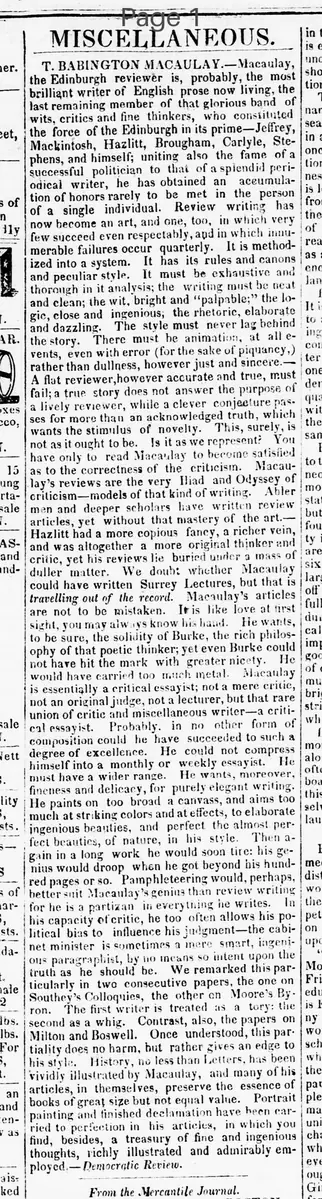
T. BABINGTON MACAULAY.—Macaulay, the Edinburgh reviewer is, probably, the most brilliant writer of English prose now living, the last remaining member of that glorious band of wits, critics and fine thinkers, who constituted the force of the Edinburgh in its prime—Jeffrey, Mackintosh, Hazlitt, Brougham, Carlyle, Stephens, and himself; uniting also the fame of a successful politician to that of a splendid periodical writer, he has obtained an accumulation of honors rarely to be met in the person of a single individual.
Review writing has now become an art, and one, too, in which very few succeed even respectably, and in which innumerable failures occur quarterly. It is methodized into a system. It has its rules and canons and peculiar style. It must be exhaustive and thorough in its analysis; the writing must be neat and clean; the wit, bright and "palpable;" the logic, close and ingenious; the rhetoric, elaborate and dazzling. The style must never lag behind the story. There must be animation, at all events, even with error (for the sake of piquancy,) rather than dullness, however just and sincere.—A flat reviewer, however accurate and true, must fail; a true story does not answer the purpose of a lively reviewer, while a clever conjecture passes for more than an acknowledged truth, which wants the stimulus of novelty. This, surely, is not as it ought to be. Is it as we represent? You have only to read Macaulay to become satisfied as to the correctness of the criticism.
Macaulay's reviews are the very Iliad and Odyssey of criticism—models of that kind of writing. Abler men and deeper scholars have written review articles, yet without that mastery of the art.—Hazlitt had a more copious fancy, a richer vein, and was altogether a more original thinker and critic, yet his reviews lie buried under a mass of duller matter. We doubt whether Macaulay could have written Surrey Lectures, but that is travelling out of the record. Macaulay's articles are not to be mistaken. It is like love at first sight, you may always know his hand. He wants, to be sure, the solidity of Burke, the rich philosophy of that poetic thinker; yet even Burke could not have hit the mark with greater nicety. He would have carried too much metal. Macaulay is essentially a critical essayist; not a mere critic, not an original judge, not a lecturer, but that rare union of critic and miscellaneous writer—a critical essayist. Probably, in no other form of composition could he have succeeded to such a degree of excellence. He could not compress himself into a monthly or weekly essayist. He must have a wider range. He wants, moreover, fineness and delicacy, for purely elegant writing. He paints on too broad a canvass, and aims too much at striking colors and at effects, to elaborate ingenious beauties, and perfect the almost perfect beauties, of nature, in his style. Then again in a long work he would soon tire: his genius would droop when he got beyond his hundred pages or so. Pamphleteering would, perhaps, better suit Macaulay's genius than review writing for he is a partizan in everything he writes. In his capacity of critic, he too often allows his political bias to influence his judgment—the cabinet minister is sometimes a mere smart, ingenious paragraphist, by no means so intent upon the truth as he should be. We remarked this particularly in two consecutive papers, the one on Southey's Colloquies, the other on Moore's Byron. The first writer is treated as a tory: the second as a whig. Contrast, also, the papers on Milton and Boswell. Once understood, this partiality does no harm, but rather gives an edge to his style.
History, no less than Letters, has been vividly illustrated by Macaulay, and many of his articles, in themselves, preserve the essence of books of great size but not equal value. Portrait painting and finished declamation have been carried to perfection in his articles, in which you find, besides, a treasury of fine and ingenious thoughts, richly illustrated and admirably employed.—Democratic Review.
T. BABINGTON MACAULAY.—Macaulay, the Edinburgh reviewer is, probably, the most brilliant writer of English prose now living, the last remaining member of that glorious band of wits, critics and fine thinkers, who constituted the force of the Edinburgh in its prime—Jeffrey, Mackintosh, Hazlitt, Brougham, Carlyle, Stephens, and himself; uniting also the fame of a successful politician to that of a splendid periodical writer, he has obtained an accumulation of honors rarely to be met in the person of a single individual.
Review writing has now become an art, and one, too, in which very few succeed even respectably, and in which innumerable failures occur quarterly. It is methodized into a system. It has its rules and canons and peculiar style. It must be exhaustive and thorough in its analysis; the writing must be neat and clean; the wit, bright and "palpable;" the logic, close and ingenious; the rhetoric, elaborate and dazzling. The style must never lag behind the story. There must be animation, at all events, even with error (for the sake of piquancy,) rather than dullness, however just and sincere.—A flat reviewer, however accurate and true, must fail; a true story does not answer the purpose of a lively reviewer, while a clever conjecture passes for more than an acknowledged truth, which wants the stimulus of novelty. This, surely, is not as it ought to be. Is it as we represent? You have only to read Macaulay to become satisfied as to the correctness of the criticism.
Macaulay's reviews are the very Iliad and Odyssey of criticism—models of that kind of writing. Abler men and deeper scholars have written review articles, yet without that mastery of the art.—Hazlitt had a more copious fancy, a richer vein, and was altogether a more original thinker and critic, yet his reviews lie buried under a mass of duller matter. We doubt whether Macaulay could have written Surrey Lectures, but that is travelling out of the record. Macaulay's articles are not to be mistaken. It is like love at first sight, you may always know his hand. He wants, to be sure, the solidity of Burke, the rich philosophy of that poetic thinker; yet even Burke could not have hit the mark with greater nicety. He would have carried too much metal. Macaulay is essentially a critical essayist; not a mere critic, not an original judge, not a lecturer, but that rare union of critic and miscellaneous writer—a critical essayist. Probably, in no other form of composition could he have succeeded to such a degree of excellence. He could not compress himself into a monthly or weekly essayist. He must have a wider range. He wants, moreover, fineness and delicacy, for purely elegant writing. He paints on too broad a canvass, and aims too much at striking colors and at effects, to elaborate ingenious beauties, and perfect the almost perfect beauties, of nature, in his style. Then again in a long work he would soon tire: his genius would droop when he got beyond his hundred pages or so. Pamphleteering would, perhaps, better suit Macaulay's genius than review writing for he is a partizan in everything he writes. In his capacity of critic, he too often allows his political bias to influence his judgment—the cabinet minister is sometimes a mere smart, ingenious paragraphist, by no means so intent upon the truth as he should be. We remarked this particularly in two consecutive papers, the one on Southey's Colloquies, the other on Moore's Byron. The first writer is treated as a tory: the second as a whig. Contrast, also, the papers on Milton and Boswell. Once understood, this partiality does no harm, but rather gives an edge to his style.
History, no less than Letters, has been vividly illustrated by Macaulay, and many of his articles, in themselves, preserve the essence of books of great size but not equal value. Portrait painting and finished declamation have been carried to perfection in his articles, in which you find, besides, a treasury of fine and ingenious thoughts, richly illustrated and admirably employed.—Democratic Review.
What sub-type of article is it?
Biography
What themes does it cover?
Triumph
What keywords are associated?
Macaulay
Edinburgh Review
Literary Criticism
Review Writing
Political Bias
Critical Essayist
What entities or persons were involved?
T. Babington Macaulay
Jeffrey
Mackintosh
Hazlitt
Brougham
Carlyle
Stephens
Burke
Southey
Moore
Milton
Boswell
Story Details
Key Persons
T. Babington Macaulay
Jeffrey
Mackintosh
Hazlitt
Brougham
Carlyle
Stephens
Burke
Southey
Moore
Milton
Boswell
Story Details
Praise for Macaulay as the premier English prose writer and Edinburgh Review critic, detailing his style, political honors, mastery of review art, comparisons to contemporaries, and noted biases in judgments.