Thank you for visiting SNEWPapers!
Sign up free
Story
August 16, 1776
The Virginia Gazette
Williamsburg, Virginia
What is this article about?
Account of the July 25, 1776, interview between General Washington and Colonel Patterson, discussing letter addresses, prisoner treatments, diplomatic efforts for reconciliation, and a proposed prisoner exchange, published by order of Congress.
Clipping
OCR Quality
98%
Excellent
Full Text
PHILADELPHIA, July 27.
The following is an exact state of what passed at the interview between his Excellency General WASHINGTON and Colonel PATTERSON, Adjutant-General of the army under General HOWE, July 25, 1776.
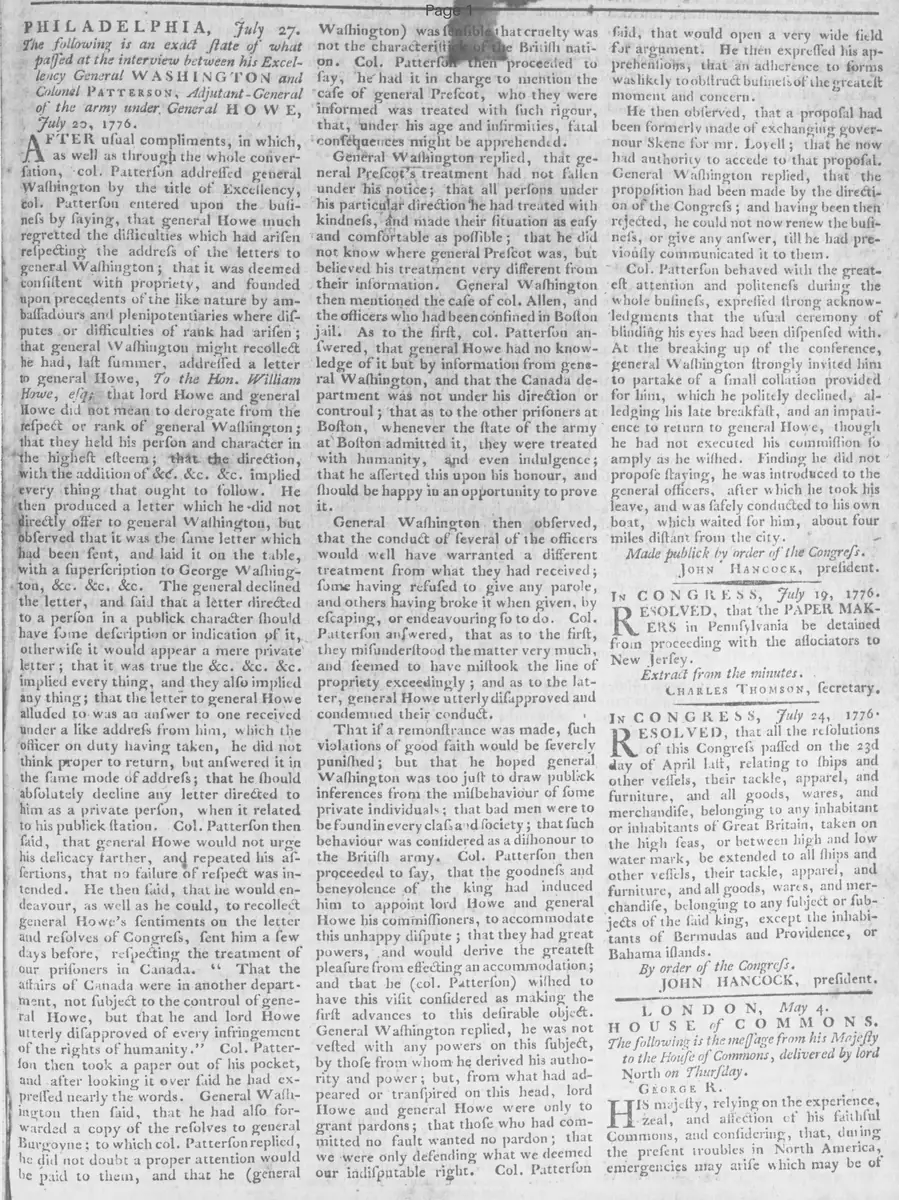
After usual compliments, in which, as well as through the whole conversation, Col. Patterson addressed General Washington by the title of Excellency, Col. Patterson entered upon the business by saying, that General Howe much regretted the difficulties which had arisen respecting the address of the letters to General Washington; that it was deemed consistent with propriety, and founded upon precedents of the like nature by ambassadors and plenipotentiaries where disputes or difficulties of rank had arisen; that General Washington might recollect he had, last summer, addressed a letter to General Howe, To the Hon. William Howe, Esq; that Lord Howe and General Howe did not mean to derogate from the respect or rank of General Washington; that they held his person and character in the highest esteem; that the direction, with the addition of &c. &c. &c. implied every thing that ought to follow. He then produced a letter which he did not directly offer to General Washington, but observed that it was the same letter which had been sent, and laid it on the table, with a superscription to George Washington, &c. &c. &c. The General declined the letter, and said that a letter directed to a person in a public character should have some description or indication of it, otherwise it would appear a mere private letter; that it was true the &c. &c. &c. implied every thing, and they also implied any thing; that the letter to General Howe alluded to was an answer to one received under a like address from him, which the officer on duty having taken, he did not think proper to return, but answered it in the same mode of address: that he should absolutely decline any letter directed to him as a private person, when it related to his public station. Col. Patterson then said, that General Howe would not urge his delicacy farther, and repeated his assertions, that no failure of respect was intended. He then said, that he would endeavour, as well as he could, to recollect General Howe's sentiments on the letter and resolves of Congress, sent him a few days before, respecting the treatment of our prisoners in Canada. That the affairs of Canada were in another department, not subject to the controul of General Howe, but that he and Lord Howe utterly disapproved of every infringement of the rights of humanity. Col. Patterson then took a paper out of his pocket, and after looking it over said he had expressed nearly the words. General Washington then said, that he had also forwarded a copy of the resolves to General Burgoyne; to which Col. Patterson replied, he did not doubt a proper attention would be paid to them, and that he (General Washington) was sensible that cruelty was not the characteristic of the British nation. Col. Patterson then proceeded to say, he had it in charge to mention the case of General Prescott, who they were informed was treated with such rigour, that, under his age and infirmities, fatal consequences might be apprehended. General Washington replied, that General Prescott's treatment had not fallen under his notice: that all persons under his particular direction he had treated with kindness, and made their situation as easy and comfortable as possible; that he did not know where General Prescott was, but believed his treatment very different from their information. General Washington then mentioned the case of Col. Allen, and the officers who had been confined in Boston jail. As to the first, Col. Patterson answered, that General Howe had no knowledge of it but by information from General Washington, and that the Canada department was not under his direction or controul; that as to the other prisoners at Boston, whenever the state of the army at Boston admitted it, they were treated with humanity, and even indulgence; that he asserted this upon his honour, and should be happy in an opportunity to prove it. General Washington then observed, that the conduct of several of the officers would well have warranted a different treatment from what they had received; some having refused to give any parole, and others having broke it when given, by escaping, or endeavouring so to do. Col. Patterson answered, that as to the first, they misunderstood the matter very much, and seemed to have mistook the line of propriety exceedingly; and as to the latter, General Howe utterly disapproved and condemned their conduct. That if a remonstrance was made, such violations of good faith would be severely punished; but that he hoped General Washington was too just to draw publick inferences from the misbehaviour of some private individuals; that bad men were to be found in every class of society; that such behaviour was considered as a dishonour to the British army. Col. Patterson then proceeded to say, that the goodness and benevolence of the king had induced him to appoint Lord Howe and General Howe his commissioners, to accommodate this unhappy dispute; that they had great powers, and would derive the greatest pleasure from effecting an accommodation; and that he (Col. Patterson) wished to have this visit considered as making the first advances to this desirable object. General Washington replied, he was not vested with any powers on this subject, by those from whom he derived his authority and power; but, from what had appeared or transpired on this head, Lord Howe and General Howe were only to grant pardons; that those who had committed no fault wanted no pardon: that we were only defending what we deemed our indisputable right. Col. Patterson said, that would open a very wide field for argument. He then expressed his apprehensions, that an adherence to forms was likely to obstruct business of the greatest moment and concern. He then observed, that a proposal had been formerly made of exchanging Governor Skene for Mr. Lovell: that he now had authority to accede to that proposal. General Washington replied, that the proposition had been made by the direction of the Congress; and having been then rejected, he could not now renew the business, or give any answer, till he had previously communicated it to them. Col. Patterson behaved with the greatest attention and politeness during the whole business, expressed strong acknowledgments that the usual ceremony of blinding his eyes had been dispensed with. At the breaking up of the conference, General Washington strongly invited him to partake of a small collation provided for him, which he politely declined, alleging his late breakfast, and an impatience to return to General Howe, though he had not executed his commission so amply as he wished. Finding he did not propose staying, he was introduced to the general officers, after which he took his leave, and was safely conducted to his own boat, which waited for him, about four miles distant from the city.
Made publick by order of the Congress.
John Hancock, president.
The following is an exact state of what passed at the interview between his Excellency General WASHINGTON and Colonel PATTERSON, Adjutant-General of the army under General HOWE, July 25, 1776.
After usual compliments, in which, as well as through the whole conversation, Col. Patterson addressed General Washington by the title of Excellency, Col. Patterson entered upon the business by saying, that General Howe much regretted the difficulties which had arisen respecting the address of the letters to General Washington; that it was deemed consistent with propriety, and founded upon precedents of the like nature by ambassadors and plenipotentiaries where disputes or difficulties of rank had arisen; that General Washington might recollect he had, last summer, addressed a letter to General Howe, To the Hon. William Howe, Esq; that Lord Howe and General Howe did not mean to derogate from the respect or rank of General Washington; that they held his person and character in the highest esteem; that the direction, with the addition of &c. &c. &c. implied every thing that ought to follow. He then produced a letter which he did not directly offer to General Washington, but observed that it was the same letter which had been sent, and laid it on the table, with a superscription to George Washington, &c. &c. &c. The General declined the letter, and said that a letter directed to a person in a public character should have some description or indication of it, otherwise it would appear a mere private letter; that it was true the &c. &c. &c. implied every thing, and they also implied any thing; that the letter to General Howe alluded to was an answer to one received under a like address from him, which the officer on duty having taken, he did not think proper to return, but answered it in the same mode of address: that he should absolutely decline any letter directed to him as a private person, when it related to his public station. Col. Patterson then said, that General Howe would not urge his delicacy farther, and repeated his assertions, that no failure of respect was intended. He then said, that he would endeavour, as well as he could, to recollect General Howe's sentiments on the letter and resolves of Congress, sent him a few days before, respecting the treatment of our prisoners in Canada. That the affairs of Canada were in another department, not subject to the controul of General Howe, but that he and Lord Howe utterly disapproved of every infringement of the rights of humanity. Col. Patterson then took a paper out of his pocket, and after looking it over said he had expressed nearly the words. General Washington then said, that he had also forwarded a copy of the resolves to General Burgoyne; to which Col. Patterson replied, he did not doubt a proper attention would be paid to them, and that he (General Washington) was sensible that cruelty was not the characteristic of the British nation. Col. Patterson then proceeded to say, he had it in charge to mention the case of General Prescott, who they were informed was treated with such rigour, that, under his age and infirmities, fatal consequences might be apprehended. General Washington replied, that General Prescott's treatment had not fallen under his notice: that all persons under his particular direction he had treated with kindness, and made their situation as easy and comfortable as possible; that he did not know where General Prescott was, but believed his treatment very different from their information. General Washington then mentioned the case of Col. Allen, and the officers who had been confined in Boston jail. As to the first, Col. Patterson answered, that General Howe had no knowledge of it but by information from General Washington, and that the Canada department was not under his direction or controul; that as to the other prisoners at Boston, whenever the state of the army at Boston admitted it, they were treated with humanity, and even indulgence; that he asserted this upon his honour, and should be happy in an opportunity to prove it. General Washington then observed, that the conduct of several of the officers would well have warranted a different treatment from what they had received; some having refused to give any parole, and others having broke it when given, by escaping, or endeavouring so to do. Col. Patterson answered, that as to the first, they misunderstood the matter very much, and seemed to have mistook the line of propriety exceedingly; and as to the latter, General Howe utterly disapproved and condemned their conduct. That if a remonstrance was made, such violations of good faith would be severely punished; but that he hoped General Washington was too just to draw publick inferences from the misbehaviour of some private individuals; that bad men were to be found in every class of society; that such behaviour was considered as a dishonour to the British army. Col. Patterson then proceeded to say, that the goodness and benevolence of the king had induced him to appoint Lord Howe and General Howe his commissioners, to accommodate this unhappy dispute; that they had great powers, and would derive the greatest pleasure from effecting an accommodation; and that he (Col. Patterson) wished to have this visit considered as making the first advances to this desirable object. General Washington replied, he was not vested with any powers on this subject, by those from whom he derived his authority and power; but, from what had appeared or transpired on this head, Lord Howe and General Howe were only to grant pardons; that those who had committed no fault wanted no pardon: that we were only defending what we deemed our indisputable right. Col. Patterson said, that would open a very wide field for argument. He then expressed his apprehensions, that an adherence to forms was likely to obstruct business of the greatest moment and concern. He then observed, that a proposal had been formerly made of exchanging Governor Skene for Mr. Lovell: that he now had authority to accede to that proposal. General Washington replied, that the proposition had been made by the direction of the Congress; and having been then rejected, he could not now renew the business, or give any answer, till he had previously communicated it to them. Col. Patterson behaved with the greatest attention and politeness during the whole business, expressed strong acknowledgments that the usual ceremony of blinding his eyes had been dispensed with. At the breaking up of the conference, General Washington strongly invited him to partake of a small collation provided for him, which he politely declined, alleging his late breakfast, and an impatience to return to General Howe, though he had not executed his commission so amply as he wished. Finding he did not propose staying, he was introduced to the general officers, after which he took his leave, and was safely conducted to his own boat, which waited for him, about four miles distant from the city.
Made publick by order of the Congress.
John Hancock, president.
What sub-type of article is it?
Historical Event
What themes does it cover?
Justice
Social Manners
What keywords are associated?
Diplomatic Interview
Prisoner Treatment
Letter Address Dispute
American Revolution
Reconciliation Efforts
Prisoner Exchange
What entities or persons were involved?
General Washington
Colonel Patterson
General Howe
Lord Howe
General Prescott
Col. Allen
Governor Skene
Mr. Lovell
General Burgoyne
John Hancock
Where did it happen?
Near The City (Likely New York)
Story Details
Key Persons
General Washington
Colonel Patterson
General Howe
Lord Howe
General Prescott
Col. Allen
Governor Skene
Mr. Lovell
General Burgoyne
John Hancock
Location
Near The City (Likely New York)
Event Date
July 25, 1776
Story Details
Colonel Patterson meets General Washington to discuss etiquette in letter addresses, treatment of prisoners including Prescott and Allen, British commissioners' role in reconciliation, and a proposal to exchange Governor Skene for Mr. Lovell, which Washington defers to Congress.