Thank you for visiting SNEWPapers!
Sign up free
Letter to Editor
September 20, 1863
The Nashville Daily Union
Nashville, Davidson County, Tennessee
What is this article about?
Governor A. W. Bradford writes to former Governor Francis Thomas advocating gradual emancipation in Maryland via a constitutional convention, stressing Union loyalty and warning against forced slave enlistment that could alienate loyalists. Proposes submitting convention question to voters for assembly by 1864.
Clipping
OCR Quality
95%
Excellent
Full Text
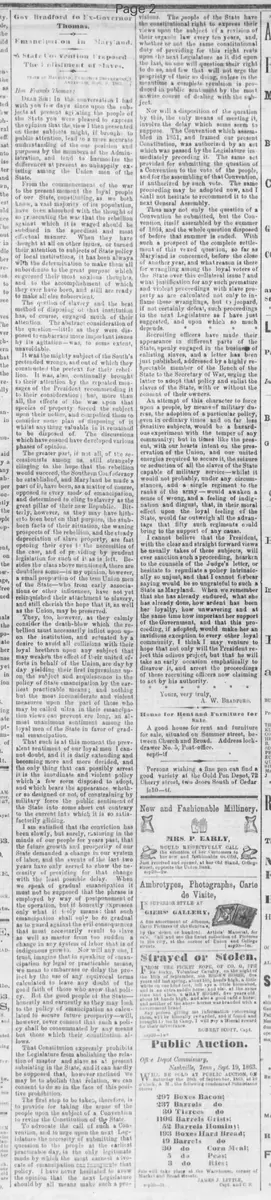
Gov. Bradford to Ex-Governor Thomas.
Emancipation in Maryland.
A State Convention Proposed
The enlistment of slaves.
From Francis Thomas:
Dear Sir: In the conversation I had with you few days since upon the subjects at present agitating the people of the State you were pleased to express the opinion that the view I then presented on these subjects might, if brought to public attention, lead to a more accurate understanding of our position and purposes by the members of the Administration, and tend to harmonize the differences at present so unhappily existing among the Union men of the State.
From the commencement of the war to the present moment the loyal people of our State, constituting, as we both know, a vast majority of its population, have been absorbed with the thought of so prosecuting the war that the rebellion against which it is waged should be subdued in the speediest and most effectual manner. When they have thought at all on other issues, or turned their attention to subjects of State policy of local institutions, it has been always with the determination to make them all subordinate to the great purpose which engrossed their most anxious thoughts, and to the accomplishment of which they ever have been, and still are ready to make all else subservient.
The question of slavery and the best method of disposing of that institution has, of course, engaged much of their attention. The abstract consideration of the question—little as they were disposed to embarrass more important issues by its agitation—was, to some extent, unavoidable. It was the mighty subject of the South's pretended wrongs, and out of which they constructed the pretext for their rebellion. It was, also, continually brought to their attention by the repeated messages of the President recommending it to their consideration; but, more than all, the effects of the war upon that species of property forced the subject upon their notice, and compelled them to consider some plan of disposing of it whilst any thing valuable in it remained to be disposed of. The discussions which have ensued have developed various phases of opinion.
The greater part, if not all, of the secessionists among us, still strangely clinging to the hope that the rebellion would succeed, the Southern Confederacy be established, and Maryland be made a part of it, have been, as a matter of course, opposed to every mode of emancipation, and determined to cling to slavery as the great pillar of their new Republic. Bitterly, however, as they may have hitherto been bent on that purpose, the stubborn facts of their situation, the waning prospects of the rebellion, and the steady depreciation of slave property, are fast opening their eyes to the necessities of the case, and of providing by prudent legislation for such of it as is left. Besides the class above mentioned, there are doubtless some—in my opinion, however, a small proportion of the true Union men of the State—who from early associations or other influences, have not yet relinquished their attachment to slavery, and still cherish the hope that it, as well as the Union, may be preserved. They, too, however, as they calmly consider the death-blow which the rebellion must necessarily inflict upon the institution, and actuated by a desire to avoid all collisions with their loyal brethren upon any subject that may weaken the effect of their united efforts in behalf of the Union, are day by day yielding their first impressions upon the subject and acquiescing in the policy of State emancipation by the earliest practicable means; and nothing but the most inconsiderate and violent measures upon the part of those who may be called ultra in their emancipation views can prevent ere long, an almost unanimous sentiment among the loyal men of the State in favor of gradual emancipation.
That such is at this moment the prevalent sentiment of our loyal men I cannot doubt, and it is daily extending and becoming more and more decided, and the only thing that can possibly arrest it is the inordinate and violent policy which a few seem disposed to adopt, and which bears the appearance whether so designed or not, of constraining by military force the public sentiment of the State into some short cut contrary to the current into which it is so satisfactorily gliding.
I am satisfied that the conviction has been slowly, but surely, maturing in the minds of our people for years past, that the future growth and prosperity of our State demanded a change in our system of labor, and the events of the last two years have only served to show the necessity of providing for that change with the least possible delay. When we speak of gradual emancipation it must not be supposed that the phrase is employed by way of postponement of the operation, but it honestly expresses only what it truly means: that such emancipation shall only be so gradual as to guard against the evil consequences that must necessarily result to slave as well as master from too sudden a change in any system of labor that is of indigenous growth. Nor will any one, I trust, imagine that in speaking of emancipation by legal or practicable means, we mean to embarrass or delay the project by the use of any equivocal terms calculated to leave any doubt of the good faith of those who avow that policy. But the good people of the State—honestly and earnestly as they may look to the policy of emancipation as calculated to secure future prosperity—will, however, never consent that such a policy shall be consummated by any means but those which their constitutional allows.
That Constitution expressly prohibits the Legislature from abolishing the relation of master and slave as at present subsisting in the State, and it can hardly be supposed that, however inclined we may be to abolish that relation, we can consent to do so in the face of this positive prohibition.
The first step to be taken, therefore, is to provide for taking the sense of the people upon the subject of a Convention to revise the Constitution of the State. To advocate the call of such a Convention, and to urge upon the next Legislature the necessity of submitting that question to the people at the earliest practicable day, is the only legitimate mode by which the most earnest advocate of emancipation can inaugurate that policy. I have never hesitated to avow the opinion that the next Legislature should by all means make such a provision. The people of the State have the constitutional right to express their views upon the subject of a revision of their organic law every ten years, and, whether or not the same constitutional duty of providing for this right rests upon the next Legislature as it did upon the last, no one will question their right to do so, and few that will not urge the propriety of their so doing, unless in the meantime a complete revulsion is produced in public sentiment by the most unwise course of dealing with the subject.
Nor will a disposition of the question by this, the only means of meeting it, involve the delay which some seem to suppose. The Convention which assembled in 1851, and framed our present Constitution, was authorized by an act which was passed by the Legislature immediately preceding it. The same act provided for submitting the question of a Convention to the vote of the people, and for the assembling of that Convention if authorized by such vote. The same proceeding may be adopted now, and I shall not hesitate to recommend it to the next General Assembly. Thus may not only the question of a Convention be submitted, but the Convention itself assembled by the summer of 1864, and the whole question disposed of before that summer is ended. With such a prospect of the complete settlement of this vexed question, so far as Maryland is concerned, before the close of another year, and what reason is there for wrangling among the loyal voters of the State over this collateral issue? and what justification for any such premature and violent proceedings with slave property as are calculated not only to inflame these wranglings, but to jeopard, if not certainly defeat, such proceedings in the next Legislature as I have just suggested, and upon which so much depends.
Recruiting officers have made their appearance in different parts of the State, openly engaged in the business of enlisting slaves, and a letter has been just published, addressed by a highly respectable member of the Bench of the State to the Secretary of War, urging the latter to adopt that policy and enlist the slaves of the State, with or without the consent of their owners.
An attempt of this character to force upon a people, by means of military duress, the adoption of a particular policy, even in ordinary times and on far less sensitive subjects, would be a hazardous experiment with the temper of any community; but in times like the present, with our hearts intent on the preservation of the Union, and our united energies required to secure it, the seizure or seduction of all the slaves of the State capable of military service—whilst it would not probably, under any circumstances, add a single regiment to the ranks of the army—would awaken a sense of wrong, and a feeling of indignation and disgust, that, in their moral effect upon the loyal feeling of the State, would far outweigh all the advantage that fifty such regiments could bring to the support of any cause.
I cannot believe that the President with the clear and straightforward views he usually takes of these subjects, will ever sanction such a proceeding, hearken to the counsels of the Judge's letter, or hesitate to repudiate a policy intrinsically so unjust, and that I cannot forbear saying would be so ungrateful to such a State as Maryland. When we remember that she has already endured, what she has already done, how ardent has been her loyalty, how unwavering and at the same time how important her support of the Government, and that this proceeding, if adopted, would make her an invidious exception to every other loyal community, I think I may venture to hope that not only will the President reject this odious project, but that he will take an early occasion emphatically to disavow it, and arrest the proceedings of these recruiting officers now claiming to act by his authority.
Yours, very truly,
A. W. BRADFORD.
Emancipation in Maryland.
A State Convention Proposed
The enlistment of slaves.
From Francis Thomas:
Dear Sir: In the conversation I had with you few days since upon the subjects at present agitating the people of the State you were pleased to express the opinion that the view I then presented on these subjects might, if brought to public attention, lead to a more accurate understanding of our position and purposes by the members of the Administration, and tend to harmonize the differences at present so unhappily existing among the Union men of the State.
From the commencement of the war to the present moment the loyal people of our State, constituting, as we both know, a vast majority of its population, have been absorbed with the thought of so prosecuting the war that the rebellion against which it is waged should be subdued in the speediest and most effectual manner. When they have thought at all on other issues, or turned their attention to subjects of State policy of local institutions, it has been always with the determination to make them all subordinate to the great purpose which engrossed their most anxious thoughts, and to the accomplishment of which they ever have been, and still are ready to make all else subservient.
The question of slavery and the best method of disposing of that institution has, of course, engaged much of their attention. The abstract consideration of the question—little as they were disposed to embarrass more important issues by its agitation—was, to some extent, unavoidable. It was the mighty subject of the South's pretended wrongs, and out of which they constructed the pretext for their rebellion. It was, also, continually brought to their attention by the repeated messages of the President recommending it to their consideration; but, more than all, the effects of the war upon that species of property forced the subject upon their notice, and compelled them to consider some plan of disposing of it whilst any thing valuable in it remained to be disposed of. The discussions which have ensued have developed various phases of opinion.
The greater part, if not all, of the secessionists among us, still strangely clinging to the hope that the rebellion would succeed, the Southern Confederacy be established, and Maryland be made a part of it, have been, as a matter of course, opposed to every mode of emancipation, and determined to cling to slavery as the great pillar of their new Republic. Bitterly, however, as they may have hitherto been bent on that purpose, the stubborn facts of their situation, the waning prospects of the rebellion, and the steady depreciation of slave property, are fast opening their eyes to the necessities of the case, and of providing by prudent legislation for such of it as is left. Besides the class above mentioned, there are doubtless some—in my opinion, however, a small proportion of the true Union men of the State—who from early associations or other influences, have not yet relinquished their attachment to slavery, and still cherish the hope that it, as well as the Union, may be preserved. They, too, however, as they calmly consider the death-blow which the rebellion must necessarily inflict upon the institution, and actuated by a desire to avoid all collisions with their loyal brethren upon any subject that may weaken the effect of their united efforts in behalf of the Union, are day by day yielding their first impressions upon the subject and acquiescing in the policy of State emancipation by the earliest practicable means; and nothing but the most inconsiderate and violent measures upon the part of those who may be called ultra in their emancipation views can prevent ere long, an almost unanimous sentiment among the loyal men of the State in favor of gradual emancipation.
That such is at this moment the prevalent sentiment of our loyal men I cannot doubt, and it is daily extending and becoming more and more decided, and the only thing that can possibly arrest it is the inordinate and violent policy which a few seem disposed to adopt, and which bears the appearance whether so designed or not, of constraining by military force the public sentiment of the State into some short cut contrary to the current into which it is so satisfactorily gliding.
I am satisfied that the conviction has been slowly, but surely, maturing in the minds of our people for years past, that the future growth and prosperity of our State demanded a change in our system of labor, and the events of the last two years have only served to show the necessity of providing for that change with the least possible delay. When we speak of gradual emancipation it must not be supposed that the phrase is employed by way of postponement of the operation, but it honestly expresses only what it truly means: that such emancipation shall only be so gradual as to guard against the evil consequences that must necessarily result to slave as well as master from too sudden a change in any system of labor that is of indigenous growth. Nor will any one, I trust, imagine that in speaking of emancipation by legal or practicable means, we mean to embarrass or delay the project by the use of any equivocal terms calculated to leave any doubt of the good faith of those who avow that policy. But the good people of the State—honestly and earnestly as they may look to the policy of emancipation as calculated to secure future prosperity—will, however, never consent that such a policy shall be consummated by any means but those which their constitutional allows.
That Constitution expressly prohibits the Legislature from abolishing the relation of master and slave as at present subsisting in the State, and it can hardly be supposed that, however inclined we may be to abolish that relation, we can consent to do so in the face of this positive prohibition.
The first step to be taken, therefore, is to provide for taking the sense of the people upon the subject of a Convention to revise the Constitution of the State. To advocate the call of such a Convention, and to urge upon the next Legislature the necessity of submitting that question to the people at the earliest practicable day, is the only legitimate mode by which the most earnest advocate of emancipation can inaugurate that policy. I have never hesitated to avow the opinion that the next Legislature should by all means make such a provision. The people of the State have the constitutional right to express their views upon the subject of a revision of their organic law every ten years, and, whether or not the same constitutional duty of providing for this right rests upon the next Legislature as it did upon the last, no one will question their right to do so, and few that will not urge the propriety of their so doing, unless in the meantime a complete revulsion is produced in public sentiment by the most unwise course of dealing with the subject.
Nor will a disposition of the question by this, the only means of meeting it, involve the delay which some seem to suppose. The Convention which assembled in 1851, and framed our present Constitution, was authorized by an act which was passed by the Legislature immediately preceding it. The same act provided for submitting the question of a Convention to the vote of the people, and for the assembling of that Convention if authorized by such vote. The same proceeding may be adopted now, and I shall not hesitate to recommend it to the next General Assembly. Thus may not only the question of a Convention be submitted, but the Convention itself assembled by the summer of 1864, and the whole question disposed of before that summer is ended. With such a prospect of the complete settlement of this vexed question, so far as Maryland is concerned, before the close of another year, and what reason is there for wrangling among the loyal voters of the State over this collateral issue? and what justification for any such premature and violent proceedings with slave property as are calculated not only to inflame these wranglings, but to jeopard, if not certainly defeat, such proceedings in the next Legislature as I have just suggested, and upon which so much depends.
Recruiting officers have made their appearance in different parts of the State, openly engaged in the business of enlisting slaves, and a letter has been just published, addressed by a highly respectable member of the Bench of the State to the Secretary of War, urging the latter to adopt that policy and enlist the slaves of the State, with or without the consent of their owners.
An attempt of this character to force upon a people, by means of military duress, the adoption of a particular policy, even in ordinary times and on far less sensitive subjects, would be a hazardous experiment with the temper of any community; but in times like the present, with our hearts intent on the preservation of the Union, and our united energies required to secure it, the seizure or seduction of all the slaves of the State capable of military service—whilst it would not probably, under any circumstances, add a single regiment to the ranks of the army—would awaken a sense of wrong, and a feeling of indignation and disgust, that, in their moral effect upon the loyal feeling of the State, would far outweigh all the advantage that fifty such regiments could bring to the support of any cause.
I cannot believe that the President with the clear and straightforward views he usually takes of these subjects, will ever sanction such a proceeding, hearken to the counsels of the Judge's letter, or hesitate to repudiate a policy intrinsically so unjust, and that I cannot forbear saying would be so ungrateful to such a State as Maryland. When we remember that she has already endured, what she has already done, how ardent has been her loyalty, how unwavering and at the same time how important her support of the Government, and that this proceeding, if adopted, would make her an invidious exception to every other loyal community, I think I may venture to hope that not only will the President reject this odious project, but that he will take an early occasion emphatically to disavow it, and arrest the proceedings of these recruiting officers now claiming to act by his authority.
Yours, very truly,
A. W. BRADFORD.
What sub-type of article is it?
Persuasive
Political
Reflective
What themes does it cover?
Slavery Abolition
Politics
Constitutional Rights
What keywords are associated?
Emancipation
Maryland
State Convention
Slavery
Union Loyalty
Gradual Abolition
Constitutional Revision
Slave Enlistment
What entities or persons were involved?
A. W. Bradford
Ex Governor Thomas
Letter to Editor Details
Author
A. W. Bradford
Recipient
Ex Governor Thomas
Main Argument
advocates for gradual emancipation of slaves in maryland through a state convention to revise the constitution, emphasizing loyalty to the union and opposition to forced enlistment of slaves by military means, which could undermine support for the war.
Notable Details
Conversation With Recipient On State Issues
References To President's Messages On Slavery
1851 Constitutional Convention As Precedent
Opposition To Recruiting Officers Enlisting Slaves Without Owner Consent
Hope For Convention Assembly By Summer 1864