Thank you for visiting SNEWPapers!
Sign up free
Editorial
November 20, 1795
Gazette Of The United States
Philadelphia, Philadelphia County, Pennsylvania
What is this article about?
In 'The Defence No. XXV,' Camillus concludes defense of a treaty article on West Indies trade, addressing criticisms on import and tonnage duties, equity in competition, potential French claims, and provisions for future negotiations on neutral rights and contraband. Emphasizes equalization and post-war adjustments.
Clipping
OCR Quality
98%
Excellent
Full Text
FROM THE ARGUS.
THE DEFENCE No. XXV.
Concluded.
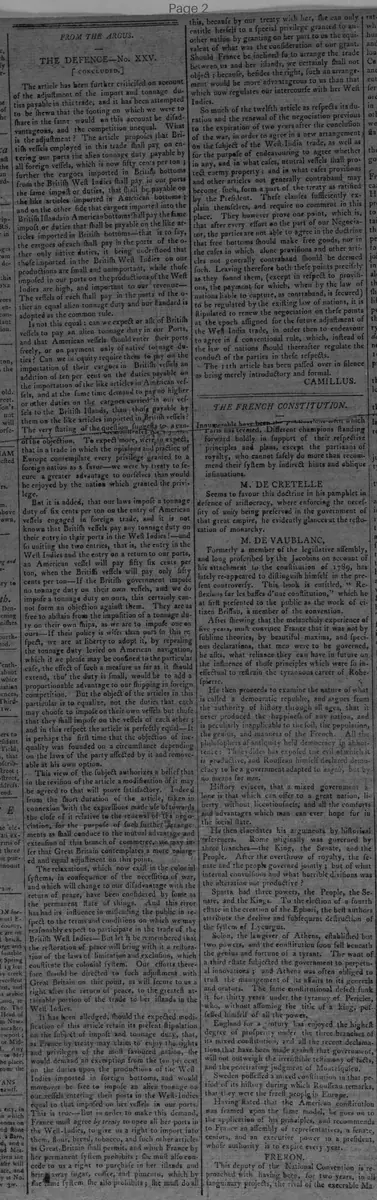
The article has been further criticised on account of the adjustment of the import and tonnage duties payable in this trade, and it has been attempted to be shewn that the footing on which we were to share in the same would on this account be disadvantageous, and the competition unequal. What is the adjustment? The article proposes that British vessels employed in this trade shall pay, on entering our ports the alien tonnage duty payable by all foreign vessels, which is now fifty cents per ton; and further the cargoes imported in British bottoms from the British West Indies shall pay in our ports the same import or duties, that shall be payable on the like articles imported in American bottoms; and on the other side that cargoes imported into the British Islands in American bottoms shall pay the same import or duties that shall be payable on the like articles imported in British bottoms that is to say, the cargoes of each shall pay in the ports of the other only native duties, it being understood that those imported in the British West Indies on our productions are small and unimportant, while those imposed in our ports on the productions of the West Indies are high, and important to our revenue—The vessels of each shall pay in the ports of the other an equal alien tonnage duty and but standard is adopted as the common rule.
and that American vessels should enter their ports freely, or on payment only of native tonnage duties? Can we in equity require them to pay on the importation of their cargoes in British vessels an addition of ten per cent on the duties payable on the importation of the like articles in American vessels, and at the same time demand to pay no higher or other duties on the cargoes carried in our vessels to the British Islands, than those payable by them on the like articles imported in British vessels? The very stating of the question suggests to a candid mind the injustice of the objection. To expect more, were to expect, that in a trade in which the opinions and practice of Europe contemplate every privilege granted to a foreign nation as a favor—we were by treaty to secure a greater advantage to ourselves than would be enjoyed by the nation which granted the privilege.
But it is added, that our laws impose a tonnage duty of six cents per ton on the entry of American vessels engaged in foreign trade, and it is not known that British vessels pay any tonnage duty on their entry in their ports in the West Indies!—and so uniting the two entries, that is, the entry in the West Indies and the entry on a return to our ports, an American vessel will pay fifty six cents per ton, when the British vessels will pay only fifty cents per ton—If the British government impose no tonnage duty on their own vessels, and we do impose a tonnage duty on ours, this certainly cannot form an objection against them. They are as free to abstain from the imposition of a tonnage duty on their own ships, as we are to impose one on ours—If their policy is wiser than ours in this respect, we are at liberty to adopt it, by repealing the tonnage duty levied on American navigation, which if we please may be confined to the particular case, the effect of such a measure as far as it should extend, tho' the duty is small, would be to add a proportionable advantage to our shipping in foreign competition. But the object of the articles in this particular is to equalize, not the duties that, each may choose to impose on their own vessels but those that they shall impose on the vessels of each other: and in this respect the article is perfectly equal—It is perhaps the first time that the objection of inequality was founded on a circumstance depending on the laws of the party affected by it and removable at his own option.
This view of the subject authorizes a belief that in the revision of the article a modification of it may be agreed to that will prove satisfactory. Indeed from the short duration of the article, taken in connexion with the expressions made use of towards the close of it relative to the renewal' of the negotiation, for the purpose of such further arrangements as shall conduce to the mutual advantage and extension of this branch of commerce, we may infer that Great Britain contemplates a more enlarged and equal adjustment on this point.
The relaxations, which now exist in the colonial systems, in consequence of the necessities of war. and which will change to our disadvantage with the return of peace, have been considered by some as the permanent state of things. And this error has had its influence in misleading the public in respect to the terms and conditions on which we may reasonably expect to participate in the trade of the British West Indies—But let it be remembered that the restoration of peace will bring with it a restoration of the laws of limitation and exclusion, which constitute the colonial system. Our efforts therefore should be directed to such adjustment with Great Britain on this point, as will secure to us a right after the return of peace, to the greatest attainable portion of the trade to her islands in the West Indies.
It has been alledged, should the expected modification of this article retain its present stipulation on the subject of import and tonnage duty, that, as France by treaty may claim to enjoy the rights and privileges of the most favoured nation, the would demand an exemption from the ten per cent on the duties upon the productions of the West Indies imported in foreign bottoms, and would moreover be free to impose an alien tonnage duty on our vessels entering their ports in the West-Indies equal to that imposed on her vessels in our ports.
This is true—But in order to make this demand, France must agree by treaty to open all her ports in the West-Indies, to give us a right to import into them, flour, bread, tobacco, and such other articles as Great-Britain shall permit, and which France by her permanent system prohibits; she must also concede to us a right to purchase in her islands and bring away sugar, coffee, and pimento, which by The same system she also prohibits; she must do all this, because by our treaty with her, she can only entitle herself to a special privilege granted to another nation by granting on her part to us the equivalent of what was the consideration of our grant.
Should France be inclined so to arrange the trade between us and her islands, we certainly shall not object; because, besides the right, such an arrangement would be more advantageous to us than that which now regulates our intercourse with her West Indies.
So much of the twelfth article as respects its duration and the renewal of the negotiation previous to the expiration of two years after the conclusion of the war, in order to agree in a new arrangement on the subject of the West India trade, as well as for the purpose of endeavouring to agree whether in any, and in what cases, neutral vessels shall protect enemy property: and in what cases provisions and other articles not generally contraband may become such, form a part of. the treaty as ratified by the President. These clauses sufficiently 'ex-plain themselves, and require no comment in this place. They however prove one point, which is, that after every effort on the part of our Negotiator, the parties are not able to agree in the doctrine that free bottoms should make free goods, nor in the cases in which alone provisions and other articles not generally contraband should be deemed such. Leaving therefore both these points precisely as they found them, (except in respect to provisions, the payment or which, when by the law of nations liable to capture, as contraband, is secured) to be regulated by the existing law of nations, it is stipulated to renew the negotiation on these points at the epoch assigned for the future adjustment of the West-India trade, in order then to endeavour to agree in a conventional rule, which, instead of the law of nations should thereafter regulate the conduct of the parties in these respects.
- The 11th article has been passed over in silence as being merely introductory and formal.
CAMILLIUS
THE DEFENCE No. XXV.
Concluded.
The article has been further criticised on account of the adjustment of the import and tonnage duties payable in this trade, and it has been attempted to be shewn that the footing on which we were to share in the same would on this account be disadvantageous, and the competition unequal. What is the adjustment? The article proposes that British vessels employed in this trade shall pay, on entering our ports the alien tonnage duty payable by all foreign vessels, which is now fifty cents per ton; and further the cargoes imported in British bottoms from the British West Indies shall pay in our ports the same import or duties, that shall be payable on the like articles imported in American bottoms; and on the other side that cargoes imported into the British Islands in American bottoms shall pay the same import or duties that shall be payable on the like articles imported in British bottoms that is to say, the cargoes of each shall pay in the ports of the other only native duties, it being understood that those imported in the British West Indies on our productions are small and unimportant, while those imposed in our ports on the productions of the West Indies are high, and important to our revenue—The vessels of each shall pay in the ports of the other an equal alien tonnage duty and but standard is adopted as the common rule.
and that American vessels should enter their ports freely, or on payment only of native tonnage duties? Can we in equity require them to pay on the importation of their cargoes in British vessels an addition of ten per cent on the duties payable on the importation of the like articles in American vessels, and at the same time demand to pay no higher or other duties on the cargoes carried in our vessels to the British Islands, than those payable by them on the like articles imported in British vessels? The very stating of the question suggests to a candid mind the injustice of the objection. To expect more, were to expect, that in a trade in which the opinions and practice of Europe contemplate every privilege granted to a foreign nation as a favor—we were by treaty to secure a greater advantage to ourselves than would be enjoyed by the nation which granted the privilege.
But it is added, that our laws impose a tonnage duty of six cents per ton on the entry of American vessels engaged in foreign trade, and it is not known that British vessels pay any tonnage duty on their entry in their ports in the West Indies!—and so uniting the two entries, that is, the entry in the West Indies and the entry on a return to our ports, an American vessel will pay fifty six cents per ton, when the British vessels will pay only fifty cents per ton—If the British government impose no tonnage duty on their own vessels, and we do impose a tonnage duty on ours, this certainly cannot form an objection against them. They are as free to abstain from the imposition of a tonnage duty on their own ships, as we are to impose one on ours—If their policy is wiser than ours in this respect, we are at liberty to adopt it, by repealing the tonnage duty levied on American navigation, which if we please may be confined to the particular case, the effect of such a measure as far as it should extend, tho' the duty is small, would be to add a proportionable advantage to our shipping in foreign competition. But the object of the articles in this particular is to equalize, not the duties that, each may choose to impose on their own vessels but those that they shall impose on the vessels of each other: and in this respect the article is perfectly equal—It is perhaps the first time that the objection of inequality was founded on a circumstance depending on the laws of the party affected by it and removable at his own option.
This view of the subject authorizes a belief that in the revision of the article a modification of it may be agreed to that will prove satisfactory. Indeed from the short duration of the article, taken in connexion with the expressions made use of towards the close of it relative to the renewal' of the negotiation, for the purpose of such further arrangements as shall conduce to the mutual advantage and extension of this branch of commerce, we may infer that Great Britain contemplates a more enlarged and equal adjustment on this point.
The relaxations, which now exist in the colonial systems, in consequence of the necessities of war. and which will change to our disadvantage with the return of peace, have been considered by some as the permanent state of things. And this error has had its influence in misleading the public in respect to the terms and conditions on which we may reasonably expect to participate in the trade of the British West Indies—But let it be remembered that the restoration of peace will bring with it a restoration of the laws of limitation and exclusion, which constitute the colonial system. Our efforts therefore should be directed to such adjustment with Great Britain on this point, as will secure to us a right after the return of peace, to the greatest attainable portion of the trade to her islands in the West Indies.
It has been alledged, should the expected modification of this article retain its present stipulation on the subject of import and tonnage duty, that, as France by treaty may claim to enjoy the rights and privileges of the most favoured nation, the would demand an exemption from the ten per cent on the duties upon the productions of the West Indies imported in foreign bottoms, and would moreover be free to impose an alien tonnage duty on our vessels entering their ports in the West-Indies equal to that imposed on her vessels in our ports.
This is true—But in order to make this demand, France must agree by treaty to open all her ports in the West-Indies, to give us a right to import into them, flour, bread, tobacco, and such other articles as Great-Britain shall permit, and which France by her permanent system prohibits; she must also concede to us a right to purchase in her islands and bring away sugar, coffee, and pimento, which by The same system she also prohibits; she must do all this, because by our treaty with her, she can only entitle herself to a special privilege granted to another nation by granting on her part to us the equivalent of what was the consideration of our grant.
Should France be inclined so to arrange the trade between us and her islands, we certainly shall not object; because, besides the right, such an arrangement would be more advantageous to us than that which now regulates our intercourse with her West Indies.
So much of the twelfth article as respects its duration and the renewal of the negotiation previous to the expiration of two years after the conclusion of the war, in order to agree in a new arrangement on the subject of the West India trade, as well as for the purpose of endeavouring to agree whether in any, and in what cases, neutral vessels shall protect enemy property: and in what cases provisions and other articles not generally contraband may become such, form a part of. the treaty as ratified by the President. These clauses sufficiently 'ex-plain themselves, and require no comment in this place. They however prove one point, which is, that after every effort on the part of our Negotiator, the parties are not able to agree in the doctrine that free bottoms should make free goods, nor in the cases in which alone provisions and other articles not generally contraband should be deemed such. Leaving therefore both these points precisely as they found them, (except in respect to provisions, the payment or which, when by the law of nations liable to capture, as contraband, is secured) to be regulated by the existing law of nations, it is stipulated to renew the negotiation on these points at the epoch assigned for the future adjustment of the West-India trade, in order then to endeavour to agree in a conventional rule, which, instead of the law of nations should thereafter regulate the conduct of the parties in these respects.
- The 11th article has been passed over in silence as being merely introductory and formal.
CAMILLIUS
What sub-type of article is it?
Trade Or Commerce
Foreign Affairs
Economic Policy
What keywords are associated?
West Indies Trade
Tonnage Duties
Import Duties
British Treaty
French Relations
Neutral Vessels
Contraband Goods
What entities or persons were involved?
Great Britain
British West Indies
France
Camillus
Editorial Details
Primary Topic
Defense Of West India Trade Treaty Provisions On Duties And Future Negotiations
Stance / Tone
Defensive Justification Against Criticisms
Key Figures
Great Britain
British West Indies
France
Camillus
Key Arguments
Adjustment Equalizes Import And Tonnage Duties Between American And British Vessels
Criticisms Of Unequal Competition Are Unjust As Each Nation Controls Duties On Its Own Ships
Treaty Allows For Future Revisions To Ensure Mutual Advantage
Post War Restoration Of Colonial Restrictions Necessitates Securing Trade Rights
France's Most Favored Nation Claims Require Reciprocal Concessions On West Indies Ports
Renewal Negotiations To Address Neutral Rights And Contraband Definitions