Thank you for visiting SNEWPapers!
Sign up free
Lynchburg Virginian
Lynchburg, Virginia
What is this article about?
A letter from Corpus Christi, Texas, dated Oct. 11, 1845, criticizes the War Department's logistical failures in equipping the Army of Occupation, particularly sending Lt. Bragg's artillery company without guns or horses, leading to vulnerabilities during landing and entrenchment amid reports of Mexican forces nearby.
Clipping
OCR Quality
Full Text
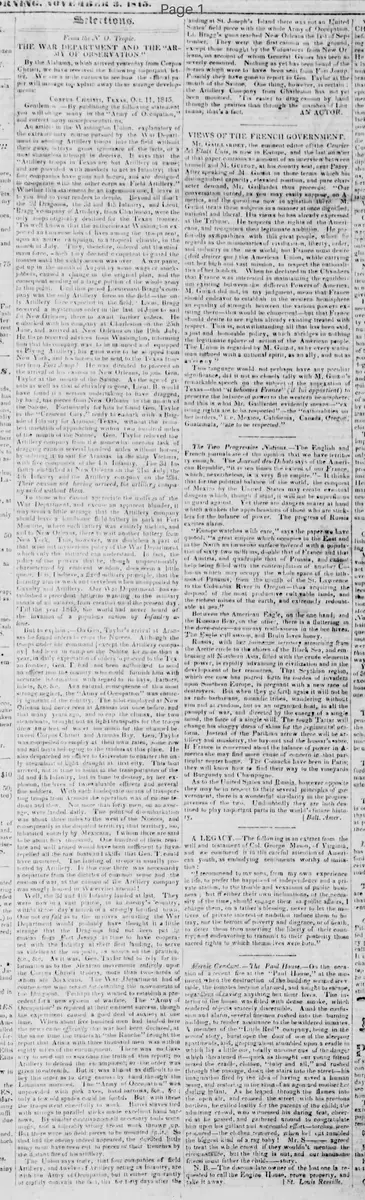
By the Alabama, which arrived yesterday from Corpus Christi, we have received the following important letter. We are a little curious to see how the special paper will manage to explain away these strange developments:
Corpus Christi, Texas, Oct. 11, 1845.
Gentlemen—By publishing the following statement you will oblige many in the "Army of Occupation," and correct many misrepresentations.
An article in the Washington Union, explanatory of the extraordinary course pursued by the War Department in sending Artillery troops into the field without their guns, betrays gross ignorance of the facts, or a most shameless attempt to deceive. It says that the "Artillery troops in Texas are but Artillery in name; and are provided with muskets to act as infantry; that four companies have guns and horses, and are designed to co-operate with the other corps as Field Artillery."
Whether this statement be an ingenious one, I leave it to you and to your readers to decide. Beyond all doubt the 2d Dragoons, the 3d and 4th Infantry, and Lieut. Bragg's company of Artillery, from Charleston, were the only troops originally destined for the Texan frontier. "'Tis well known that the authorities at Washington expected an immense loss of lives among the troops sent, upon an active campaign, to a tropical climate, in the month of July. They, therefore, ordered out the minimum force, which they deemed expedient to guard the frontier until the sickly season was over. A war panic, got up in the month of August by some wagon or stock-jobbers, caused a change in the original plan, and the consequent sending of a large portion of the whole army to this point. Until thus period Lieutenant Bragg's company was the only Artillery force in the field—the only Artillery force expected in the field." Lieut. Bragg received a mysterious order in the last of June to sail for New Orleans, there to await "further orders." He embarked with his company at Charleston on the 25th June, and arrived at New Orleans on the 19th July. He there received advices from Washington, informing him that his company was to be mounted and equipped as Flying Artillery, his guns were to be shipped from New York, and his horses to be sent to the Texas frontier from Fort Jesup. He was directed to proceed on the arrival of his horses in New Orleans, to join Gen. Taylor at the mouth of the Sabine. As the age of giants as well as that of chivalry is gone, Lieut. B. would have found it a serious undertaking to have dragged, by hand, six pieces from New Orleans to the mouth of the Sabine. Fortunately for him he found Gen. Taylor in the "Crescent City," ready to embark with a Brigade of Infantry for Aransas, Texas, without the remotest intention of approaching within two hundred miles of the mouth of the Sabine. Gen. Taylor relieved the Artillery company from the somewhat onerous task of dragging cannon several hundred miles without horses, by ordering it to sail for Aransas in the ship Victoria, with five companies of the 3d Infantry. The 3d Infantry embarked at New Orleans on the 21st July; the 4th Infantry and the Artillery company on the 23d. Their cannon not having arrived, the artillery company sailed without them.
To those who cannot reconcile the wisdom of the War Department, and excuse an apparent blunder, it may seem a little strange that the Artillery company should leave a handsome field battery in park at Fort Moultrie, where such battery was entirely useless, and sail to New Orleans, there to await another battery from New York. This, however, was doubtless a part of that wise mysterious policy of the War Department which only the initiated can understand. In fact, the policy of the powers that be, though unquestionably characterized by current wisdom, does seem a little queer. It is, I believe, a fixed military principle, that the Infantry arm is weak and nerveless when unsupported by Cavalry and Artillery. Our War Department has established a precedent hitherto wanting in the military annals of all nations, from creation down to the present day. 'Till the year 1845, the world had never heard of the invasion of a populous nation by infantry alone.
But to explain. On Gen. Taylor's arrival at Aransas he found orders from the North. Although the troops under his command except the Artillery company had been waiting at camp on the Sabine for more than a year, in daily expectation of orders for speedy movement to the Texan frontier, Gen. T. had not been authorized to send an officer into the country who could furnish him with accurate information with regard to its bays, harbors, inlets, &c. &c. As a natural consequence of this most strange neglect, the "Army of Occupation" was entirely ignorant of the country. The pilot employed at New Orleans had never been at Aransas but once before, and that many years ago, and to cap the climax, the two steamboats, brought out as light transports for the troops drew two feet of water too much for the channel between Corpus Christi and Aransas Bay. Gen. Taylor was compelled to employ at their own rates, some row and sail boats belonging to the traders at this place. He also despatched an officer to Galveston to charter the only steamboat of light draught at that city. This boat arrived, not in time to assist in the transportation of the 3d and 4th Infantry, but in time to destroy, by her explosion, the lives of two valuable officers and several fine soldiers. With such inadequate means of transporting troops from Aransas the operation was of course tedious and slow. Not more than forty men on an average, were landed daily. The point of disembarkation was about three miles to the west of the Nueces, and consequently in the disputed territory; that territory, too, inhabited entirely by Mexicans, of whom there are said to be about fifteen thousand. One hundred of these resolute and well armed would have been sufficient to have repelled all the row boats and skiffs that Gen. T. could have mustered. 'The landing of troops is usually protected by Artillery. In this case there was necessarily a departure from the dictates of common sense and the custom of war, as the cannon of the Artillery company was snugly housed in Watervliet arsenal!
Well, the 3d and 4th Infantry landed at last. They were now in a vast prairie, in an enemy's "country," within three day's march of a strongly fortified town. One not au fait as to the motives actuating the War Department would probably have thought it a little strange that the Dragoons had not been put in motion from Fort Jesup in time to have co-operated with the infantry at their first landing, to serve as videttes at the out posts, as scouts on the prairies, &c. &c. As it was, Gen. Taylor had to rely for information as to the Mexican movements entirely upon the Corpus Christi traders, more than two-thirds of whom are Mexicants. The War Department had of course the wise design in delaying the movements of the Dragoons. Perhaps they wished to establish a precedent for a new system of warfare. The "Army of Occupation" is rejoiced at their eminent success, though the experiment caused a good deal of anxiety at one time. When about five hundred men had landed here the news came officially that war had been declared, at the same time the traders at "the Ranche" brought the report that Ampudia with three thousand men was within eighty miles of the encampment. There was no Cavalry to send out to ascertain the truth of this report; no Artillery to defend the encampment; so the order was given to entrench. But it was almost as difficult to obey this order as to drag cannon by hand through the Louisiana marshes. The "Army of Occupation" was unprovided with pick axes, hand barrows, &c., &c.; only a few old spades could be found. But with these the troops went cheerfully to work. Barred slaves tied with strings to parallel sticks made excellent hand barrows. By similar contrivances all necessary tools were made, and a tolerably strong breast work thrown up. But there were no field pieces to be mounted on it. So that had the enemy indeed appeared, the devoted little army must have been torn to pieces in their trenches by the distant fire of his artillery.
The Union says truly. That four companies of field Artillery, and twelve of Artillery acting as Infantry, are with the Army of Occupation, but it either ignorantly or craftily conceals the fact, that for forty days after the landing at St. Joseph's Island there was not a United States' field piece with the whole Army of Occupation.
Lt. Bragg's guns reached New Orleans the last of September. They were the first cannon on the ground, except those brought by the Volunteers from New Orleans, on account of whom General Gaines has been so severely censured. Nothing as yet has been heard of the horses which were to have been sent from Fort Jesup. Possibly they have gone to report to Gen. Taylor at the mouth of the Sabine. One thing, however, is certain: the Artillery Company from Charleston has not yet been mounted. 'Tis easier to drag cannon by hand through the prairies than through the marshes of Louisiana; that's a fact,
AN ACTOR.
What sub-type of article is it?
What keywords are associated?
What entities or persons were involved?
Where did it happen?
Foreign News Details
Primary Location
Corpus Christi, Texas
Event Date
Oct. 11, 1845
Key Persons
Outcome
steamboat explosion killed two officers and several soldiers; troops entrenched without artillery amid reports of 3,000 mexican troops nearby; artillery guns arrived late in september without horses.
Event Details
The letter details War Department errors in deploying the Army of Occupation to Texas, including sending Lt. Bragg's artillery company from Charleston without guns or horses, leading to infantry-only landings at Aransas vulnerable to Mexican forces; troops improvised entrenchments with limited tools upon war declaration and rumors of Ampudia's approach.