Thank you for visiting SNEWPapers!
Sign up free
The Rhode Island Republican
Newport, Newport County, Rhode Island
What is this article about?
American officers refute claims in Goldsmith's history that U.S. troops sacked and destroyed York, Upper Canada, in 1813. Documents show humane treatment under General Dearborn, protection of civilians, compensation for minor damages, and strategic abandonment after capturing public property and destroying military assets, supported by Commodore Chauncey's fleet.
Merged-components note: This is a single continuous article refuting claims about the American conduct at the capture of York in Upper Canada during the war, spanning multiple components across pages 1 and 2. Relabeled to foreign_news as it reports on an international military event.
Clippings
1 of 2
OCR Quality
Full Text
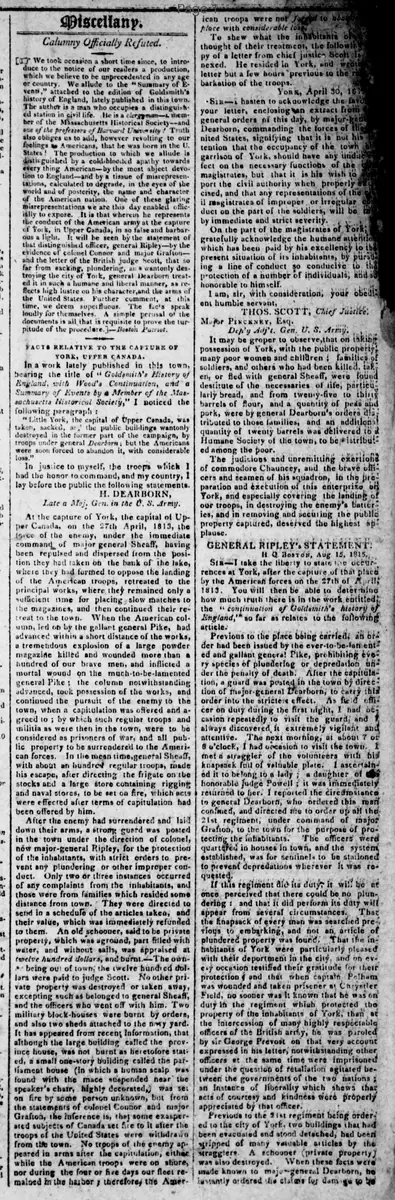
Calumny Officially Refuted.
[We took occasion a short time since, to introduce to the notice of our readers a production, which we believe to be unprecedented in any age or country. We allude to the "Summary of Events," attached to the edition of Goldsmith's history of England, lately published in this town. The author is a man who occupies a distinguished station in civil life. He is a clergyman—a member of the Massachusetts Historical Society—and one of the professors of Harvard University! Truth also obliges us to add, however revolting to our feelings Americans, that he was born in the U. States! The production to which we allude is distinguished by a cold-blooded apathy towards every thing American—by the most abject devotion to England—and by a tissue of misrepresentations, calculated to degrade, in the eyes of the world and of posterity, the name and character of the American nation. One of these glaring misrepresentations we are this day enabled officially to expose. It is that wherein he represents the conduct of the American army at the capture of York, in Upper Canada, in so false and barbarous a light. It will be seen by the statement of that distinguished officer, general Ripley—by the evidence of colonel Connor and major Grafton—and the letter of the British judge Scott, that so far from sacking, plundering, and wantonly destroying the city of York, general Dearborn treated it in such a humane and liberal manner, as reflects high lustre on his character, and the arms of the United States. Further comment, at this time, we deem superfluous. The facts speak loudly for themselves. A simple perusal of the documents is all that is requisite to prove the turpitude of the procedure.]—Boston Patriot.
FACTS RELATIVE TO THE CAPTURE OF YORK, UPPER CANADA.
In a work lately published in this town, bearing the title of "Goldsmith's History of England, with Wood's Continuation, and a Summary of Events by a Member of the Massachusetts Historical Society," I noticed the following paragraph:
"Little York, the capital of Upper Canada, was taken, sacked, and the public buildings wantonly destroyed in the former part of the campaign, by troops under general Dearborn; but the Americans were soon forced to abandon it, with considerable loss."
In justice to myself, the troops which I had the honor to command, and my country, I lay before the public the following statements.
H. DEARBORN,
Late a Maj. Gen. in the U. S. Army.
At the capture of York, the capital of Upper Canada, on the 27th April, 1813, the force of the enemy, under the immediate command of major general Sheaffe, having been repulsed and dispersed from the position they had taken on the bank of the lake, where they had formed to oppose the landing of the American troops, retreated to the principal works, where they remained only a sufficient time for placing slow matches to the magazines, and then continued their retreat to the town. When the American column, led on by the gallant general Pike, had advanced within a short distance of the works, a tremendous explosion of a large powder magazine killed and wounded more than a hundred of our brave men, and inflicted a mortal wound on the much-to-be-lamented general Pike; the column notwithstanding advanced, took possession of the works, and continued the pursuit of the enemy to the town, when a capitulation was offered and agreed to; by which such regular troops and militia as were then in the town, were to be considered as prisoners of war, and all public property to be surrendered to the American forces. In the mean time, general Sheaffe, with about a hundred regular troops, made his escape, after directing the frigate on the stocks and a large store containing rigging and naval stores, to be set on fire, which acts were effected after terms of capitulation had been offered by him.
After the enemy had surrendered and laid down their arms, a strong guard was posted in the town under the direction of colonel, now major-general Ripley, for the protection of the inhabitants, with strict orders to prevent any plundering or other improper conduct. Only two or three instances occurred of any complaints from the inhabitants, and those were from families which resided some distance from town. They were directed to send in a schedule of the articles taken, and their value, which was immediately refunded to them. An old schooner, said to be private property, which was aground, part filled with water, and without sails, was appraised at twelve hundred dollars, and burnt. The owner being out of town; the twelve hundred dollars were paid to judge Scott. No other private property was destroyed or taken away, excepting such as belonged to general Sheaffe, and the officers who went off with him. Two military block-houses were burnt by orders, and also two sheds attached to the navy yard. It has appeared from recent information, that although the large building called the province house, was not burnt as heretofore stated, a small one-story building called the parliament house (in which a human scalp was found with the mace suspended near the speaker's chair, highly decorated,) was set on fire by some person unknown, but from the statements of colonel Connor and major Grafton, the inference is, that some exasperated subjects of Canada set fire to it after the troops of the United States were withdrawn from the town. No troops of the enemy appeared in arms after the capitulation, either while the American troops were on shore, nor during the four or five days our fleet remained in the harbor; therefore the American troops were not forced to abandon place with considerable loss
To show what the inhabitants of York thought of their treatment, the following copy of a letter from chief justice Scott is annexed. He resided in York, and wrote the letter but a few hours previous to the embarkation of the troops.
York, April 30, 1813
—Sir—I hasten to acknowledge the favor of your letter, enclosing an extract from general orders of this day, by major-general Dearborn, commanding the forces of the United States, signifying that it is not his intention that the occupancy of the town by garrison of York, should have any injurious effect on the necessary functions of the magistrates, but that it is his wish to support the civil authority when properly exercised, and that any representations of the civil magistrates of improper, or irregular conduct on the part of the soldiers, will be treated by immediate and strict severity.
On the part of the magistrates of York; gratefully acknowledge the humane attention which has been paid by his excellency to the present situation of its inhabitants, by pursuing a line of conduct so conducive to the protection of a number of individuals; and honorable to himself.
I am, sir, with consideration; your obedient humble servant,
THOS. SCOTT, Chief Justice:
Major Pinckney, Esq.
Dep'y Adj't. Gen. U. S. Army.
In taking possession of York, with the public property? many poor women and children; families of soldiers, and others who had been killed. taken, or fled with general Sheaffe, were found destitute of the necessaries of life, particularly bread, and from twenty-five to thirty barrels of flour, and a quantity of peas and pork, were by general Dearborn's orders distributed to those families, and an additional quantity of twenty barrels was delivered to a Humane Society of the town, to be distributed among the poor.
The judicious and unremitting exertions of commodore Chauncey, and the brave officers and seamen of his squadron, in the preparation and execution of this enterprise on York, and especially covering the landing of our troops, in destroying the enemy's Batteries; and in removing and securing the public property captured, deserved the highest applause.
GENERAL RIPLEY'S STATEMENT:
H.Q. Boston, Aug. 15, 1815.,
Sir—I take the liberty to state the occurrences at York, after the capture of that place by the American forces on the 27th of April; 1813. You will then be able to determine how much truth there is in the work entitled? the "continuation of Goldsmith's history of England,'" so far as relates to the following article.
Previous to the place being carried; an order had been issued by the ever-to-be-lamented and gallant general Pike, prohibiting every species of plundering or depredation under the penalty of death: After the capitulation, a guard was posted in the town by direction of major-general Dearborn, to carry this order into the strictest effect. As field officer on duty during the first night, I had occasion repeatedly to visit the guard; and I always discovered it extremely vigilant and attentive. The next morning, at about 7 or 8 o'clock, I had occasion to visit the town. I met a straggler of the volunteers with his knapsack full of valuable plate: I ascertained it to belong to a lady; a daughter of honorable judge Powell; it was immediately returned to her. I reported the circumstance to general Dearborn, who ordered this man confined, and directed me to order up the 21st regiment, under command of majors Grafton, to the town for the purpose of protecting the inhabitants. The officers were quartered in houses in town, and the system established, was for sentinels to be stationed to prevent depredations wherever it was requested.
If this regiment did its duty, it will be at once perceived that there could be no plundering: and that it did perform its duty will appear from several circumstances. That the knapsack of every man was searched previous to embarking, and not an article of plundered property was found: That the inhabitants of York were particularly pleased with their deportment in the city, and on every occasion testified their gratitude for their protection § and that when captain Pelham was wounded and taken prisoner at Chrystler's Field, no sooner was it known that he was on duty in the regiment which protected the property of the inhabitants of York, than at the intercession of many highly respectable officers of the British army, he was paroled by sir George Prevost on that very account expressed in his letter, notwithstanding other officers at the same time were imprisoned under the question of retaliation agitated between the governments of the two nations; an instance of liberality which shews that acts of courtesy and kindness were properly appreciated by that officer.
Previous to the 21st regiment being ordered to the city of York, two buildings that had been evacuated and stood detached, had been stripped of many valuable articles by the stragglers. A schooner (private property) was also destroyed. When these facts were made known to major-general Dearborn, he instantly ordered the claims for damage to be paid.
Any attempt to be made. It is of such property taken during the siege, it was made to the proprietors personally. In that of the schooner, the owner Lewis was absent from town, major Dearborn sent the money to judge who receipted for it. In the place was captured, large stores of beef and peas were found in depot. By the articles of capitulation, these were delivered to us. Major-general Dearborn directed a large proportion of them to be delivered to the needy in the city, and partly to the widows and families of the British and Canadian soldiers who had been killed in the action. In addition to this, considerable quantities were deposited with the mayor of the place to be distributed in a similar manner. And during our stay at York, the citizens of that ambitious place seemed to be more alarmed by some disloyal inhabitants of the country, than in relation to the American forces. They frequently expressed their apprehensions in strong terms, they had reason so to do. I recollect very well a man who lived in the vicinity of town, who came to me one day, and observed, he intended to burn the gaol. I remarked to him, if he did I should hang him, and detached constantly a sentinel to guard it. I have seen many British officers who have always complimented our forces for their liberality of conduct, on this occasion manifested at York. Some have informed me, that the inhabitants had applauded it in such forcible terms, that they had even been accused of disloyalty by the British army. As it respects the manner in which York was stated to be evacuated, in the work I have alluded to, it is perfectly incorrect. The object of striking York, at the opening of the campaign, was solely to destroy the frigate building there; and the military and naval depot. The first object was effected in order to ensure our control on lake Ontario during the summer of 1813. The second, with a view to destroy the military depot, from whence the right and central division of the army, under generals Proctor and Vincent, drew their supplies; and the naval depot, to paralyze the efforts of the British in building ships on lake Erie. It was settled before the army left Sackett's Harbor, that these objects accomplished, the division would sail for Niagara and operate against Fort George. After the reduction of that post, the army was to concentrate, by means of the fleet, on Lake Ontario, and reduce Kingston. I will add, that when we abandoned York, no British forces were, to my knowledge, nearer than Fort George on one side, and Kingston on the other. I am, respectfully, your obedient servant, E. W. RIPLEY, Major-general, U. S. army. Major-general Henry Dearborn.
COLONEL CONNER'S STATEMENT. Albany, Sept. 18, 1815. Dear sir--The conduct of the American troops at York, and that of the commander in chief, was marked by such humanity and attention to the wants and interests of the citizens that I should have supposed no "American gentleman," in an imposing historical form, would have hazarded assertions so directly to the contrary. The explosion of the mine, which killed the gallant Pike, and killed and wounded more than one hundred men in our columns, did not add to the defence of the place, and perhaps the army would have been justified in subjecting York to all the severities of a town carried by assault. But far different was its treatment; the persons and property of the inhabitants were protected; large storehouses of valuable goods were thrown open next day by the citizens, and payment made in specie by our men, for any article they had occasion for.--Some petty depredations were practiced, principally by the light troops, who patroled the skirts of the town; but, on detection, they were punished, and the citizens were invited to carry complaints of any abuses directly to head-quarters. The letter of judge Scott to major Pinkney, the acting adjutant-general, will show in what manner these attentions were appreciated. No public or private buildings, except such as added to the defence of the place, were destroyed, to my knowledge. It would appear, from the report of Col. Monroe, that information had reached him, that the parliament house, a one-story brick building with wings, was burnt down. If this was a fact, it must have been done after the rear guard had been withdrawn from the town, by some solitary individual, (perhaps by a citizen, for some of them who left York with the army, were exceedingly exasperated against the magistracy) unbeknown to the commanding officers of the army or navy ; as I was witness to the anxious and strenuous endeavors of those officers to prevent any cause of complaint whatever. It was the wish of the commander in chief, that the conduct of our troops at York might afford as great a contrast to the then recent behavior of the enemy at Ogdensburg as possible, and you will believe his wishes were realized, when you are informed, that lieut. Pelham, of the 21st, (which formed the guard of the town) who was captured the next November, on the St. Lawrence, was paroled on the special consideration of the humanity and polite attention experienced from his regiment at York. There was no apprehension of the enemy's being in sufficient force to attack us at the time of embarkation. I am, dear sir, with great respect, your very obedient servant, SAM'L S. CONNER. Major-general Henry Dearborn. Note--Colonel S. S. Conner was aid-de-camp to major-general Dearborn at that time, but having volunteered his services, landed with the troops, and was in the advancing column at the time of the explosion. Colonel Conner, negotiated the capitulation on the part of the United States.
MAJOR GRAFTON'S STATEMENT. I certify, that after the capture of York, the capital of Upper Canada, lieut. Pelham, with myself, were ordered into the city by major-general Dearborn to protect the inhabitants; and the then acting adjutant-general, major Pinkney, stated to me, that we should have as many soldiers as were requisite for that purpose. We made known our orders to the inhabitants; they appeared gratified with the arrangements which were made for their security, as some of them observed they had much to fear from their own disaffected. I kept patroles out during the night, and safeguards were furnished to all those who requested them. One gentleman, I think his name was Cameron, who applied for safeguards, gave as a reason, that two or three of these disaffected, "some of our own rascals," as he called them, had threatened to burn his house. This request as the others was promptly complied with. The third day after our landing, I saw a column of smoke arising at the distance of 200 or 300 paces. I immediately rode towards it, and saw the flames bursting from the windows of a small one-story brick building. I enquired of the citizens who had collected, and were quietly looking on, how the fire had originated, and what building that was? They said it was called the parliament house, but could not say how it had occurred. At this time there was not in sight an American soldier. JOSEPH GRAFTON.
What sub-type of article is it?
What keywords are associated?
What entities or persons were involved?
Where did it happen?
Foreign News Details
Primary Location
York, Upper Canada
Event Date
27th April, 1813
Key Persons
Outcome
explosion killed and wounded over 100 americans, including mortal wound to general pike; americans captured york, took prisoners, destroyed public military property and frigate, protected private property, distributed food to needy; no enemy forces forced abandonment.
Event Details
American forces under General Dearborn captured York on April 27, 1813, after repulsing British under General Sheaffe, who retreated and exploded a magazine. Terms of capitulation surrendered public property and prisoners. Guards protected inhabitants; minimal plundering compensated. Public buildings like block-houses and sheds burned by order; parliament house possibly burned by locals. Fleet under Commodore Chauncey supported landing and secured property. York abandoned per plan after objectives met, without enemy pursuit.