Thank you for visiting SNEWPapers!
Sign up free
Gazette Of The United States, & Philadelphia Daily Advertiser
Philadelphia, Philadelphia County, Pennsylvania
What is this article about?
In the British House of Commons on Friday, May 6, Mr. Grey proposed impeaching the Minister for violating laws on public expenditure by concealing funds and falsifying accounts, urging the House to uphold its ancient privilege over the nation's purse.
Clipping
OCR Quality
Full Text
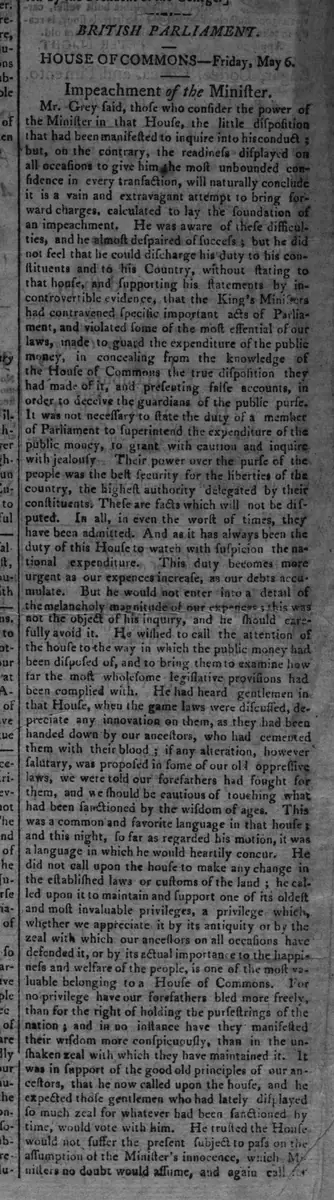
HOUSE OF COMMONS—Friday, May 6.
Impeachment of the Minister.
Mr. Grey said, those who consider the power of the Minister in that House, the little disposition that had been manifested to inquire into his conduct; but, on the contrary, the readiness displayed on all occasions to give him the most unbounded confidence in every transaction, will naturally conclude it is a vain and extravagant attempt to bring forward charges, calculated to lay the foundation of an impeachment. He was aware of these difficulties, and he almost despaired of success; but he did not feel that he could discharge his duty to his constituents and to his Country, without stating to that house, and supporting his statements by incontrovertible evidence, that the King's Ministers had contravened specific important acts of Parliament, and violated some of the most essential of our laws, made to guard the expenditure of the public money, in concealing from the knowledge of the House of Commons the true disposition they had made of it, and presenting false accounts, in order to deceive the guardians of the public purse.
It was not necessary to state the duty of a member of Parliament to superintend the expenditure of the public money, to grant with caution and inquire with jealousy. Their power over the purse of the people was the best security for the liberties of the country, the highest authority delegated by their constituents. These are facts which will not be disputed. In all, in even the worst of times, they have been admitted. And as it has always been the duty of this House to watch with suspicion the national expenditure. This duty becomes more urgent as our expenses increase, as our debts accumulate. But he would not enter into a detail of the melancholy magnitude of our expenses; this was not the object of his inquiry, and he should carefully avoid it. He wished to call the attention of the house to the way in which the public money had been disposed of, and to bring them to examine how far the most wholesome legislative provisions had been complied with. He had heard gentlemen in that House, when the game laws were discussed, depreciate any innovation on them, as they had been handed down by our ancestors, who had cemented them with their blood; if any alteration, however salutary, was proposed in some of our old oppressive laws, we were told our forefathers had fought for them, and we should be cautious of touching what had been sanctioned by the wisdom of ages. This was a common and favorite language in that house; and this night, so far as regarded his motion, it was a language in which he would heartily concur. He did not call upon the house to make any change in the established laws or customs of the land; he called upon it to maintain and support one of its oldest and most invaluable privileges, a privilege which, whether we appreciate it by its antiquity or by the zeal with which our ancestors on all occasions have defended it, or by its actual importance to the happiness and welfare of the people, is one of the most valuable belonging to a House of Commons. For no privilege have our forefathers bled more freely, than for the right of holding the purse-strings of the nation; and in no instance have they manifested their wisdom more conspicuously, than in the unshaken zeal with which they have maintained it. It was in support of the good old principles of our ancestors, that he now called upon the house, and he expected those gentlemen who had lately displayed so much zeal for whatever had been sanctioned by time, would vote with him. He trusted the House would not suffer the present subject to pass on the assumption of the Minister's innocence, which Ministers no doubt would assume, and again call
What sub-type of article is it?
What keywords are associated?
What entities or persons were involved?
Where did it happen?
Foreign News Details
Primary Location
House Of Commons
Event Date
Friday, May 6.
Key Persons
Event Details
Mr. Grey addressed the House of Commons, stating his intent to bring forward charges against the King's Ministers for contravening acts of Parliament and violating laws guarding public money expenditure by concealing true dispositions and presenting false accounts. He emphasized the duty of Parliament to superintend public expenditure with caution and jealousy, highlighting the privilege of controlling the nation's purse-strings as a key security for liberties, defended by ancestors.