Thank you for visiting SNEWPapers!
Sign up free
Story
March 27, 1838
Morning Herald
New York, New York County, New York
What is this article about?
In 1838, the U.S. Senate passes a compromise Sub-Treasury Bill allowing bank notes for revenue, amid voting shifts by Calhoun (against) and Webster (for). President Van Buren threatens veto if unmodified, causing public excitement in the city.
Clipping
OCR Quality
98%
Excellent
Full Text
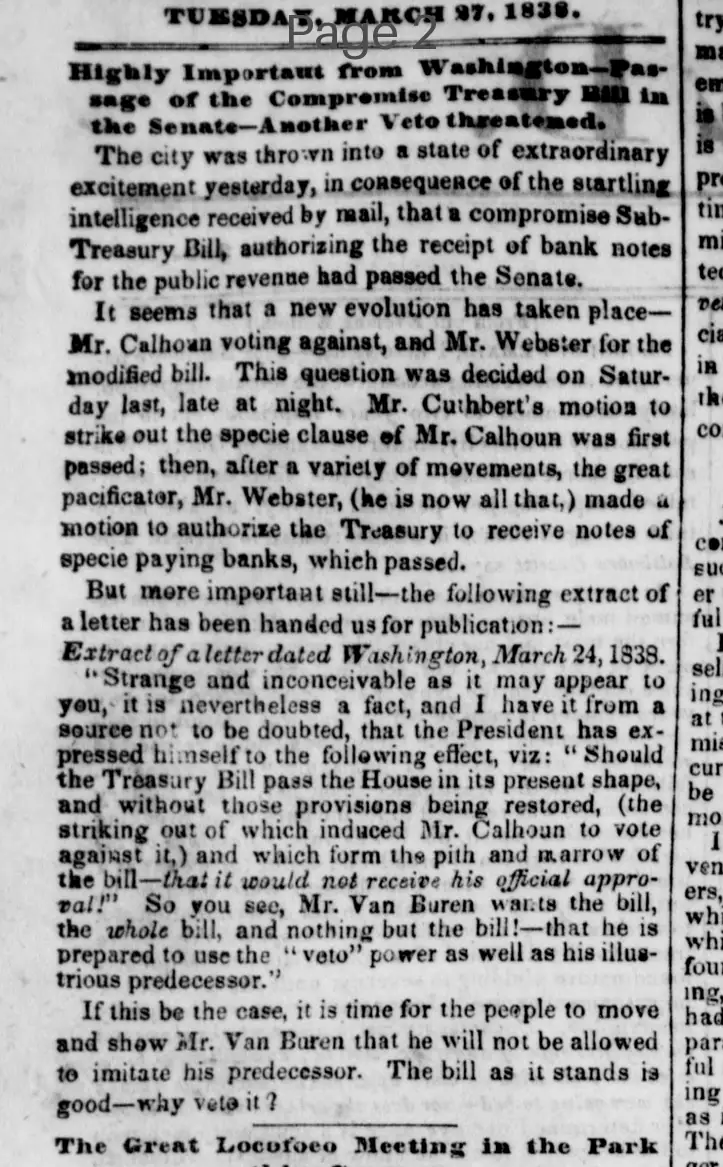
Highly Important from Washington—Passage of the Compromise Treasury Bill in the Senate—Another Veto Threatened.
The city was thrown into a state of extraordinary excitement yesterday, in consequence of the startling intelligence received by mail, that a compromise Sub-Treasury Bill, authorizing the receipt of bank notes for the public revenue had passed the Senate.
It seems that a new revolution has taken place—Mr. Calhoun voting against, and Mr. Webster for the unmodifed bill. This question was decided on Saturday last, late at night. Mr. Cuthbert's motion to strike out the specie clause of Mr. Calhoun was first passed; then, after a variety of movements, the great pacificator, Mr. Webster, (he is now all that,) made a motion to authorize the Treasury to receive notes of specie paying banks, which passed.
But more important still—the following extract of a letter has been handed us for publication:—
Extract of a letter dated Washington, March 24, 1838.
"Strange and inconceivable as it may appear to you, it is nevertheless a fact, and I have it from a source not to be doubted, that the President has expressed himself to the following effect, viz: "Should the Treasury Bill pass the House in its present shape, and without those provisions being restored, (the striking out of which induced Mr. Calhoun to vote against it,) and which form the pith and marrow of the bill—that it would not receive his official approbation!" So you see, Mr. Van Buren wants the bill, the whole bill, and nothing but the bill!—that he is prepared to use the "veto" power as well as his illustrious predecessor."
If this be the case, it is time for the people to move and show Mr. Van Buren that he will not be allowed to imitate his predecessor. The bill as it stands is good—why veto it?
The city was thrown into a state of extraordinary excitement yesterday, in consequence of the startling intelligence received by mail, that a compromise Sub-Treasury Bill, authorizing the receipt of bank notes for the public revenue had passed the Senate.
It seems that a new revolution has taken place—Mr. Calhoun voting against, and Mr. Webster for the unmodifed bill. This question was decided on Saturday last, late at night. Mr. Cuthbert's motion to strike out the specie clause of Mr. Calhoun was first passed; then, after a variety of movements, the great pacificator, Mr. Webster, (he is now all that,) made a motion to authorize the Treasury to receive notes of specie paying banks, which passed.
But more important still—the following extract of a letter has been handed us for publication:—
Extract of a letter dated Washington, March 24, 1838.
"Strange and inconceivable as it may appear to you, it is nevertheless a fact, and I have it from a source not to be doubted, that the President has expressed himself to the following effect, viz: "Should the Treasury Bill pass the House in its present shape, and without those provisions being restored, (the striking out of which induced Mr. Calhoun to vote against it,) and which form the pith and marrow of the bill—that it would not receive his official approbation!" So you see, Mr. Van Buren wants the bill, the whole bill, and nothing but the bill!—that he is prepared to use the "veto" power as well as his illustrious predecessor."
If this be the case, it is time for the people to move and show Mr. Van Buren that he will not be allowed to imitate his predecessor. The bill as it stands is good—why veto it?
What sub-type of article is it?
Historical Event
What themes does it cover?
Fortune Reversal
Justice
What keywords are associated?
Treasury Bill
Senate Passage
Veto Threat
Calhoun Vote
Webster Motion
Van Buren
Sub Treasury
Bank Notes
Specie Clause
What entities or persons were involved?
Mr. Calhoun
Mr. Webster
Mr. Cuthbert
President Van Buren
Where did it happen?
Washington
Story Details
Key Persons
Mr. Calhoun
Mr. Webster
Mr. Cuthbert
President Van Buren
Location
Washington
Event Date
March 24, 1838
Story Details
The Senate passes a compromise Sub-Treasury Bill authorizing receipt of bank notes for public revenue, with Mr. Calhoun voting against and Mr. Webster in favor after motions to strike the specie clause and allow notes from specie-paying banks. A letter reveals President Van Buren threatens to veto the bill without restored provisions.