Thank you for visiting SNEWPapers!
Sign up free
Norfolk Gazette And Publick Ledger
Norfolk, Virginia
What is this article about?
In the House of Lords on Friday, April 9, the Marquis of Wellesley delivered a lengthy speech advocating for the production of documents on East India affairs, defending the East India Company's dual role as sovereign and merchant, emphasizing its importance to trade with India and China, and critiquing proposed resolutions that would alter its privileges and open trade, warning of potential harm to governance and natives.
Merged-components note: These components form a continuous article on the Imperial Parliament debate on East India affairs, spanning columns on page 1 and into page 2.
Clippings
1 of 2
OCR Quality
Full Text
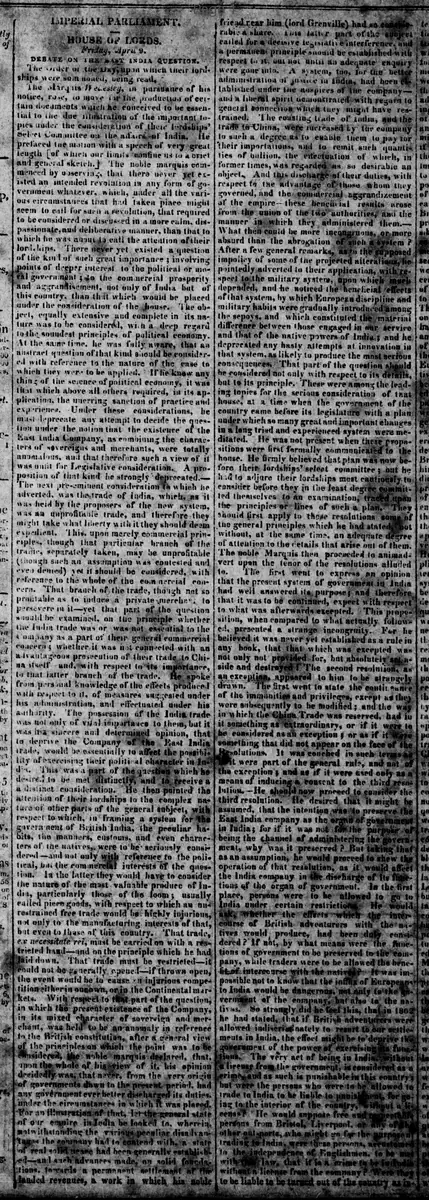
HOUSE OF LORDS.
Friday, April 9.
DEBATE ON THE EAST INDIA QUESTION.
The order of the day on which their lordships were summoned, being read,
The Marquis of Wellesley, in pursuance of his notice, rose, to move for the production of certain documents which he conceived to be essential to the due investigation of the important topics under the consideration of their lordships Select Committee on the affairs of India. He prefaced the motion with a speech of very great length of which our limits confine us to a brief and general sketch. The noble marquis commenced by observing, that there never yet existed an intended revolution in any form of government whatever, which, under all the various circumstances that had taken place might seem to call for such a revolution, that required to be considered or discussed in a more calm, dispassionate, and deliberative manner, than that to which he was about to call the attention of their lordships. There never yet existed a question of the kind of such great importance; involving points of deeper interest to the political or moral government; so to the commercial prosperity and aggrandisement, not only of India but of this country, than that which would be placed under the consideration of the house. The object, equally extensive and complete in its nature was to be considered, with a deep regard to the soundest principles of political economy. At the same time, he was fully aware, that an abstract question of that kind should be considered with reference to the nature of the case to which they were to be applied. If he knew anything of the science of political economy, it was that which above all others required, in its application, the unerring sanction of practice and experience. Under these considerations, he must deprecate any attempt to decide the question under the notion that the existence of the East India Company, as combining the characters of sovereigns and merchants, were totally anomalous, and that therefore such a view of it was unfit for Legislative consideration. A proposition of that kind he strongly deprecated.
The next pre-eminent consideration to which he adverted, was the trade of India, which as it was held by the proposers of the new system, was an unprofitable trade, and therefore they might take what liberty with it they should deem expedient. This, upon merely commercial principles, though that particular branch of the trade, separately taken, may be unprofitable (though such an assumption was contested and even denied) yet it should be considered, with reference to the whole of the commercial concern. That branch of the trade, though not so profitable as to induce a private merchant to persevere in it--yet that part of the question should be examined, on the principle whether the India trade was or was not essential to the Company as a part of their general commercial concern; whether it was not connected with an advantageous prosecution of their trade to China itself -and, with respect to its importance, to that latter branch of the trade. He spoke from personal knowledge of the effects produced with respect to it, of measures suggested under his administration, and effectuated under his authority. The possession of the Indian trade was not only of vital importance to them, but it was his sincere and determined opinion, that to deprive the Company of the East Indian trade, would be essentially to affect the possibility of exercising their political character in India. This was a part of the question which he desired to be met distinctly and to receive a distinct consideration. He then pointed the attention of their lordships to the complex nature of other parts of the general subject, with respect to which, in framing a system for the government of British India, the peculiar habits, the manners, customs, and even characters of, the natives, were to be seriously considered -and not only with reference to the political, but the commercial interests of the question. In the latter they would have to consider the nature of the most valuable produce of India, particularly those of the loom; usually called piece goods, with respect to which an unrestrained free trade would be highly injurious, not only to the manufacturing interests of that, but even to those of this country. That trade, by necessity, must be carried on with a restricted hand-and on the principle which he had laid down. That trade must be restricted-it could not be generally opened if thrown open, the event would be to cause an injurious competition either in our own, or in the Continental markets. With respect to that part of the question, in which the present existence of the Company in its mixed character of sovereign and merchant, was held to be an anomaly in reference to the British constitution, after a general view of the principles on which the point was to be considered, the noble marquis declared, that upon the whole of his view of it, his opinion decidedly was that never, from the very origin of governments down to the present period, had any government ever better discharged its duties, under the circumstances in which it was placed. For an illustration of that, the general state of our empire in India be looked to, wherein notwithstanding the various peculiar disadvantages the company had to contend with a state of real solid peace had been generally established, and such advances made on solid foundations towards a permanent settlement in the landed-revenues, A work in which lord Cornwallis friend near him. (lord Grenville) had conceded rubrics share. his just part of the answer called for a decisive legislative interference until a permanent principle should be established with respect to it but not until an adequate enquiry were gone into. A system, too, for the better administration of justice in India- had been established under the auspices of the company, and a liberal spirit demonstrated with regard to general connection which they might have restrained. The coasting trade of India, and the trade for China, were increased by the company to such a degree as to enable them to pay for their importations, and to remit such quantities of bullion. the effectuation of which, in former times, was regarded as, so desirable an object, And this discharge of their duties, with respect to the advantage of those whom they governed, and their commercial aggrandizement of the empire- these beneficial results arose from the union of the two authorities and the manner in which they, administered them.
What then could be more incongruous, or more absurd than the abrogation of such system?
After a few general remarks, as to the impolicy of some of the projected alterations he pointedly adverted to their application, with respect to the military system, upon which much depended, and he noticed the beneficial effect of that system, by which European discipline and military habits were gradually introduced among the sepoys, and which constituted the material difference between those engaged in our service and that of the native powers of India: and he deprecated any hasty attempts at innovation in that system, as likely to produce the most serious consequences. That part of the question should he considered not only with respect to its details, but to its principle. These were among the leading topics for the serious consideration of that house, at a time when the government of the country came before its legislature with a plan under which so many great and important changes in a long tried and experienced system were meditated. He was not present when these propositions were first formally communicated to the house. He firmly believed that plan was now before their lordships' select committee; but he had to admire their lordships most cautiously, to consider before they in the least degree committed themselves to an examination, traced upon the principles or lines of such a plan They should first apply to these resolutions some of the general principles which he had stated not without, at the same time, an adequate degree of attention to the details that arise out of them.
The noble Marquis then proceeded to animadvert upon the tenor of the resolutions alluded to. The first went to express an opinion that the present system of government in India had well answered its purpose and therefore that it was to be continued, except with respect to what was afterwards excepted, This proposition, when compared to what actually followed, presented a strange incongruity. For he believed it was never yet established as a rule in any book, that that which was excepted was not only not provided for, but absolutely separate and destroyed The second resolution as an exception, appeared to him to be strangely drawn. The first went to state the continuance of the immunities and privileges, except as they were subsequently to be modified; and the way in which the China Trade was reserved, had in it something as extraordinary, or if it were to be considered as an exception ; or as if it something that did not appear on the face of the resolutions. It was couched in such terms it were part of the general rule. and not of the exception ; and as if it were used only as means of inducing a consent to the third resolution,-He should now proceed to consider the third resolution He desired that it might be assumed, that the intention was to preserve the East India company as the organ of government in India; for if it was not for the purpose of being the channel of administering the government, why was it preserved A But having thus as an assumption,-he would proceed to show the operation of that resolution as it would affect the Indian company in the discharge of its functions of the organ of government. In the first place, persons were to be allowed to go to India under certain restrictions He would ask whether the effects which the intercourse of British adventurers with the natives would produce, had been duly considered? If not, by what means were the functions of government to be preserved to the company, while traders were to be allowed the benefit of intercourse with the natives P-It was impossible not to know that the influx of Europeans to India would be dangerous not only to the government of the company but also to the natives. So strongly did he feel this that in 1802 he had stated that if British adventurers were allowed indiscriminately to resort to our settlements in India, the effect might be to deprive the government of the power of exercising its functions The very act of being in India without license from the government is considered as a crime and as such is punishable in this country. but were the persons who were to be allowed to trade to India to be liable to punishment for going to the interior of the country without license? ' He would suppose free and joint persons from Bristol Liverpool, or any other out-ports, who might go for the purpose trading to India. were these persons, against toc the independence of Englishmen. to.be with no hay.that ien crime to be withoat a License from the companyt Were thet tobelinblehhemrweleut-afitccoiaty
to what he had said upon it, he was not ob.
Mr. Indiviri.1sri
rhd
By her cantird to British rogater.
so thal seamen from the territories or the
tip
suyaare British seamen uhder the drue con
rue
tion ot themavigation-act.r All ihat he
d wad, thar theges persons shiould be in.
ned sylat twere thcir legal rights; because
was necessary for the secnrity of' their capis
I his ied hioi te smlice an omission in his
ryation on the ihird pesnlntiou reapecting the
Whih wereto beallowedfotradc with India
hes noble lord consrdered the wareheusin:
nd juquired how far its provisions were
Blied sitlr E lbe a (rade to India ought not
bejaid open to anr port, uutil it was proved
Oparliament that nl was expedient, and that the
jrewas hilted for ihe cxteinon which it required
t w particular objection to the ninth reso-
Intion, for he feit it highly proper that the roy-
) nthorit y shoild hrave greaier influence in the
Tni ointniens of the governor. general of India.
He iMoulil reserve his observatious on the other
resolution to the end Having delivered his o-
pinion oas (he resolution, aud said ou what points
ic thoughi them obeeuce, in w hat parts he tho't
em inproper, and caleulated to leare the com-
bany shorn. of its power; he would procced to
if jhe-attention of their lordships to some o-
biwelons in tliose resolutions.. Hi: had already
said that he wonld not separate between the
bower of ihe crowu and that of the coinpany ;
would naire them amalgamated and combin-
d. Bht he thought that the system reqnired
mpraveinent ; and if improvemeut Iad been ap-
hed judiciously and properly, it would have
produced the very best consequeneea.- He had
lyars thought that the power of the king over
connfrwvap neither snfhciently distinct, nor
uily actire; for it shauld be so as to in-
Creosc ihc strdrth and dignity of rachr. At that
Jime there wog distinet responsibolity of the.com
pony. He thonghi that there was a great dehi-
jency in this, that although tbe commercial and
political capacifics of the company were inse.
arable, yei be wad far from tying that the ac.
Is of these two branchea might not be sepr.
cuy W hy did not the executive power of the
exercise its authority in this P. If ourht to
CO
I jit must be corrected, and he tho't
very
caordinary that no notice, should have
eenIn
of this in the large plan which was
bmilted to arliament. He next referred to
de ubjcet o he sitnation of the. whole army
India with reference to the authority of the
any He eaid, that the real cause of the
tions letween the coinmanders in chief and
eruor general, was the undefined relati-
hich they subsisted with respect to eacl
Referring to the native froops of Sepoys,
ht ibnt they ought to be admitted to
1000
bichthcysei
ight deserye, instead
boing
excluded from those
lor
which
fr of the inme description
ther parda aumitted, He also censured
omizsiou of any rules reapccling the admis-
0r
jreitncroio Indin in case of a peace,
Jecaufc,inteasek
aprace, .foreigners, in the
present slate of things couid not be prevented
im:
roaming through onr Indian territorics
uf reatrirtion, Respeeting the ftih reso-
lation. about.
an:eecleaiastical .establishment
india rad alwaysfeit that such an esta-
blik
ment should be plaeed on a footing of grent
Koily in order to elevatethe British in the esti.
mnyon ofi
beanntives. Hle also thought tliat the
ead
LeUc cccleaiastical estaUlishment sltould
tand in thie
same relatiou to the head of the ci
if boveramen
hore as in Grcat Britain, so as
o pheycstxany
collision betwceu the authorities.
C late unforfunate occurrences in In-
qathe
Feinjxht Se grcat delicacy in the imme-
blious formgfion of such an estab.
esscan
fully dope it might ex
3
could not separate thc consider.
anofsther
ectesieslical cstablishiment from an
otter extraprd
nar omission viz. that po provi-
Mion had beef. r
dexfur the establishiment of sc-
minurienot edvari
which seemed almost in.
aojarat
le from any censideratian bre matters of
rehiom
Avirh resucct to the diftusion of the
Clinistiapity amtongal tbe metiyes, if
Cierif
was tog be done it svks neceseary that it
tannidbe
tohe
xr
dunily and must work its way
minaricas
ncation. It had ever
yd
inion, Uhat ihe d fusion of the bles-
Ef thr Christian religion amons the
s to be ofccied Ly eofablishing
jen,saries.
education under onr eccdesiastical
digar
Ltie (o obtain the asaistance of
len rnud na
livcs for this desirablc purpose. He
aries. thouch he had
dxtiaroinidered (hem iba
carncd, respectal
and hodand i had
pryer Lae edrrona
hadngl ed efme od dhew ior transiating th
Hplr. Ser nren ind, tha Phoghnest the n
iyennig men
sometimce
, tiye'i"duti-which he Dad vonm
ivedSto
, ) he in
eumbacLoncbine govehreseneral, Ye, finisl
ed e wery. long apeceh brjaying, dhaereh
jeerion the planof miriners way ihi tha
wHle itheld forh country and. i the
world, that the Enar-iudinsCompany wan Toabe
rontimi-d in Ubt gorery wrnt ofndinBalthough
e play adstsentln llr-deprire. iheampany
Ean
Wofeacrring fm: tir erarinmentyaad
In vnriou4 ' ot)er
pojtk kit : Gauld, nobeutire:
ydr
apriatlaidt
* monid jnrair the come
merchinizrehtrane c.am
vwhil at hrkd out to
British mctebauita Relnniv hopesich conld.never
x
realizei:He rbred for the pinduction of certain
pariri th jisurgtrabe whatte aid malily and that chbse
pepers rhronld be rehirred to-the congideratinn gf the
Sjrctcimimriet'og-me afsir of the Kast latia?Camm
taw, ' tt-x sitting-
-and after th: commifies.shoyl!
emd praypa, be ahoptshink himselt
at libertv.to bubuit a the Mlkne jai firtler cimeicera
ptier to (hr mrot:
Dics on that subiect, -3: Gi
What sub-type of article is it?
What keywords are associated?
What entities or persons were involved?
Where did it happen?
Foreign News Details
Primary Location
India
Event Date
Friday, April 9.
Key Persons
Event Details
The Marquis of Wellesley moved for production of documents essential to investigating East India affairs before the Select Committee. In a lengthy speech, he defended the East India Company's combined sovereign and merchant roles, stressed the vital importance of Indian trade to the Company's operations and political authority in India, highlighted benefits to peace, justice administration, and commerce with China, warned against unrestricted free trade harming manufacturing interests, critiqued proposed resolutions for inconsistencies and risks from allowing British adventurers into India without restrictions, and urged cautious consideration of changes to the established system including military, ecclesiastical, and educational aspects.