Thank you for visiting SNEWPapers!
Sign up free
The Democratic Leader
Cheyenne, Laramie County, Wyoming
What is this article about?
Adjutant General Drum advocates reforming West Point by admitting more students, limiting army commissions, and deploying graduates to civilian roles for military instruction and militia support. He faults the existing system for fostering routine-bound officers and highlights that top Civil War generals benefited from civilian experience.
Clipping
OCR Quality
Full Text
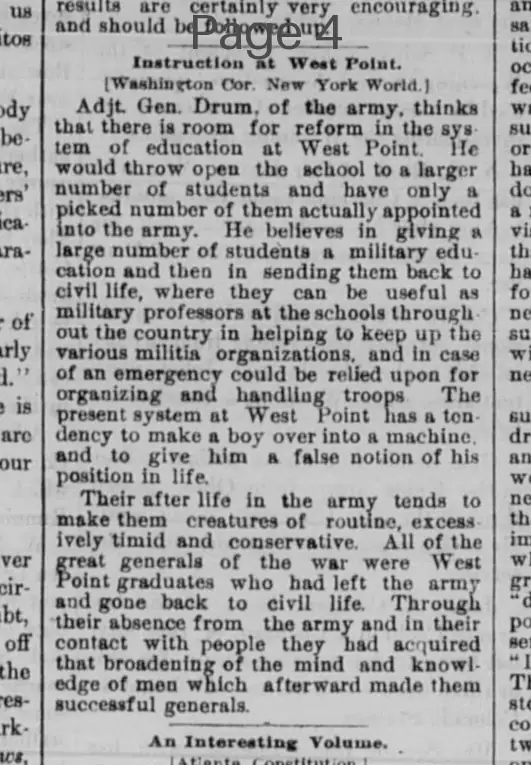
[Washington Cor. New York World.]
Adj. Gen. Drum of the army thinks
that there is room for reform in the sys-
tem of education at West Point. He
would throw open the school to a larger
number of students and have only a
picked number of them actually appointed
into the army. He believes in giving a
large number of students a military edu-
cation and then in sending them back to
civil life, where they can be useful as
military professors at the schools through-
out the country in helping to keep up the
various militia organizations, and in case
of an emergency could be relied upon for
organizing and handling troops. The
present system at West Point has a ten-
dency to make a boy over into a machine
and to give him a false notion of his
position in life.
Their after life in the army tends to
make them creatures of routine, excess-
ively timid and conservative. All of the
great generals of the war were West
Point graduates who had left the army
and gone back to civil life. Through
their absence from the army and in their
contact with people they had acquired
that broadening of the mind and knowl-
edge of men which afterward made them
successful generals.
What sub-type of article is it?
What keywords are associated?
What entities or persons were involved?
Where did it happen?
Story Details
Key Persons
Location
West Point
Story Details
Adj. Gen. Drum proposes expanding West Point to more students, appointing only select few to the army, and sending others to civil life to teach military education in schools and support militias. He criticizes the current system for producing rigid, timid officers and notes that successful Civil War generals were West Point graduates who gained broader experience in civilian life.