Thank you for visiting SNEWPapers!
Sign up free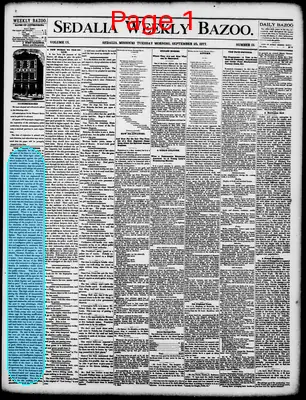
Editorial
September 25, 1877
The Sedalia Weekly Bazoo
Sedalia, Pettis County, Missouri
What is this article about?
An editorial defends the St. Louis public school system against opposition from German Infidels seeking to abolish high schools, limit education to basics, and exclude religious texts, arguing that such changes would harm intellectual and moral development while emphasizing the benefits of accessible education for all.
Clipping

OCR Quality
98%
Excellent
Full Text
THE PUBLIC SCHOOLS.
It is impossible for the people in this part of the State to view with indifference the bitter fight which has been inaugurated against the public school system of St. Louis. It springs up under conditions so startling, and aims so momentous, that the people of the State may well indulge the gravest apprehensions for its safety. Nor does this assault come from a sectarian standpoint. It is not engineered by Catholics who have schools and universities of their own, and who have sought to divert a portion of the public revenues to their support. The opposition is masked in a more insidious guise. It comes from a class of people who believe that the public school system should be so arranged as to exclude anything from its course of study but the elementary principles of instruction. They want the high schools abolished and all the higher branches of polite education rigidly suppressed. When it is stated that this opposition has sprung from what is known as German Infidels, a class of population which numbers an immense percentage of the people of St. Louis, the character of the contest will be understood as involving the life of the public school system in the country.
They war against all sects and all religions. They have dreamed that in this vast empire of mixed populations, with new industries and institutions, and an intelligence quick in apprehension and aggressive in sentiment, that the field has been discovered for that most repulsive of all impassive metaphysics, German Socialism, to take root. They seek to limit the range of common school education, and then exclude by law the use of the Bible or any other sectarian or religious publication in institutions which derive their support in whole or in part from the public revenue.
This done, says the Infidel, "the young minds of the youth of America will be open for the reception of those rational views of life in which bigotry and superstition find no part." It may well be doubted if this would be a compensation for the loss of all which they propose to take away. The high schools are completing the education of innumerable youth. In many of the large towns they have taken the places of colleges and seminaries, and are enabling the poor to reap advantages which heretofore belonged exclusively to the rich. They are rearing in every State in the Union young men and women whose rage for learning would otherwise be repressed by the chill of penury; and are training intellects which will make their way in art or science, and lend luster to the world of letters, when those who would wither their opportunities are sleeping in unforgotten graves. No man in this country has ever yet felt the burden of the school tax. No one ever will. It grows as industry widens and wealth augments; a silent and invisible spirit of good, which, like an angel visitant, shakes blessings from its wings. It hovers over hovels, and the hut sings with joy—it enters the rude cabin of the laborer, and intelligence brightens in its pathway; it touches with its wand the sluggish senses and kindles upon the altars of the heart a thirst for Promethean fire. It breaks the chains of ignorance and throws wide its prison doors. Out of the darkness it calls the fettered mind and makes the wilderness of superstition bloom like the garden of knowledge. Can we barter all this for the soulless, mindless, churchless future of the Infidel?
It is impossible for the people in this part of the State to view with indifference the bitter fight which has been inaugurated against the public school system of St. Louis. It springs up under conditions so startling, and aims so momentous, that the people of the State may well indulge the gravest apprehensions for its safety. Nor does this assault come from a sectarian standpoint. It is not engineered by Catholics who have schools and universities of their own, and who have sought to divert a portion of the public revenues to their support. The opposition is masked in a more insidious guise. It comes from a class of people who believe that the public school system should be so arranged as to exclude anything from its course of study but the elementary principles of instruction. They want the high schools abolished and all the higher branches of polite education rigidly suppressed. When it is stated that this opposition has sprung from what is known as German Infidels, a class of population which numbers an immense percentage of the people of St. Louis, the character of the contest will be understood as involving the life of the public school system in the country.
They war against all sects and all religions. They have dreamed that in this vast empire of mixed populations, with new industries and institutions, and an intelligence quick in apprehension and aggressive in sentiment, that the field has been discovered for that most repulsive of all impassive metaphysics, German Socialism, to take root. They seek to limit the range of common school education, and then exclude by law the use of the Bible or any other sectarian or religious publication in institutions which derive their support in whole or in part from the public revenue.
This done, says the Infidel, "the young minds of the youth of America will be open for the reception of those rational views of life in which bigotry and superstition find no part." It may well be doubted if this would be a compensation for the loss of all which they propose to take away. The high schools are completing the education of innumerable youth. In many of the large towns they have taken the places of colleges and seminaries, and are enabling the poor to reap advantages which heretofore belonged exclusively to the rich. They are rearing in every State in the Union young men and women whose rage for learning would otherwise be repressed by the chill of penury; and are training intellects which will make their way in art or science, and lend luster to the world of letters, when those who would wither their opportunities are sleeping in unforgotten graves. No man in this country has ever yet felt the burden of the school tax. No one ever will. It grows as industry widens and wealth augments; a silent and invisible spirit of good, which, like an angel visitant, shakes blessings from its wings. It hovers over hovels, and the hut sings with joy—it enters the rude cabin of the laborer, and intelligence brightens in its pathway; it touches with its wand the sluggish senses and kindles upon the altars of the heart a thirst for Promethean fire. It breaks the chains of ignorance and throws wide its prison doors. Out of the darkness it calls the fettered mind and makes the wilderness of superstition bloom like the garden of knowledge. Can we barter all this for the soulless, mindless, churchless future of the Infidel?
What sub-type of article is it?
Education
Moral Or Religious
Social Reform
What keywords are associated?
Public Schools
St Louis Education
German Infidels
High Schools
Religious Exclusion
School Reform
What entities or persons were involved?
German Infidels
Public School System Of St. Louis
Catholics
Editorial Details
Primary Topic
Defense Of Public Schools Against German Infidel Opposition
Stance / Tone
Strongly Supportive Of Public Education And Religious Inclusion
Key Figures
German Infidels
Public School System Of St. Louis
Catholics
Key Arguments
Opposition From German Infidels Seeks To Abolish High Schools And Limit Education To Basics
Infidels Aim To Exclude Bible And Religious Publications From Public Schools
High Schools Provide Essential Education To The Poor, Replacing Colleges
Public School Taxes Are Not Burdensome And Promote Widespread Intelligence
Limiting Education Would Hinder Intellectual And Moral Progress In America