Thank you for visiting SNEWPapers!
Sign up free
Editorial
March 14, 1846
Weekly National Intelligencer
Washington, District Of Columbia
What is this article about?
Editorial criticizes Democratic Party's aggressive stance on Oregon dispute, advocating peace and compromise on the 49th parallel. Quotes New York Journal of Commerce on Senate debate, highlighting war hawks like Allen and Hannegan versus President Polk's potential moderation via Haywood's speech.
Clipping
OCR Quality
98%
Excellent
Full Text
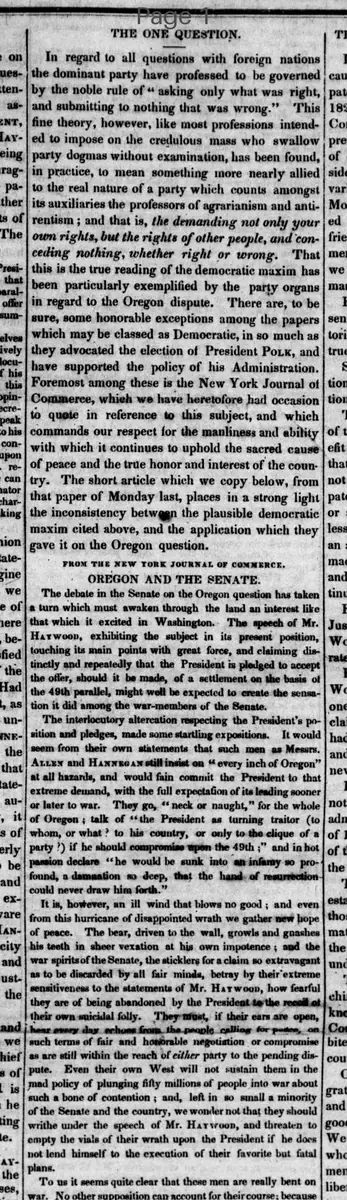
THE ONE QUESTION.
In regard to all questions with foreign nations the dominant party have professed to be governed by the noble rule of "asking only what was right, and submitting to nothing that was wrong." This fine theory, however, like most professions intended to impose on the credulous mass who swallow party dogmas without examination, has been found, in practice, to mean something more nearly allied to the real nature of a party which counts amongst its auxiliaries the professors of agrarianism and anti-rentism; and that is, the demanding not only your own rights, but the rights of other people, and conceding nothing, whether right or wrong. That this is the true reading of the democratic maxim has been particularly exemplified by the party organs in regard to the Oregon dispute. There are, to be sure, some honorable exceptions among the papers which may be classed as Democratic, in so much as they advocated the election of President Polk, and have supported the policy of his Administration. Foremost among these is the New York Journal of Commerce, which we have heretofore had occasion to quote in reference to this subject, and which commands our respect for the manliness and ability with which it continues to uphold the sacred cause of peace and the true honor and interest of the country. The short article which we copy below, from that paper of Monday last, places in a strong light the inconsistency between the plausible democratic maxim cited above, and the application which they gave it on the Oregon question.
FROM THE NEW YORK JOURNAL OF COMMERCE
OREGON AND THE SENATE.
The debate in the Senate on the Oregon question has taken a turn which must awaken through the land an interest like that which it excited in Washington. The speech of Mr. Haywood, exhibiting the subject in its present position, touching its main points with great force, and claiming distinctly and repeatedly that the President is pledged to accept the offer, should it be made, of a settlement on the basis of the 49th parallel, might well be expected to create the sensation it did among the war-members of the Senate.
The interlocutory altercation respecting the President's position and pledges, made some startling expositions. It would seem from their own statements that such men as Messrs. Allen and Hannegan still insist on "every inch of Oregon" at all hazards, and would fain commit the President to that extreme demand, with the full expectation of its leading sooner or later to war. They go, "neck or naught," for the whole of Oregon; talk of "the President as turning traitor (to whom, or what? to his country, or only to the clique of a party?) if he should compromise upon the 49th;" and in hot passion declare "he would be sunk into an enemy so profound, a damnation so deep, that the hand of resurrection could never draw him forth."
It is, however, an ill wind that blows no good; and even from this hurricane of disappointed wrath we gather new hope of peace. The bear, driven to the wall, growls and gnashes his teeth in sheer vexation at his own impotence; and the war spirits of the Senate, the sticklers for a claim so extravagant as to be discarded by all fair minds, betray by their extreme sensitiveness to the statements of Mr. Haywood, how fearful they are of being abandoned by the President to the record of their own suicidal folly. They must, if their ears are open, hear every day echoes from the people calling for peace, on such terms of fair and honorable negotiation or compromise as are still within the reach of either party to the pending dispute. Even their own West will not sustain them in the mad policy of plunging fifty millions of people into war about such a bone of contention; and, left in so small a minority of the Senate and the country, we wonder not that they should writhe under the speech of Mr. Haywood, and threaten to empty the vials of their wrath upon the President if he does not lend himself to the execution of their favorite but fatal plans.
To us it seems quite clear that these men are really bent on war. No other supposition can account for their course; because they must know that England will never yield to the exorbitant claim which they make. On looking again over the map of Oregon, drawn by the late Exploring Expedition, we have just counted nearly a dozen English forts in the country north of 49, and about half as many in the regions drained by the Columbia river. If we take the number of places thus occupied as the basis of comparison, we shall find the British claim, on the score of actual possession, much better than ours; and it would seem from this very map of our own, that a compromise on the 49th parallel would oblige England to yield far more than we should, and give us decidedly the best bargain. Indeed, we should give up nothing that is now in our possession, while she would relinquish a considerable number of places which she has occupied for a long time. No man, looking at this map, and seeing how extensively England has dotted it over with her forts, can for a moment suppose she will ever yield the whole territory to a claimant occupying not a quarter so many places as she does, and none at all between 49 and 54 40, of which tract she has had actual possession for some forty years. We wonder at the strange demands of these men; and we feel a thrill of honest pride as co-patriots, when we hear Mr. Haywood boldly avowing, in the name of our Government and our country, that "we would not demand the whole of Oregon, even if we could obtain it without a war." That was a noble avowal; the world will admire it; all fair-minded men through the land will cordially respond to it; and if such a spirit were carried into renewed negotiations, we should confidently anticipate a speedy adjustment to the substantial satisfaction of both parties.
We think it clear that the question of peace or war now rests with ourselves. England has evinced a spirit decidedly pacific; but our rulers and people must take care not to calculate too much on her continued forbearance. The war passion, once roused there in earnest, would render a collision inevitable; and, should popular sentiment here second the demand of the war-men in our Senate for all Oregon, at all hazards, then war must come. Here is the alternative; and it is time for the nation to look it full in the face; and, as they wish for peace, to rebuke the spirit and policy which would provoke war.
In regard to all questions with foreign nations the dominant party have professed to be governed by the noble rule of "asking only what was right, and submitting to nothing that was wrong." This fine theory, however, like most professions intended to impose on the credulous mass who swallow party dogmas without examination, has been found, in practice, to mean something more nearly allied to the real nature of a party which counts amongst its auxiliaries the professors of agrarianism and anti-rentism; and that is, the demanding not only your own rights, but the rights of other people, and conceding nothing, whether right or wrong. That this is the true reading of the democratic maxim has been particularly exemplified by the party organs in regard to the Oregon dispute. There are, to be sure, some honorable exceptions among the papers which may be classed as Democratic, in so much as they advocated the election of President Polk, and have supported the policy of his Administration. Foremost among these is the New York Journal of Commerce, which we have heretofore had occasion to quote in reference to this subject, and which commands our respect for the manliness and ability with which it continues to uphold the sacred cause of peace and the true honor and interest of the country. The short article which we copy below, from that paper of Monday last, places in a strong light the inconsistency between the plausible democratic maxim cited above, and the application which they gave it on the Oregon question.
FROM THE NEW YORK JOURNAL OF COMMERCE
OREGON AND THE SENATE.
The debate in the Senate on the Oregon question has taken a turn which must awaken through the land an interest like that which it excited in Washington. The speech of Mr. Haywood, exhibiting the subject in its present position, touching its main points with great force, and claiming distinctly and repeatedly that the President is pledged to accept the offer, should it be made, of a settlement on the basis of the 49th parallel, might well be expected to create the sensation it did among the war-members of the Senate.
The interlocutory altercation respecting the President's position and pledges, made some startling expositions. It would seem from their own statements that such men as Messrs. Allen and Hannegan still insist on "every inch of Oregon" at all hazards, and would fain commit the President to that extreme demand, with the full expectation of its leading sooner or later to war. They go, "neck or naught," for the whole of Oregon; talk of "the President as turning traitor (to whom, or what? to his country, or only to the clique of a party?) if he should compromise upon the 49th;" and in hot passion declare "he would be sunk into an enemy so profound, a damnation so deep, that the hand of resurrection could never draw him forth."
It is, however, an ill wind that blows no good; and even from this hurricane of disappointed wrath we gather new hope of peace. The bear, driven to the wall, growls and gnashes his teeth in sheer vexation at his own impotence; and the war spirits of the Senate, the sticklers for a claim so extravagant as to be discarded by all fair minds, betray by their extreme sensitiveness to the statements of Mr. Haywood, how fearful they are of being abandoned by the President to the record of their own suicidal folly. They must, if their ears are open, hear every day echoes from the people calling for peace, on such terms of fair and honorable negotiation or compromise as are still within the reach of either party to the pending dispute. Even their own West will not sustain them in the mad policy of plunging fifty millions of people into war about such a bone of contention; and, left in so small a minority of the Senate and the country, we wonder not that they should writhe under the speech of Mr. Haywood, and threaten to empty the vials of their wrath upon the President if he does not lend himself to the execution of their favorite but fatal plans.
To us it seems quite clear that these men are really bent on war. No other supposition can account for their course; because they must know that England will never yield to the exorbitant claim which they make. On looking again over the map of Oregon, drawn by the late Exploring Expedition, we have just counted nearly a dozen English forts in the country north of 49, and about half as many in the regions drained by the Columbia river. If we take the number of places thus occupied as the basis of comparison, we shall find the British claim, on the score of actual possession, much better than ours; and it would seem from this very map of our own, that a compromise on the 49th parallel would oblige England to yield far more than we should, and give us decidedly the best bargain. Indeed, we should give up nothing that is now in our possession, while she would relinquish a considerable number of places which she has occupied for a long time. No man, looking at this map, and seeing how extensively England has dotted it over with her forts, can for a moment suppose she will ever yield the whole territory to a claimant occupying not a quarter so many places as she does, and none at all between 49 and 54 40, of which tract she has had actual possession for some forty years. We wonder at the strange demands of these men; and we feel a thrill of honest pride as co-patriots, when we hear Mr. Haywood boldly avowing, in the name of our Government and our country, that "we would not demand the whole of Oregon, even if we could obtain it without a war." That was a noble avowal; the world will admire it; all fair-minded men through the land will cordially respond to it; and if such a spirit were carried into renewed negotiations, we should confidently anticipate a speedy adjustment to the substantial satisfaction of both parties.
We think it clear that the question of peace or war now rests with ourselves. England has evinced a spirit decidedly pacific; but our rulers and people must take care not to calculate too much on her continued forbearance. The war passion, once roused there in earnest, would render a collision inevitable; and, should popular sentiment here second the demand of the war-men in our Senate for all Oregon, at all hazards, then war must come. Here is the alternative; and it is time for the nation to look it full in the face; and, as they wish for peace, to rebuke the spirit and policy which would provoke war.
What sub-type of article is it?
Foreign Affairs
War Or Peace
Partisan Politics
What keywords are associated?
Oregon Dispute
49th Parallel
Peace Negotiations
Democratic Party
Senate Debate
War Hawks
British Forts
What entities or persons were involved?
Democratic Party
President Polk
Mr. Haywood
Messrs. Allen And Hannegan
New York Journal Of Commerce
England
Senate War Members
Editorial Details
Primary Topic
Oregon Boundary Dispute And Peace Compromise
Stance / Tone
Pro Peace And Anti War Hawk
Key Figures
Democratic Party
President Polk
Mr. Haywood
Messrs. Allen And Hannegan
New York Journal Of Commerce
England
Senate War Members
Key Arguments
Democratic Maxim Of Right Is Inconsistent With Demanding Others' Rights In Oregon
President Pledged To Accept 49th Parallel Settlement
War Hawks Insist On All Oregon, Risking War
British Possession Of Forts North Of 49th Makes Full Claim Unrealistic
Compromise On 49th Gives Us Better Bargain
Haywood Avows Us Would Not Demand Whole Oregon Even Without War
Question Of Peace Or War Rests With Us, Not England