Thank you for visiting SNEWPapers!
Sign up free
Vermont Watchman And State Journal
Montpelier, Washington County, Vermont
What is this article about?
William Henry Harrison delivers a speech at Fort Meigs, reflecting on his military service under Gen. Wayne, the War of 1812, injustices to veterans, his anti-federalist principles, and calls for vigilance against executive overreach in the 1840 presidential campaign.
Merged-components note: Direct continuation of General Harrison's speech across pages, forming a single coherent narrative.
Clippings
1 of 2
OCR Quality
Full Text
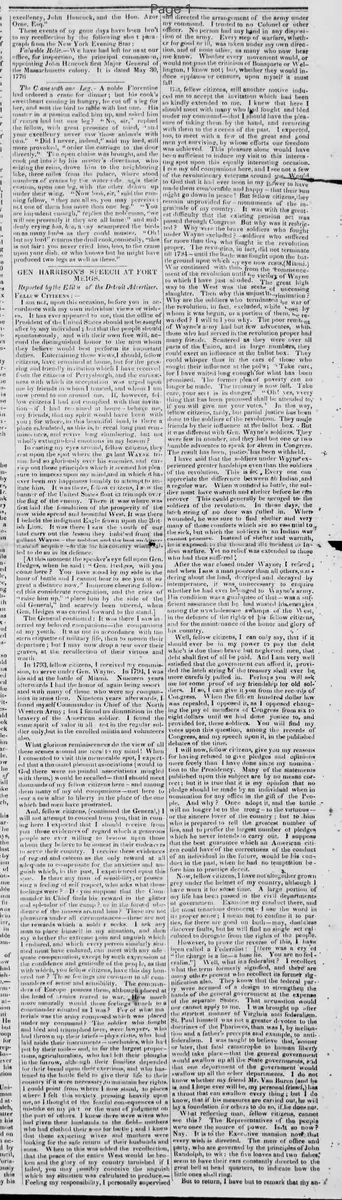
Reported by the Ed. of the Detroit Advertiser.
Fellow Citizens:—
I am not, upon this occasion, before you in accordance with my own individual views or wishes. It has ever appeared to me, that the office of President of the United States should not be sought after by any individual; but that the people should spontaneously, and with their own free will, accord the distinguished honor to the man whom they believe would best perform its important duties. Entertaining these views, I should, fellow citizens, have remained at home, but for the pressing and friendly invitation which I have received from the citizens of Perrysburgh, and the earnestness with which its acceptation was urged upon me by friends in whom I trusted, and whom I am now proud to see around me. If, however, fellow citizens I had not complied with that invitation—if I had remained at home—believe me, my friends, that my spirit would have been with you: for where, in this beautiful land, is there a place calculated, as this is, to recal long past reminiscences, and revive long slumbering, but not wholly extinguished emotions in my bosom
In casting my eyes around, fellow citizens, they rest upon the spot where the gallant Wayne triumphed so gloriously over his enemies, and carried out those principles which it seemed his pleasure to impress upon my mind, and in which it has ever been my happiness humbly to attempt to imitate him. It was there. fellow citizens, I saw the banner of the United States float in triumph over the flag of the enemy. There it was where was first laid the foundation of the prosperity of the no wide spread and beautiful West. It was there I beheld the indignant Eagle frown upon the British Lion. It was there I saw the youth of our land carry out the lesson they imbibed from the gallant Wayne—the noblest and the best an American could acquire—to be true to his country when called to do so in its defence.
[At this moment the speaker's eye fell upon Gen. Hedges, when he said: " Gen. Hedges, will you come here? You have stood by my side in the hour of battle and I cannot bear to see you at so great a distance now." Immense cheering followed this considerate recognition, and the cries of "raise him up," "place him by the side of the old General," had scarcely been uttered, when Gen. Hedges was carried forward to the stand.]
The General continued: It was there I saw interred my beloved companions—the companions of my youth. It was not in accordance with the stern etiquette of military life, then to mourn their departure; but I may now drop a tear over their graves, at the recollection of their virtues and worth
In 1793, fellow citizens, I received my commission, to serve under Gen. Wayne. In 1794, I was his aid at the battle of Miami. Nineteen years afterwards I had the honor of again being associated with many of those who were my companions in arms then. Nineteen years afterwards, I found myself Commander-in Chief of the North Western Army; but I found no diminution in the bravery of the American soldier. I found the same spirit of valor in all not in the regular soldier only, but in the enrolled militia and volunteers also.
What glorious reminiscences do the view of all these scenes around me recal to my mind! When I consented to visit this memorable spot, I expected that a thousand pleasant associations (would to God there were no painful associations mingled with them.) would be recalled—that I should meet thousands of my fellow citizens here—and among them many of my old companions—meet here to rear a new altar to liberty in the place of the one which bad men have prostrated.
And, fellow citizens, (continued the General,) I will not attempt to conceal from you, that in coming here I expected that I should receive from you those evidences of regard which a generous people are ever willing to bestow upon those whom they believe to be honest in their endeavors to serve their country. I receive these evidences of regard and esteem as the only reward at all adequate to compensate for the anxieties and anguish which, in the past, I experienced upon this spot. Is there any man of sensibility, or possessing a feeling of self respect, who asks what those feelings were? Do you suppose that the Commander in Chief finds his reward in the glitter and splendor of the camp? or in the forced obedience of the masses around him? These are no pleasures under all circumstances—these are not the rewards which a soldier seeks. I ask any man to place himself in my situation, and then say whether the extreme pain and anguish which I endured, and which every person similarly situated must have endured, can meet with any adequate compensation, except by such expression of the confidence and gratitude of the people, as that with which, you fellow citizens, have this day honored me? These feelings are common to all commanders of sense and sensibility. The commanders of Europe—possess them, although placed at the head of armies reared to war. How much more naturally would those feelings attach to a commander situated as I was? For of what materials was the army composed which was placed under my command? The soldier who fought and bled and triumphed here, were lawyers. who had thrown up their briefs—physicians, who had laid aside their instruments—mechanics, who had put by their tools— and, in far the largest proportions, agriculturalists, who had left their ploughs in the furrow, although their families depended for their bread upon their exertions, and who hastened to the battle field to give their life to their country if it were necessary, to maintain her rights.
I could point from where I now stand, to places where I felt this anxiety pressing heavily upon me, as I thought of the fearful consequences of a mistake on my part. or the want of judgment on the part of others. I knew there were wives who had given their husbands to the field—mothers who had clothed their sons for battle; and I knew that these expecting wives and mothers were looking for the safe return of their husbands and SONS.
When to this was added the recollection, that the peace of the entire West would be broken and the glory of my country tarnished if I failed, you may possibly conceive the anguish which my situation was calculated to produce.—Feeling my responsibility, I personally supervised and directed the arrangement of the army under my command. I trusted to no Colonel or other officer. No person had any hand in any disposition of the army. Every step of warfare, whether for good or ill, was taken under my own direction, and of none other, as many who now hear me know. Whether every movement would, or would not pass the criticism of Bonaparte or Wellington, I know not; but, whether they would induce applause or censure, upon myself it must fall
But, fellow citizens, still another motive induced me to accept the invitation which had been so kindly extended to me. I knew that here I should meet with many who had fought and bled under my command—that I should have the pleasure of taking them by the hand, and recurring with them to the scenes of the past. I expected, too, to meet with a few of the great and good men yet surviving, by whose efforts our freedom was achieved. This pleasure alone would have been sufficient to induce my visit to this interesting spot upon this equally interesting occasion.
I see my old companions here, and I see not a few of the revolutionary veterans around me. Would to God that it had ever been in my power to have made them comfortable and happy—that their sun might go down in peace! But fellow citizens, they remain unprovided for—monuments of the ingratitude of my country. It was with the greatest difficulty that the existing pension act was passed through Congress But why was it restricted? Why were the brave soldiers who fought under Wayne excluded?—soldiers who suffered far more than they who fought in the revolution proper. The revolution, in fact, did not terminate till 1794—until the battle was fought upon the battle ground upon which my eye now rests, (Miami.) War continued with them from the commencement of the revolution until the victory of Wayne way to the West was the scene of unceasing slaughter. Then why this unjust discrimination? Why are the soldiers who terminated the war of the revolution, in fact, excluded, while those by whom was begun or portion of warded? I will tell you why. The poor remnant of Wayne's army had but few advocates, while those who had served in the revolution proper had many friends. Scattered as they were over all parts of the Union, and in large numbers, they could exert an influence at the ballot box. They could whisper thus in the ears of those who sought their influence at the polls; " Take care, for I have waited long enough for what has been promised. The former plea of poverty can no longer be made. The treasury is now full. Take care, your seat is in danger." "Oh! yes, every thing that has been promised shall be attended to, if you will give me your votes.' In this way, fellow citizens, tardy, but partial justice has been done to the soldiers of the revolution. They made friends by their influence at the ballot box. But it was different with Gen. Wayne's soldiers. They were few in number, and they had but one or two humble advocates to speak for them in Congress. The result has been, justice has been withheld.
I have said that the soldiers under Wayne experienced greater hardships even than the soldiers of the revolution. This is so. Every one can appreciate the difference between an Indian and a regular war. When wounded in battle, the soldier must have warmth and shelter before he can recover This could generally be secured to the soldiers of the revolution. In those days, the latch string of no door was pulled in. When wounded, he was sure to find shelter and very many of those comforts which are so essential to the sick, but which the soldiers in an Indian war cannot procure. Instead of shelter and warmth, he is exposed to the thousand ills incident to Indian warfare. Yet no relief was extended to those who had thus suffered!
After the war closed under Wayne, I retired: and when I saw a man poorer than all others, wandering about the land, decrepit and decayed by intemperance, it was unnecessary to enquire whether he had ever belonged to Wayne's army. His condition was a guarantee of that—was a sufficient assurance that he had wasted his energies among the unwholesome swamps of the West, in the defence of the rights of his fellow citizens, and for the maintenance of the honor and glory of his country.
Well, fellow citizens, I can only say, that if it should ever be in my power to pay the debt which is due these brave but neglected men, that debt shall first of all be paid. And I am very well satisfied that the government can afford it, provided the latch string of the treasury shall ever be more carefully pulled in. Perhaps you will ask me for some proof of my friendship for old soldiers. If so, I can give it you from the records of Congress. When the fifteen hundred dollar law was repealed, I opposed it, as I opposed increasing the pay of members of Congress from six to eight dollars until we had done justice to, and provided for, these soldiers. You will find my votes upon this question, among the records of Congress, and my speech upon it, in the published debates of the time.
I will now, fellow citizens, give you my reasons for having refused to give pledges and opinions more freely than I have done since my nomination to the Presidency. Many of the statements published upon this subject are by no means correct; but it is true that it is my opinion that no pledge should be made by an individual when in nomination for any office in the gift of the People. And why? Once adopt it, and the battle will no longer be to the strong—to the virtuous—or the sincere lover of the country; but to him who is prepared to tell the greatest number of lies, and to proffer the largest number of pledges which he never intends to carry out. Suppose that the best guarantee which an American citizen could have of the correctness of the conduct of an individual in the future, would be his conduct in the past, when he had no temptation before him to practice deceit.
Now, fellow citizens, I have not altogether grown grey under the helmet of my country, although I have worn it for some time. A large portion of my life has been passed in the civil departments of government Examine my conduct there, and the most tenacious democrat—I use the word in its proper sense; I mean not to confine it to parties, for there are good on both—may, doubtless discover faults, but he will find no single act calculated to derogate from the rights of the people. However, to prove the reverse of this, I have been called a Federalist! [here was a cry 'of the charge is a lie—a base lie. You are no federalist."] Well, what is a federalist? I recollect what the term formerly signified, and there are many others present who recollect its former signification also. They know that the federal party were accused of wishing to place too much power in the hands of the general government at the expense of the separate States. That accusation would nor cannot apply to me. I was brought up after the strictest manner of Virginia anti federalism. St. Paul himself was not a greater devotee to the doctrines of the Pharisees, than was I, by injunction and a father's precepts and example, to anti-federalism. I was taught to believe that, sooner or later that fatal catastrophe to human liberty would take place—that the general government would swallow up all the State governments, and that one department of the government would swallow up all the other departments. I do not know whether my friend Mr. Van Buren (and he is_ and I hope ever will be, my personal friend,) has a throat that can swallow every thing; but I do know, that if his measures are carried out, he will lay a foundation for others to do so, if he does not.
What reflecting man, fellow citizens, cannot see this? The Representatives of the people were once the source of power. Is it so now? Nay. It is to the Executive mansion now that every wish is directed. 'The men of office and party, who are governed by the principles of John Randolph, to wit: the five loaves and two fishes, seem to have their ears constantly directed to the great bell at head quarters, to indicate how the little ones shall ring.
But to return, I have but to remark that my anti-federal principles have undergone no change.
Anti-federalism has been tempered by my long service in the employ of that country—and my frequent oaths to support the general government; but I am as ready to resist the encroachments on State rights, as I am to support the legitimate authority of the Executive, or general government.
Now, fellow citizens, I have very little more to say, except to exhort you to go on, peacefully if you can—and you can—to effect that reform upon which your hearts are fixed. What calamitous consequences will ensue to the world if you fail! If you should fail, how the tyrants of Europe will rejoice. If you fail, how will the friends of freedom, scattered, like the few planets of heaven, over the world, mourn, when they see the beacon light of liberty extinguished—the light whose rays they had hoped would yet penetrate the whole benighted world. If you triumph, it will only be done by vigilance and attention. Our personal friends, but political enemies, remind each other that "Eternal vigilance is the price of liberty." While journeying thitherward, I observed this motto waving at the head of a procession composed of the friends of the present administration. From this I inferred, that discrimination was necessary in order to know who to watch.
Under Jefferson, Madison and Monroe, the eye of the People was turned to the right source—to the administration. The administration, however, now say to the People, "You must not watch us but you must watch the Whigs! Only do that, and all is safe!" But that, my friends, is not the way. The old fashioned republican rule is to watch the government. See to the government. See that the government does not acquire too much power. Keep a check upon your rulers. Do this, and liberty is safe. And if your efforts should result successfully, and I should be placed in the Presidential chair, I shall invite a recurrence to the old republican rule, to watch the administration, and to see that it keeps within the bounds of the Constitution and the laws of the land. The Executive of this Union has immense power to do mischief, if he sees fit to exercise that power. He may prostrate the country. Indeed, this country has been already prostrated. It has already fallen from pure republicanism, to a monarchy in spirit if not in name.
A celebrated author defines monarchy to be that form of government in which the Executive has at once the command of the army, the execution of the laws and the control of the purse. Now, how is it with our present Executive? The Constitution gives to him the control of the army, and the execution of the laws. He now only awaits the possession of the purse to make him a Monarch. Not a Monarch simply, with the power of England, but a Monarch with powers of the Autocrat of Russia. For Gibbon says that an individual possessed of these powers "will, unless closely watched, make himself a despot."
The passage of the Sub-Treasury bill will give to the President an accumulation of power that the Constitution withholds from him: power that would constitute him a Monarch. This catastrophe to freedom should be, and can be prevented, by vigilance, union and perseverance.
["We will do it," resounded from twenty thousand voices, "we will do it!"]
In conclusion, then, fellow-citizens, I would impress it upon all—Democrats and Whigs—to give up the idea of watching each other, and direct your eye to the Government. Do that, and your children and your children's children, to the latest posterity, will be as happy and as free as you and your fathers have been.
[At the close of this speech, the vast multitude gave "three times three," with a unanimity and heartiness which spoke eloquently the unanimity of their sentiments as to the force, truth and beauty of the speech, and the worth, merit and virtue of the speaker.]
What sub-type of article is it?
What themes does it cover?
What keywords are associated?
What entities or persons were involved?
Where did it happen?
Story Details
Key Persons
Location
Fort Meigs
Story Details
Gen. Harrison reflects on his military career under Wayne in 1793-1794 and command in 1813, laments injustices to Wayne's veterans, defends his anti-federalist views, criticizes executive overreach under Van Buren, and urges vigilance for liberty in his presidential bid.