Thank you for visiting SNEWPapers!
Sign up free
Alexandria Daily Advertiser
Alexandria, Virginia
What is this article about?
English naval squadron arrives near Constantinople on February 20, prompting defensive preparations aided by French ambassador General Sebastiani; negotiations fail, and the fleet retreats after Turkish fortifications strengthen, repelling aggression at the Dardanelles.
Merged-components note: These two components form a single continuous foreign news article translating Paris papers on the English expedition to Constantinople and related events in Turkey.
Clipping
OCR Quality
Full Text
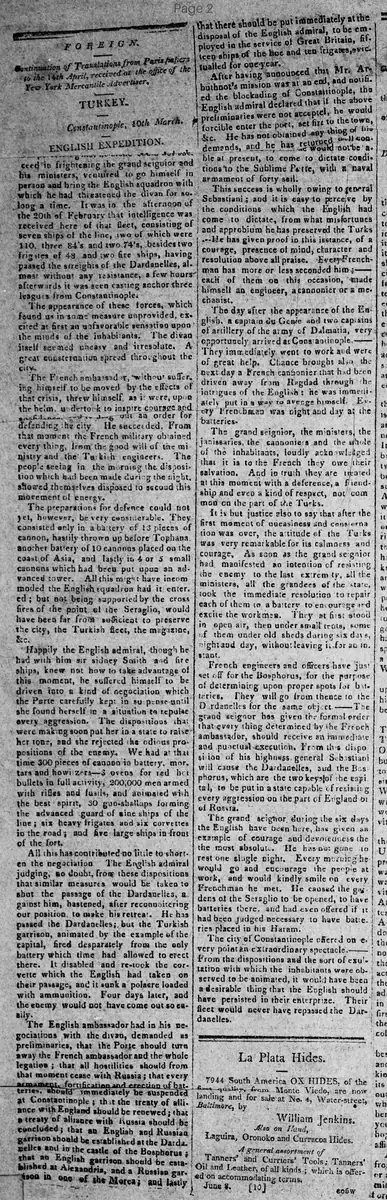
Continuation of Translations from Paris papers to the 14th April, received at the office of the New York Mercantile Advertiser.
TURKEY.
Constantinople, 10th March.
ENGLISH EXPEDITION
Mavrocordato.
succeeded in frightening the grand seignior and his ministers, ventured to go himself in person and bring the English squadron with which he had threatened the divan for so long a time. It was in the afternoon of the 20th of February that intelligence was received here of that fleet, consisting of seven ships of the line, two of which were 110, three 84's and two 74's, besides two frigates of 48 and two fire-ships, having passed the straits of the Dardanelles, almost without any resistance, a few hours afterwards it was seen casting anchor three leagues from Constantinople:
The appearance of these forces, which found us in some measure unprovided, excited at first an unfavorable sensation upon the minds of the inhabitants. The divan itself seemed uneasy and irresolute. A great consternation spread throughout the City.
The French ambassador, without suffering himself to be moved by the effects of that crisis, threw himself, as it were, upon the helm, undertook to inspire courage and confidence to the Turks out an order for defending the city. He succeeded. From that moment the French military obtained everything, from the good will of the ministry and the Turkish engineers. The people seeing in the morning the disposition which had been made during the night, showed themselves disposed to second this movement of energy.
The preparations for defence could not yet, however, be very considerable. They consisted only in a battery of 13 pieces of cannon, hastily thrown up before Tophana, another battery of 10 cannons placed on the coast of Asia, and lastly in 4 or 5 small cannons which had been put upon an advanced tower. All this might have incommoded the English squadron had it entered; but not being supported by the cross fires of the point of the Seraglia, would have been far from sufficient to preserve the city, the Turkish fleet, the magazine, &c.
Happily the English admiral, though he had with him sir Sidney Smith and fire ships, knew not how to take advantage of this moment, he suffered himself to be driven into a kind of negotiation which the Porte carefully kept in suspense until she found herself in a situation to repulse every aggression. The dispositions that were making soon put her in a state to raise her tone, and she rejected the odious propositions of the enemy. We had at that time 300 pieces of cannon in battery, mortars and howitzers as ovens for red hot bullets in full activity, 200,000 men armed with rifles and fusils, and animated with the best spirit, 30 gun-shallops forming the advanced guard of nine ships of the line; six heavy frigates and six corvettes in the road; and five large ships in front of the fort.
All this has contributed not a little to shorten the negotiation. The English admiral judging, no doubt, from these dispositions that similar measures would be taken to shut the passage of the Dardanelles against him, hastened, after reconnoitering our position, to make his retreat. He has passed the Dardanelles; but the Turkish garrison, animated by the example of the capital, fired desperately from the only battery which time had allowed to erect there. It disabled and re-took the corvette which the English had taken on their passage, and it sunk a polacre loaded with ammunition. Four days later, and the enemy would not have come out so easily.
The English ambassador had in his negotiations with the divan, demanded as preliminaries, that the Porte should turn away the French ambassador and the whole legation; that all hostilities should from that moment cease with Russia; that every armament, fortification and erection of batteries, should immediately be suspended at Constantinople; that the treaty of alliance with England should be renewed; that no treaty of alliance with Russia should be concluded; that an English and Russian garrison should be established at the Dardanelles and in the castle of the Bosphorus; that an English garrison should be established at Alexandria, and a Russian garrison in one of the Morea; and lastly
that there should be put immediately at the disposal of the English admiral, to be employed in the service of Great Britain, fifteen ships of the line and ten frigates, victualled for one year.
After having announced that Mr. Arbuthnot's mission was at an end, and notified the preliminaries were not accepted, he would forcible enter the port, set fire to the town, &c. He has not obtained anything of this demands, and he has returned g-l/ son.
It would not be able at present, to come to dictate conditions to the Sublime Porte, with a naval armament of forty sail.
This success is wholly owing to general Sebastiani; and it is easy to perceive by the conditions which the English had come to dictate from what misfortunes and approbrium he has preserved the Turks.
He has given proof in this instance, of a courage, presence of mind, character and resolution above all praise. Every Frenchman has more or less seconded him; each of them on this occasion, made himself an engineer, a cannoneer or a mechanist.
The day after the appearance of the English, a captain du Genie and two captains of artillery of the army of Dalmatia, very opportunely arrived at Constantinople. They immediately went to work and were of great help. Chance brought also the next day a French cannoneer that had been driven away from Bagdad through the intrigues of the English: he was immediately put in a way to avenge himself. Every Frenchman was night and day at the batteries.
The grand seignior, the ministers, the janissaries, the cannoneers and the whole of the inhabitants, loudly acknowledged that it is to the French they owe their salvation. And in truth they are treated at this moment with a deference, a friendship and even a kind of respect, not common on the part of the Turks.
It is but justice also to say that after the first moment of uneasiness and consternation was over, the attitude of the Turks was very remarkable for its calmness and courage. As soon as the grand seignior had manifested an intention of resisting the enemy to the last extremity, all the ministers, all the grandees of the state, took the immediate resolution to repair each of them to a battery to encourage and excite the workmen. They at first stood in open air, then under small tents, some of them under old sheds during six days, night and day, without leaving it for an instant.
French engineers and officers have just set off for the Bosphorus, for the purpose of determining upon proper spots for batteries. They will go from thence to the Dardanelles for the same object. The grand seignior has given the formal order that everything determined by the French ambassador, should receive an immediate and punctual execution. From this disposition of his highness, general Sebastiani will cause the Dardanelles, and the Bosphorus, which are the two keys of the capital, to be put in a state capable of resisting every aggression on the part of England or of Russia.
The grand seignior during the six days the English have been here, has given an example of courage and devotedness the most absolute. He has not gone to rest one single night. Every morning he would go and encourage the people at work, and would kindly smile on every Frenchman he met. He caused the gardens of the Seraglio to be opened, to have batteries there, and had even offered if it had been judged necessary to have batteries placed in his Harem.
The city of Constantinople offered on every point an extraordinary spectacle. From the dispositions and the sort of exultation with which the inhabitants were observed to be animated, it would have been a desirable thing that the English should have persisted in their enterprize. Their fleet would never have repassed the Dardanelles.
What sub-type of article is it?
What keywords are associated?
What entities or persons were involved?
Where did it happen?
Foreign News Details
Primary Location
Constantinople
Event Date
20th Of February To 10th March
Key Persons
Outcome
english fleet retreats without achieving demands; turkish forces re-take corvette and sink polacre loaded with ammunition; no major casualties reported; porte rejects english propositions and strengthens defenses with french aid.
Event Details
English squadron of seven ships of the line, frigates, and fire-ships passes Dardanelles on February 20 and anchors near Constantinople, causing initial consternation. French ambassador General Sebastiani inspires Turkish defenses, including batteries and 200,000 armed men. Negotiations ensue with English demands for expulsion of French, cessation of hostilities with Russia, garrisons, and Turkish ships; Porte rejects them. English admiral retreats after reconnaissance; Dardanelles battery disables English corvette and sinks ammunition polacre. Turks acknowledge French role in averting disaster; ongoing fortifications at Bosphorus and Dardanelles planned.