Thank you for visiting SNEWPapers!
Sign up free
Story
June 13, 1920
Bisbee Daily Review
Bisbee, Cochise County, Arizona
What is this article about?
Instructional article on troubleshooting self-starter failures in early automobiles, detailing common electrical and mechanical issues like wiring problems, battery discharge, and generator faults, with diagnostic steps using a voltmeter.
Clipping
OCR Quality
98%
Excellent
Full Text
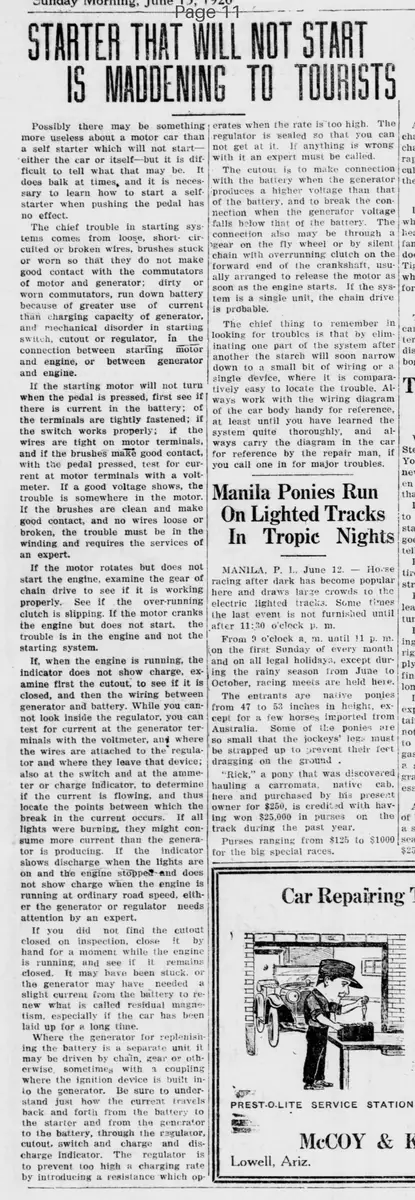
STARTER THAT WILL NOT START
MADDENING TO IT TOURISTS
Possibly there may be something more useless about a motor car than a self starter which will not start—either the car or itself—but it is difficult to tell what that may be. It does balk at times, and it is necessary to learn how to start a self-starter when pushing the pedal has no effect.
The chief trouble in starting systems comes from loose, short-circuited or broken wires, brushes stuck or worn so that they do not make good contact with the commutators of motor and generator; dirty or worn commutators, run down battery because of greater use of current than charging capacity of generator, and mechanical disorder in starting switch, cutout or regulator, in the connection between starting motor and engine, or between generator and engine.
If the starting motor will not turn when the pedal is pressed, first see if there is current in the battery; if the terminals are tightly fastened; if the switch works properly; if the wires are tight on motor terminals, and if the brushes make good contact. With the pedal pressed, test for current at motor terminals with a voltmeter. If a good voltage shows, the trouble is somewhere in the motor.
If the brushes are clean and make good contact, and no wires loose or broken, the trouble must be in the winding and requires the services of an expert.
If the motor rotates but does not start the engine, examine the gear of chain drive to see if it is working properly. See if the over-running clutch is slipping. If the motor cranks the engine but does not start, the trouble is in the engine and not the starting system.
If, when the engine is running, the indicator does not show charge, examine first the cutout, to see if it is closed, and then the wiring between generator and battery. While you cannot look inside the regulator, you can test for current at the generator terminals with the voltmeter, and where the wires are attached to the regulator and where they leave that device; also at the switch and at the ammeter or charge indicator, to determine if the current is flowing, and thus locate the points between which the break in the current occurs. If all lights were burning, they might consume more current than the generator is producing.
If the indicator shows discharge when the lights are on and the engine stopped—and does not show charge when the engine is running at ordinary road speed, either the generator or regulator needs attention by an expert.
If you did not find the cutout closed on inspection, close it by hand for a moment while the engine is running, and see if it remains closed. It may have been stuck, or the generator may have needed a slight current from the battery to renew what is called residual magnetism, especially if the car has been laid up for a long time.
Where the generator for replenishing the battery is a separate unit it may be driven by chain, gear or otherwise, sometimes with a coupling where the ignition device is built into the generator. Be sure to understand just how the current travels back and forth from the battery to the starter and from the generator to the battery, through the regulator, cutout, switch and charge and discharge indicator. The regulator is to prevent too high a charging rate by introducing a resistance which operates when the rate is too high. The regulator is sealed so that you cannot get at it. If anything is wrong with it an expert must be called.
The cutout is to make connection with the battery when the generator produces a higher voltage than that of the battery, and to break the connection when the generator voltage falls below that of the battery. The connection also may be through a gear on the fly wheel or by silent chain with overrunning clutch on the forward end of the crankshaft, usually arranged to release the motor as soon as the engine starts. If the system is a single unit, the chain drive is probable.
The chief thing to remember in looking for troubles is that by eliminating one part of the system after another the search will soon narrow down to a small bit of wiring or a single device, where it is comparatively easy to locate the trouble. Always work with the wiring diagram of the car body handy for reference, at least until you have learned the system quite thoroughly, and always carry the diagram in the car for reference by the repair man, if you call one in for major troubles.
MADDENING TO IT TOURISTS
Possibly there may be something more useless about a motor car than a self starter which will not start—either the car or itself—but it is difficult to tell what that may be. It does balk at times, and it is necessary to learn how to start a self-starter when pushing the pedal has no effect.
The chief trouble in starting systems comes from loose, short-circuited or broken wires, brushes stuck or worn so that they do not make good contact with the commutators of motor and generator; dirty or worn commutators, run down battery because of greater use of current than charging capacity of generator, and mechanical disorder in starting switch, cutout or regulator, in the connection between starting motor and engine, or between generator and engine.
If the starting motor will not turn when the pedal is pressed, first see if there is current in the battery; if the terminals are tightly fastened; if the switch works properly; if the wires are tight on motor terminals, and if the brushes make good contact. With the pedal pressed, test for current at motor terminals with a voltmeter. If a good voltage shows, the trouble is somewhere in the motor.
If the brushes are clean and make good contact, and no wires loose or broken, the trouble must be in the winding and requires the services of an expert.
If the motor rotates but does not start the engine, examine the gear of chain drive to see if it is working properly. See if the over-running clutch is slipping. If the motor cranks the engine but does not start, the trouble is in the engine and not the starting system.
If, when the engine is running, the indicator does not show charge, examine first the cutout, to see if it is closed, and then the wiring between generator and battery. While you cannot look inside the regulator, you can test for current at the generator terminals with the voltmeter, and where the wires are attached to the regulator and where they leave that device; also at the switch and at the ammeter or charge indicator, to determine if the current is flowing, and thus locate the points between which the break in the current occurs. If all lights were burning, they might consume more current than the generator is producing.
If the indicator shows discharge when the lights are on and the engine stopped—and does not show charge when the engine is running at ordinary road speed, either the generator or regulator needs attention by an expert.
If you did not find the cutout closed on inspection, close it by hand for a moment while the engine is running, and see if it remains closed. It may have been stuck, or the generator may have needed a slight current from the battery to renew what is called residual magnetism, especially if the car has been laid up for a long time.
Where the generator for replenishing the battery is a separate unit it may be driven by chain, gear or otherwise, sometimes with a coupling where the ignition device is built into the generator. Be sure to understand just how the current travels back and forth from the battery to the starter and from the generator to the battery, through the regulator, cutout, switch and charge and discharge indicator. The regulator is to prevent too high a charging rate by introducing a resistance which operates when the rate is too high. The regulator is sealed so that you cannot get at it. If anything is wrong with it an expert must be called.
The cutout is to make connection with the battery when the generator produces a higher voltage than that of the battery, and to break the connection when the generator voltage falls below that of the battery. The connection also may be through a gear on the fly wheel or by silent chain with overrunning clutch on the forward end of the crankshaft, usually arranged to release the motor as soon as the engine starts. If the system is a single unit, the chain drive is probable.
The chief thing to remember in looking for troubles is that by eliminating one part of the system after another the search will soon narrow down to a small bit of wiring or a single device, where it is comparatively easy to locate the trouble. Always work with the wiring diagram of the car body handy for reference, at least until you have learned the system quite thoroughly, and always carry the diagram in the car for reference by the repair man, if you call one in for major troubles.
What sub-type of article is it?
Troubleshooting Guide
Mechanical Instruction
What keywords are associated?
Self Starter
Troubleshooting
Automobile
Battery
Generator
Wiring
Cutout
Regulator
Voltmeter
Story Details
Story Details
Detailed guide to identifying and resolving issues in automobile self-starting systems, including checks for battery, wiring, motor, generator, cutout, and regulator.