Thank you for visiting SNEWPapers!
Sign up free
Editorial
August 21, 1933
The Daily Alaska Empire
Juneau, Juneau County, Alaska
What is this article about?
Editorial defends the Pioneers' Home Building Commission against Anchorage Times' criticism for selecting Sitka as the site, arguing the board was qualified, followed the 1933 law, and acted impartially, while noting delays cost the Territory $35,000-$40,000.
Clipping
OCR Quality
98%
Excellent
Full Text
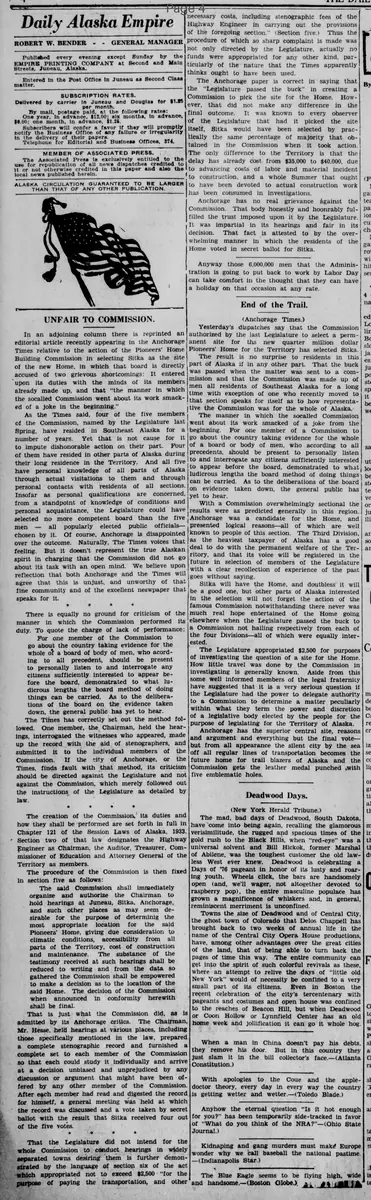
UNFAIR TO COMMISSION.
In an adjoining column there is reprinted an editorial article recently appearing in the Anchorage Times relative to the action of the Pioneers' Home Building Commission in selecting Sitka as the site of the new Home, in which that board is directly accused of two grievous shortcomings: It entered upon its duties with the minds of its members already made up, and that "the manner in which the so-called Commission went about its work smacked of a joke in the beginning."
As the Times said, four of the five members of the Commission, named by the Legislature last Spring, have resided in Southeast Alaska for a number of years. Yet that is not cause for it to impute dishonorable action on their part. Four of them have resided in other parts of Alaska during their long residence in the Territory. And all five have personal knowledge of all parts of Alaska through actual visitations to them and through personal contacts with residents of all sections.
Insofar as personal qualifications are concerned from a standpoint of knowledge of conditions and personal acquaintance, the Legislature could have selected no more competent board than the five men - all popularly elected public officials—chosen by it. Of course, Anchorage is disappointed over the outcome. Naturally, The Times voices that feeling. But it doesn't represent the true Alaskan spirit in charging that the Commission did not go about its task with an open mind. We believe upon reflection that both Anchorage and the Times will agree that this is unjust, and unworthy of that fine community and of the excellent newspaper that speaks for it.
There is equally no ground for criticism of the manner in which the Commission performed its duty. To quote the charge of lack of performance:
For one member of the Commission to go about the country taking evidence for the whole of a board or body of men, who according to all precedent, should be present to personally listen to and interrogate any citizens sufficiently interested to appear before the board, demonstrated to what ludicrous lengths the board method of doing things can be carried. As to the deliberations of the board on the evidence taken down, the general public has yet to hear.
The Times has correctly set out the method followed. One member, the Chairman, held the hearings, interrogated the witnesses who appeared, made up the record with the aid of stenographers, and submitted it to the individual members of the Commission. If the city of Anchorage, or the Times, finds fault with that method, its criticism should be directed against the Legislature and not against the Commission, which merely followed out the instructions of the Legislature as detailed by law.
The creation of the Commission, its duties and how they shall be performed are set forth in full in Chapter 121 of the Session Laws of Alaska, 1933.
Section two of that law designates the Highway Engineer as Chairman, the Auditor, Treasurer, Commissioner of Education and Attorney General of the Territory as members.
The procedure of the Commission is then fixed in section five as follows:
The said Commission shall immediately organize and authorize the Chairman to hold hearings at Juneau, Sitka, Anchorage, and such other places as may seem desirable for the purpose of determining the most appropriate location for the said Pioneers' Home, giving due consideration to climatic conditions, accessibility from all parts of the Territory, cost of construction and maintenance. The substance of the testimony received at such hearings shall be reduced to writing and from the data so gathered the Commission shall be empowered to make a decision as to the location of the said Home. The decision of the Commission when announced in conformity herewith shall be final.
That is just what the Commission did, as is admitted by its Anchorage critics. The Chairman, Mr. Hesse, held hearings at various places, including those specifically mentioned in the law, prepared a complete stenographic record and furnished a complete set to each member of the Commission so that each could study it individually and arrive at a decision unbiased and unprejudiced by any discussion or argument that might have been offered by any other member of the Commission.
After each member had read and digested the record for himself, a general meeting was held at which the record was discussed and a vote taken by secret ballot with the result that Sitka received four out of the five votes.
That the Legislature did not intend for the whole Commission to conduct hearings in widely separated towns desiring them is further demonstrated by the language of section six of the act which appropriated not to exceed $2,500 "for the purpose of paying the transportation, and other necessary costs, including stenographic fees of the Highway Engineer in carrying out the provisions of the foregoing section." (Section five.) Thus the procedure of which so sharp complaint is made was not only directed by the Legislature, actually no funds were appropriated for any other kind, particularly of the nature that the Times apparently thinks ought to have been used.
The Anchorage paper is correct in saying that the "Legislature passed the buck" in creating a Commission to pick the site for the Home. However, that did not make any difference in the final outcome. It was known to every observer of the Legislature that had it picked the site itself, Sitka would have been selected by practically the same percentage of majority that obtained in the Commission when it took action.
The only difference to the Territory is that the delay has already cost from $35,000 to $40,000, due to advancing costs of labor and material incident to construction, and a whole Summer that ought to have been devoted to actual construction work has been consumed in investigations.
Anchorage has no real grievance against the Commission. That body honestly and honorably fulfilled the trust imposed upon it by the Legislature. It was impartial in its hearings and fair in its decision. That fact is attested to by the overwhelming manner in which the residents of the Home voted in secret ballot for Sitka.
Anyway those 6,000,000 men that the Administration is going to put back to work by Labor Day can take comfort in the thought that they can have a holiday on that occasion at any rate.
In an adjoining column there is reprinted an editorial article recently appearing in the Anchorage Times relative to the action of the Pioneers' Home Building Commission in selecting Sitka as the site of the new Home, in which that board is directly accused of two grievous shortcomings: It entered upon its duties with the minds of its members already made up, and that "the manner in which the so-called Commission went about its work smacked of a joke in the beginning."
As the Times said, four of the five members of the Commission, named by the Legislature last Spring, have resided in Southeast Alaska for a number of years. Yet that is not cause for it to impute dishonorable action on their part. Four of them have resided in other parts of Alaska during their long residence in the Territory. And all five have personal knowledge of all parts of Alaska through actual visitations to them and through personal contacts with residents of all sections.
Insofar as personal qualifications are concerned from a standpoint of knowledge of conditions and personal acquaintance, the Legislature could have selected no more competent board than the five men - all popularly elected public officials—chosen by it. Of course, Anchorage is disappointed over the outcome. Naturally, The Times voices that feeling. But it doesn't represent the true Alaskan spirit in charging that the Commission did not go about its task with an open mind. We believe upon reflection that both Anchorage and the Times will agree that this is unjust, and unworthy of that fine community and of the excellent newspaper that speaks for it.
There is equally no ground for criticism of the manner in which the Commission performed its duty. To quote the charge of lack of performance:
For one member of the Commission to go about the country taking evidence for the whole of a board or body of men, who according to all precedent, should be present to personally listen to and interrogate any citizens sufficiently interested to appear before the board, demonstrated to what ludicrous lengths the board method of doing things can be carried. As to the deliberations of the board on the evidence taken down, the general public has yet to hear.
The Times has correctly set out the method followed. One member, the Chairman, held the hearings, interrogated the witnesses who appeared, made up the record with the aid of stenographers, and submitted it to the individual members of the Commission. If the city of Anchorage, or the Times, finds fault with that method, its criticism should be directed against the Legislature and not against the Commission, which merely followed out the instructions of the Legislature as detailed by law.
The creation of the Commission, its duties and how they shall be performed are set forth in full in Chapter 121 of the Session Laws of Alaska, 1933.
Section two of that law designates the Highway Engineer as Chairman, the Auditor, Treasurer, Commissioner of Education and Attorney General of the Territory as members.
The procedure of the Commission is then fixed in section five as follows:
The said Commission shall immediately organize and authorize the Chairman to hold hearings at Juneau, Sitka, Anchorage, and such other places as may seem desirable for the purpose of determining the most appropriate location for the said Pioneers' Home, giving due consideration to climatic conditions, accessibility from all parts of the Territory, cost of construction and maintenance. The substance of the testimony received at such hearings shall be reduced to writing and from the data so gathered the Commission shall be empowered to make a decision as to the location of the said Home. The decision of the Commission when announced in conformity herewith shall be final.
That is just what the Commission did, as is admitted by its Anchorage critics. The Chairman, Mr. Hesse, held hearings at various places, including those specifically mentioned in the law, prepared a complete stenographic record and furnished a complete set to each member of the Commission so that each could study it individually and arrive at a decision unbiased and unprejudiced by any discussion or argument that might have been offered by any other member of the Commission.
After each member had read and digested the record for himself, a general meeting was held at which the record was discussed and a vote taken by secret ballot with the result that Sitka received four out of the five votes.
That the Legislature did not intend for the whole Commission to conduct hearings in widely separated towns desiring them is further demonstrated by the language of section six of the act which appropriated not to exceed $2,500 "for the purpose of paying the transportation, and other necessary costs, including stenographic fees of the Highway Engineer in carrying out the provisions of the foregoing section." (Section five.) Thus the procedure of which so sharp complaint is made was not only directed by the Legislature, actually no funds were appropriated for any other kind, particularly of the nature that the Times apparently thinks ought to have been used.
The Anchorage paper is correct in saying that the "Legislature passed the buck" in creating a Commission to pick the site for the Home. However, that did not make any difference in the final outcome. It was known to every observer of the Legislature that had it picked the site itself, Sitka would have been selected by practically the same percentage of majority that obtained in the Commission when it took action.
The only difference to the Territory is that the delay has already cost from $35,000 to $40,000, due to advancing costs of labor and material incident to construction, and a whole Summer that ought to have been devoted to actual construction work has been consumed in investigations.
Anchorage has no real grievance against the Commission. That body honestly and honorably fulfilled the trust imposed upon it by the Legislature. It was impartial in its hearings and fair in its decision. That fact is attested to by the overwhelming manner in which the residents of the Home voted in secret ballot for Sitka.
Anyway those 6,000,000 men that the Administration is going to put back to work by Labor Day can take comfort in the thought that they can have a holiday on that occasion at any rate.
What sub-type of article is it?
Infrastructure
Partisan Politics
What keywords are associated?
Pioneers Home
Sitka Selection
Commission Defense
Anchorage Criticism
Alaska Legislature
Hearing Process
Site Decision
What entities or persons were involved?
Pioneers' Home Building Commission
Anchorage Times
Alaska Legislature
Mr. Hesse
Sitka
Anchorage
Editorial Details
Primary Topic
Defense Of Pioneers' Home Building Commission Selection Of Sitka
Stance / Tone
Strongly Supportive Of Commission, Critical Of Anchorage Times
Key Figures
Pioneers' Home Building Commission
Anchorage Times
Alaska Legislature
Mr. Hesse
Sitka
Anchorage
Key Arguments
Commission Members Qualified With Knowledge Of Alaska
Followed Legislative Instructions For Hearings And Decision
Chairman Held Hearings And Prepared Record For Individual Review
Decision By Secret Ballot Favored Sitka 4 5
No Funds For Full Commission Travel
Delay Cost Territory $35,000 $40,000
Residents Of Home Voted For Sitka
Anchorage Criticism Unjust And Un Alaskan