Thank you for visiting SNEWPapers!
Sign up free
Editorial
November 29, 1822
The Rhode Island American, And General Advertiser
Providence, Providence County, Rhode Island
What is this article about?
An Englishman's sketches of key members of the 1821 New York Constitutional Convention in Albany, describing their debates, characteristics, and positions on issues like suffrage, landed interests, and slavery.
Merged-components note: Continuation of the literary piece on political sketches of convention members across pages; relabeled to editorial as it fits opinion/political analysis.
Clippings
1 of 2
OCR Quality
95%
Excellent
Full Text
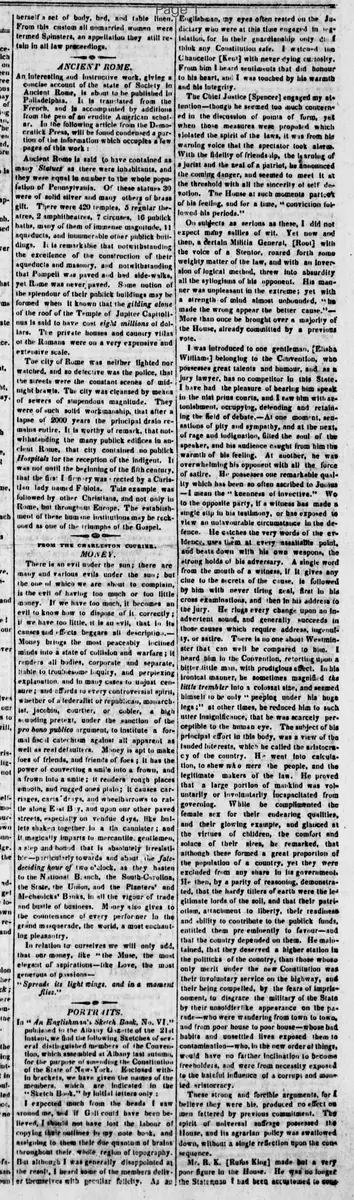
PORTRAITS.
In "An Englishman's Sketch Book, No. VI."
published in the Albany Gazette of the 21st
Instant, we find the following Sketches of sev-
eral distinguished members of the Conven-
tion, which assembled at Albany last autumn,
for the purpose of amending the Constitution
of the State of New-York. Enclosed with-
in brackets, we have given the names of the
members, which are indicated in the
"Sketch Book." by initial letters only:
I expected much from the heads I saw around me, and if Gall could have been believed, I should not have lost the labour of copying their outlines in my note book, and assigning to them their due quantum of brains throughout their whole region of phrenology. But although I was generally disappointed at the result, I heard some of the members deliver themselves with peculiar felicity. As an Englishman, my eyes often rested on the Judiciary who were at this time engaged in legislation, for in their guardianship only could I think any Constitution safe. I watched the Chancellor [Kent] with never dying curiosity. From him I heard sentiments that did honour to his heart, and I was touched by his warmth and his integrity.
The Chief Justice [Spencer] engaged my attention—though he seemed too much concerned in the discussion of points of form, yet when those measures were proposed which violated the spirit of the laws, it was from his warning voice that the spectator took alarm. With the fidelity of friendship, the learning of a jurist and the zeal of a patriot, he announced the coming danger, and seemed to meet it at the threshold with all the sincerity of self devotion. The House at such moments partook of his feeling, and for a time, "conviction followed his periods."
On subjects as serious as these, I did not expect many sallies of wit. Yet now and then, a Certain Militia General, [Root] with the voice of a Stentor, roared forth some weighty matter of the law, and with an inversion of logical method, threw into absurdity all the syllogisms of his opponent. His manner was unpleasant in the extreme; yet with a strength of mind almost unbounded, "he made the wrong appear the better cause."— More than once he brought over a majority of the House, already committed by a previous vote.
I was introduced to one gentleman, [Elisha Williams,] belonging to the Convention, who possesses great talents and humour, and as a jury lawyer, has no competitor in this State. I have had the pleasure of hearing him speak in the nisi prius courts, and I saw him with astonishment, occupying, defending and retaining the field of debate.—At one moment, sensations of pity and sympathy, and at the next, of rage and indignation, filled the soul of the speaker, and his audience caught from him the warmth of his feeling. At another, he was overwhelming his opponent with all the force of satire. He possesses one remarkable quality which has been so often ascribed to Junius—I mean the "keenness of invective." Woe to the opposite party, if a witness has made a single slip in his testimony, or has exposed to view an unfavourable circumstance in the defence. He catches the very words of the evidence, uses them at every assailable point, and beats down with his own weapons, the strong holds of his adversary. A single word from the mouth of a witness, if it gives any clue to the secrets of the cause, is followed up by him with never tiring zeal, first in his cross examinations, and then in his address to the jury. He rings every change upon an inadvertent sound, and generally succeeds in those causes which require address, ingenuity, or satire. There is no one about Westminster that can well be compared to him. I heard him in the Convention, retorting upon a bitter little man, with prodigious effect. In his ironical manner, he sometimes magnified the little trembler into a colossal size, and seemed himself to be only "peeping under his huge legs:" at other times, he reduced him to such utter insignificance, that he was scarcely perceptible to the human eye. The subject of his principal effort in this body, was a view of the landed interests, which he called the aristocracy of the country. He went into calculation, to shew who were the people, and the legitimate makers of the law. He proved that a large portion of mankind was voluntarily or involuntarily incapacitated from governing.
While he complimented the female sex on their endearing qualities, and their glowing example, and glanced at the virtues of children, the comfort and solace of their sires, he remarked, that although these formed a great proportion of the population of a country, yet they were excluded from any share in its government. He then, by a parity of reasoning, demonstrated, that the hardy tillers of earth were the legitimate lords of the soil, and that their patriotism, attachment to liberty, their readiness and ability to contribute to the public funds, entitled them pre-eminently to favour—and that the country depended on them. He maintained, that they deserved a higher station in the politics of the country, than those whose only merit under the new Constitution was their involuntary service on the highway, and their being compelled, by the fears of imprisonment, to disgrace the military of the State by their unsoldierlike appearance on the parade—who were wandering from town to town, and from poor house to poor house—whose bad habit and unsettled lives exposed them to contamination—who, in the new order of things, would have no farther inclination to become freeholders, and were from necessity exposed to the baneful influence of a corrupt and worn out aristocracy.
These strong and forcible arguments, for I believe they were his, produced no effect on men fettered by previous commitment. The spirit of universal suffrage possessed the House, and its agrarian policy was swallowed down, without a single reflection upon the consequence.
Mr. R. K. [Rufus King] made but a very poor figure in the House. He was no longer the Statesman I had been accustomed to consider him.
either Ohio, nor the proud advocate of the slave, for whom he but lately, in the Senate of the United States, had urged the necessity of "universal emancipation." He now consigned by his vote, to the sorrows of an eternal slavery. the wretch for whom but lately he had demanded freedom and citizenship. From so gross an inconsistency, I pass to the consideration of another striking character. M. V. B. Esq. [Martin Van Buren,] is an extraordinary man, and upon the whole I am pleased with him. Without any advantages in the early period of life, except those which his ingenuity supplied. he struggled through all the adversities which perplex the young, and all the coldness and opposition which are in general the gratuities of the old. His talents gained him the popular favour--his readiness of speech made him useful at public meetings, and his great readiness knew how to seize on this advantage. Step by step, he has passed through all the grades of publick favour, and has possessed an extraordinary influence in the politicks of the State. Like Warwick, he has been "the setter up and puller down of Kings." I am thus particular about this gentleman, for I hear that nothing but an embassay will satisfy him. I believe that he will only attain this object, if he is backed by the influence of his State in the next Presidential Election. No northern politician can ever make an honourable submission to Southern interests. If he forsakes his constituents, his integrity will be justly questioned; and it is only in the character of an high-minded politician, who is jealous of his honour, that he can receive any office with honour, as a reward, and not as a bribe. If ever this gentleman reaches this favourable point, you will thank me for this sketch of him; and you yourself, on the rise to fame and fortune, may one day meet him on the field of diplomatick renown.
In "An Englishman's Sketch Book, No. VI."
published in the Albany Gazette of the 21st
Instant, we find the following Sketches of sev-
eral distinguished members of the Conven-
tion, which assembled at Albany last autumn,
for the purpose of amending the Constitution
of the State of New-York. Enclosed with-
in brackets, we have given the names of the
members, which are indicated in the
"Sketch Book." by initial letters only:
I expected much from the heads I saw around me, and if Gall could have been believed, I should not have lost the labour of copying their outlines in my note book, and assigning to them their due quantum of brains throughout their whole region of phrenology. But although I was generally disappointed at the result, I heard some of the members deliver themselves with peculiar felicity. As an Englishman, my eyes often rested on the Judiciary who were at this time engaged in legislation, for in their guardianship only could I think any Constitution safe. I watched the Chancellor [Kent] with never dying curiosity. From him I heard sentiments that did honour to his heart, and I was touched by his warmth and his integrity.
The Chief Justice [Spencer] engaged my attention—though he seemed too much concerned in the discussion of points of form, yet when those measures were proposed which violated the spirit of the laws, it was from his warning voice that the spectator took alarm. With the fidelity of friendship, the learning of a jurist and the zeal of a patriot, he announced the coming danger, and seemed to meet it at the threshold with all the sincerity of self devotion. The House at such moments partook of his feeling, and for a time, "conviction followed his periods."
On subjects as serious as these, I did not expect many sallies of wit. Yet now and then, a Certain Militia General, [Root] with the voice of a Stentor, roared forth some weighty matter of the law, and with an inversion of logical method, threw into absurdity all the syllogisms of his opponent. His manner was unpleasant in the extreme; yet with a strength of mind almost unbounded, "he made the wrong appear the better cause."— More than once he brought over a majority of the House, already committed by a previous vote.
I was introduced to one gentleman, [Elisha Williams,] belonging to the Convention, who possesses great talents and humour, and as a jury lawyer, has no competitor in this State. I have had the pleasure of hearing him speak in the nisi prius courts, and I saw him with astonishment, occupying, defending and retaining the field of debate.—At one moment, sensations of pity and sympathy, and at the next, of rage and indignation, filled the soul of the speaker, and his audience caught from him the warmth of his feeling. At another, he was overwhelming his opponent with all the force of satire. He possesses one remarkable quality which has been so often ascribed to Junius—I mean the "keenness of invective." Woe to the opposite party, if a witness has made a single slip in his testimony, or has exposed to view an unfavourable circumstance in the defence. He catches the very words of the evidence, uses them at every assailable point, and beats down with his own weapons, the strong holds of his adversary. A single word from the mouth of a witness, if it gives any clue to the secrets of the cause, is followed up by him with never tiring zeal, first in his cross examinations, and then in his address to the jury. He rings every change upon an inadvertent sound, and generally succeeds in those causes which require address, ingenuity, or satire. There is no one about Westminster that can well be compared to him. I heard him in the Convention, retorting upon a bitter little man, with prodigious effect. In his ironical manner, he sometimes magnified the little trembler into a colossal size, and seemed himself to be only "peeping under his huge legs:" at other times, he reduced him to such utter insignificance, that he was scarcely perceptible to the human eye. The subject of his principal effort in this body, was a view of the landed interests, which he called the aristocracy of the country. He went into calculation, to shew who were the people, and the legitimate makers of the law. He proved that a large portion of mankind was voluntarily or involuntarily incapacitated from governing.
While he complimented the female sex on their endearing qualities, and their glowing example, and glanced at the virtues of children, the comfort and solace of their sires, he remarked, that although these formed a great proportion of the population of a country, yet they were excluded from any share in its government. He then, by a parity of reasoning, demonstrated, that the hardy tillers of earth were the legitimate lords of the soil, and that their patriotism, attachment to liberty, their readiness and ability to contribute to the public funds, entitled them pre-eminently to favour—and that the country depended on them. He maintained, that they deserved a higher station in the politics of the country, than those whose only merit under the new Constitution was their involuntary service on the highway, and their being compelled, by the fears of imprisonment, to disgrace the military of the State by their unsoldierlike appearance on the parade—who were wandering from town to town, and from poor house to poor house—whose bad habit and unsettled lives exposed them to contamination—who, in the new order of things, would have no farther inclination to become freeholders, and were from necessity exposed to the baneful influence of a corrupt and worn out aristocracy.
These strong and forcible arguments, for I believe they were his, produced no effect on men fettered by previous commitment. The spirit of universal suffrage possessed the House, and its agrarian policy was swallowed down, without a single reflection upon the consequence.
Mr. R. K. [Rufus King] made but a very poor figure in the House. He was no longer the Statesman I had been accustomed to consider him.
either Ohio, nor the proud advocate of the slave, for whom he but lately, in the Senate of the United States, had urged the necessity of "universal emancipation." He now consigned by his vote, to the sorrows of an eternal slavery. the wretch for whom but lately he had demanded freedom and citizenship. From so gross an inconsistency, I pass to the consideration of another striking character. M. V. B. Esq. [Martin Van Buren,] is an extraordinary man, and upon the whole I am pleased with him. Without any advantages in the early period of life, except those which his ingenuity supplied. he struggled through all the adversities which perplex the young, and all the coldness and opposition which are in general the gratuities of the old. His talents gained him the popular favour--his readiness of speech made him useful at public meetings, and his great readiness knew how to seize on this advantage. Step by step, he has passed through all the grades of publick favour, and has possessed an extraordinary influence in the politicks of the State. Like Warwick, he has been "the setter up and puller down of Kings." I am thus particular about this gentleman, for I hear that nothing but an embassay will satisfy him. I believe that he will only attain this object, if he is backed by the influence of his State in the next Presidential Election. No northern politician can ever make an honourable submission to Southern interests. If he forsakes his constituents, his integrity will be justly questioned; and it is only in the character of an high-minded politician, who is jealous of his honour, that he can receive any office with honour, as a reward, and not as a bribe. If ever this gentleman reaches this favourable point, you will thank me for this sketch of him; and you yourself, on the rise to fame and fortune, may one day meet him on the field of diplomatick renown.
What sub-type of article is it?
Constitutional
Partisan Politics
What keywords are associated?
Constitutional Convention
Albany
New York
Political Sketches
Chancellor Kent
Chief Justice Spencer
Elisha Williams
Rufus King
Martin Van Buren
Universal Suffrage
Landed Interests
Slavery Emancipation
What entities or persons were involved?
Chancellor Kent
Chief Justice Spencer
Militia General Root
Elisha Williams
Rufus King
Martin Van Buren
Editorial Details
Primary Topic
Sketches Of New York Constitutional Convention Members
Stance / Tone
Observational And Appreciative With Critical Notes
Key Figures
Chancellor Kent
Chief Justice Spencer
Militia General Root
Elisha Williams
Rufus King
Martin Van Buren
Key Arguments
Chancellor Kent's Sentiments Honor His Heart And Integrity
Chief Justice Spencer's Warnings Against Measures Violating The Spirit Of Laws
General Root's Strong But Unpleasant Manner Sways The House
Elisha Williams' Satirical And Invective Style In Debate, Arguing For Landed Interests And Against Universal Suffrage
Rufus King's Inconsistency On Slavery And Emancipation
Martin Van Buren's Rise Through Talents And Influence In State Politics