Thank you for visiting SNEWPapers!
Sign up free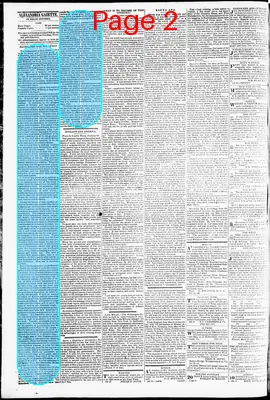
Alexandria Gazette
Alexandria, Alexandria County, District Of Columbia
What is this article about?
New Jersey Legislature taxes bachelors and widowers to promote marriage. Wm. M. Elroy, Jr. petitions for repeal. Committee of single men reports the tax as an anomalous, needless, and ineffectual law that stigmatizes them, citing overpopulation concerns, lack of impact on marriage rates, and greater legislative issues from married men.
Clipping
OCR Quality
Full Text
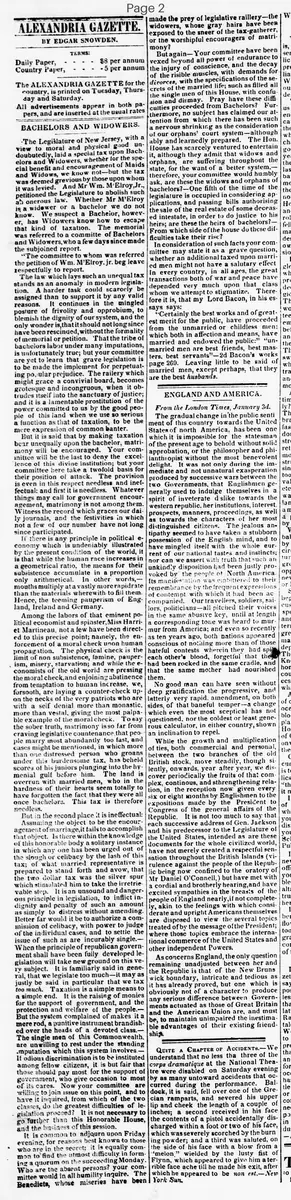
The Legislature of New Jersey, with a view to moral and physical good undoubtedly, laid a special tax upon Bachelors and Widowers. Whether for the special benefit and encouragement of Maids and Widows, we know not—but the tax was deemed grievous by those upon whom it was levied. And Mr. Wm. M. Elroy, Jr., petitioned the Legislature to abolish such an onerous law. Whether Mr. M'Elroy is a widower or a bachelor we do not know. We suspect a Bachelor, however, as Widowers know how to escape that kind of taxation. The memorial was referred to a committee of Bachelors and Widowers, who a few days since made the subjoined report.
"The committee to whom was referred the petition of Wm. M'Elroy, Jr., beg leave respectfully to report.
The law which lays such an unequal tax stands as an anomaly in modern legislation. A harder task could scarcely be assigned than to support it by any valid reasons. It continues in the mingled posture of frivolity and opprobrium, to blemish the dignity of our system, and the only wonder is, that it should not long since have been rescinded, without the formality of memorial or petition. That the tribe of bachelors labor under many imputations, is unfortunately true; but your committee are yet to learn that grave legislation is to be made the implement for perpetuating popular prejudice. The raillery which might grace a convivial board, becomes grotesque and incongruous, when it obtrudes itself into the sanctuary of justice and it is a lamentable prostitution of the power committed to us by the good people of this land when we use so serious a function as that of taxation, to be the mere expression of common banter.
But it is said that by making taxation bear unequally upon the bachelor, matrimony will be encouraged. Your committee will be the last to deny the excellence of this divine institution; but your committee here take a twofold basis for their position of attack. The provision is even in this respect needless and ineffectual: and first it is needless. Whatever things may call for government encouragement, matrimony is not among them. Witness the record which graces our daily journals, and the festivities in which not a few of our number have not long since participated.
If there is any principle in political economy which is undeniably illustrated by the present condition of the world, it is that while the human race increases in a geometrical ratio, the means for their subsistence accumulate in a proportion only arithmetical. In other words,—mouths multiply at a vastly more rapid rate than the materials wherewith to fill them. Hence, the teeming pauperism of England, Ireland and Germany.
Among the labors of that eminent political economist and spinster, Miss Harriet Martineau, not a few have been directed to this precise point; namely, the enforcement of a moral check upon human propagation. The physical check is the limit of non subsistence, famine, pauperism, misery, starvation; and while the economists of the old world are pressing the moral check, and enjoining abstinence from temptation to human increase, we, forsooth, are laying a counter-check upon the necks of the very patriots who are with a self denial more than monastic, more than vestal, giving the most palpable example of the moral check. To say the sober truth, matrimony is so far from craving legislative countenance, that people marry most abundantly too fast, and cases might be mentioned, in which more than one distressed person who groans under this burdensome tax, has beheld scores of his juniors plunging into the hymeneal gulf before him. The land is overrun with married men, who in the hardness of their hearts seem totally to have forgotten the fact that they were all once bachelors. This tax is therefore needless.
But in the second place it is ineffectual: Assuming the object to be the encouragement of marriage, it fails to accomplish that object. Is there within the knowledge of this honorable body a solitary instance in which any one has been urged out of the slough of celibacy by the lash of this tax; of what married representative is prepared to stand forth and avow, that the two dollar tax was the silver spur which stimulated him to take the irretrievable step. It is an unsound and dangerous principle in legislation, to inflict indignity and penalty of such an amount as simply to distress without amending. Better far would it be to authorize a commission of celibacy, with power to judge of the individual cases, and to settle the issue of such as are incurably single.—
When the principle of republican government shall have been fully developed legislation will take new ground on this very subject. It is familiarly said in general, that we legislate too much—it may as justly be said in particular that we tax too much. Taxation is a simple means to a simple end. It is the raising of monies for the support of government, and the protection and welfare of the people.— But the system complained of makes it a mere rod, a punitive instrument brandished over the heads of a devoted class.— The single men of this Commonwealth, are unwilling to rest under the standing imputation which this system involves.— If odious discrimination is to be instituted among fellow citizens, it is but fair that those should pay most for the support of government, who give occasion to most of its cares. Now your committee are willing to join issue on this point, and to have it inquired, from which of the two classes, do the greatest difficulties of legislation proceed? It is not necessary to go further than this Honorable House, and the business of this session.
It is common to adjourn upon Friday evening, for reasons best known to those who are in the secret; it is equally common to find the utmost difficulty in forming a quorum on the succeeding Monday. Who are the absent persons? your committee would in all humility inquire. The Benedicts, whose miseries have been made the prey of legislative raillery—the widowers, whose gray hairs have been exposed to the sneer of the tax-gatherer, or the worshipful encouragers of matrimony?
But again—Your committee have been vexed beyond all power of endurance to the injury of conscience, and the decay of the risible muscles, with demands for divorces, with the specifications of the secrets of the married life; such as filled the single men of this House, with confusion and dismay. Pray have these difficulties proceeded from Bachelors? Furthermore, no subject has claimed our attention from which there has been such a nervous shrinking as the consideration of our orphans' court system—although ably and learnedly prepared. The Hon. House has scarcely ventured to entertain it, although they admit that widows and orphans, are suffering throughout the state, for the want of a better system,—therefore, your committee would humbly ask, are these the widows and orphans of bachelors?—One fifth of the time of the legislature is occupied in considering applications, and passing bills authorising the sale of the real estate of some deceased intestate, in order to do justice to his heirs; are these the heirs of bachelors? From which side of the house do these difficulties take their rise?
In consideration of such facts your committee may state it as a grave question, whether an additional tax upon married men might not have a salutary effect In every country, in all ages, the great transactions both of war and peace have depended very much upon that class whom we attempt to stigmatize. Therefore it is, that my Lord Bacon, in his essays says:
"Certainly the best works and of greatest merit for the public, have proceeded from the unmarried or childless men: which both in affection and means, have married and endowed the public:" "unmarried men are best friends, best masters, best servants"—2d Bacon's works page 269. Leaving little to be said of married men, except perhaps, that they are the best husbands."
What sub-type of article is it?
What themes does it cover?
What keywords are associated?
What entities or persons were involved?
Where did it happen?
Story Details
Key Persons
Location
New Jersey
Story Details
A satirical committee report opposes a New Jersey tax on bachelors and widowers aimed at encouraging marriage, deeming it an undignified anomaly that is both needless—given rapid population growth and high marriage rates—and ineffectual, while highlighting legislative burdens from married men and praising single men's societal contributions.