Thank you for visiting SNEWPapers!
Sign up free
Story
February 10, 1922
Morris Tribune
Morris, Stevens County, Minnesota
What is this article about?
Article contrasts China's vegetation-dependent population facing famine in bad years with the US, where animal agriculture buffers grain shortages by increasing meat consumption and feeding surplus grain to livestock, stabilizing markets.
Clipping
OCR Quality
95%
Excellent
Full Text
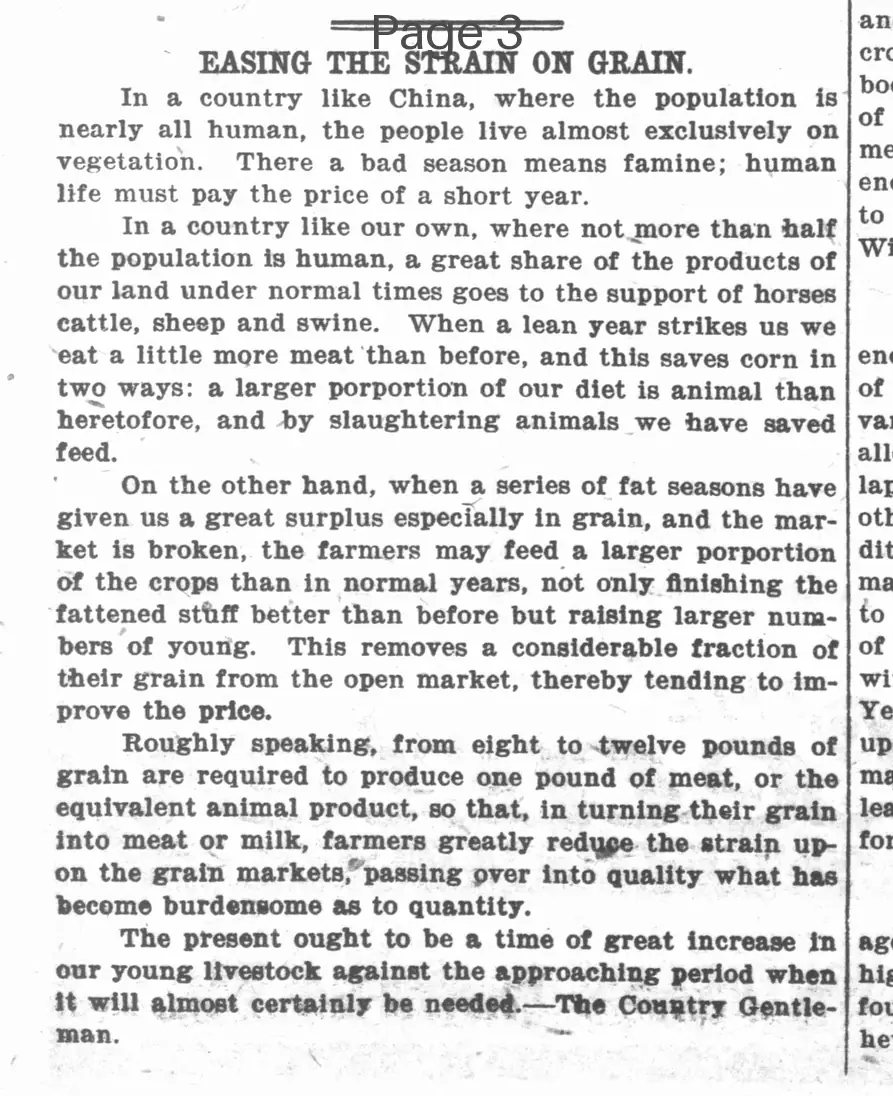
EASING THE STRAIN ON GRAIN
In a country like China, where the population is nearly all human, the people live almost exclusively on vegetation. There a bad season means famine; human life must pay the price of a short year.
In a country like our own, where not more than half the population is human, a great share of the products of our land under normal times goes to the support of horses, cattle, sheep and swine. When a lean year strikes us we eat a little more meat than before, and this saves corn in two ways: a larger proportion of our diet is animal than heretofore, and by slaughtering animals we have saved feed.
On the other hand, when a series of fat seasons have given us a great surplus especially in grain, and the market is broken, the farmers may feed a larger proportion of the crops than in normal years, not only finishing the fattened stuff better than before but raising larger numbers of young. This removes a considerable fraction of their grain from the open market, thereby tending to improve the price.
Roughly speaking, from eight to twelve pounds of grain are required to produce one pound of meat, or the equivalent animal product, so that, in turning their grain into meat or milk, farmers greatly reduce the strain upon the grain markets, passing over into quality what has become burdensome as to quantity.
The present ought to be a time of great increase in our young livestock against the approaching period when it will almost certainly be needed.—The Country Gentleman.
In a country like China, where the population is nearly all human, the people live almost exclusively on vegetation. There a bad season means famine; human life must pay the price of a short year.
In a country like our own, where not more than half the population is human, a great share of the products of our land under normal times goes to the support of horses, cattle, sheep and swine. When a lean year strikes us we eat a little more meat than before, and this saves corn in two ways: a larger proportion of our diet is animal than heretofore, and by slaughtering animals we have saved feed.
On the other hand, when a series of fat seasons have given us a great surplus especially in grain, and the market is broken, the farmers may feed a larger proportion of the crops than in normal years, not only finishing the fattened stuff better than before but raising larger numbers of young. This removes a considerable fraction of their grain from the open market, thereby tending to improve the price.
Roughly speaking, from eight to twelve pounds of grain are required to produce one pound of meat, or the equivalent animal product, so that, in turning their grain into meat or milk, farmers greatly reduce the strain upon the grain markets, passing over into quality what has become burdensome as to quantity.
The present ought to be a time of great increase in our young livestock against the approaching period when it will almost certainly be needed.—The Country Gentleman.
What sub-type of article is it?
Curiosity
What themes does it cover?
Survival
Misfortune
What keywords are associated?
Grain Shortage
Animal Husbandry
Famine Prevention
Agricultural Economics
Livestock Feeding
Market Stabilization
Where did it happen?
China, United States
Story Details
Location
China, United States
Story Details
In China, bad seasons cause famine due to reliance on vegetation; in the US, with half the population non-human (animals), lean years are eased by eating more meat, saving grain. Surplus years allow feeding more grain to livestock, removing it from market to improve prices. Eight to twelve pounds of grain produce one pound of meat, reducing strain on grain markets.