Thank you for visiting SNEWPapers!
Sign up free
The New Hampshire Gazette And General Advertiser
Portsmouth, Exeter, Rockingham County, New Hampshire
What is this article about?
Extract of a letter from Major-General Greene dated July 26, 1781, detailing Gen. Sumter's expedition against British lower posts in South Carolina. American forces captured prisoners, horses, wagons, and baggage; burned vessels; pursued and engaged the enemy at Biggin's Church and Guinea Bridge, with minor losses but significant enemy captures.
Clipping
OCR Quality
Full Text
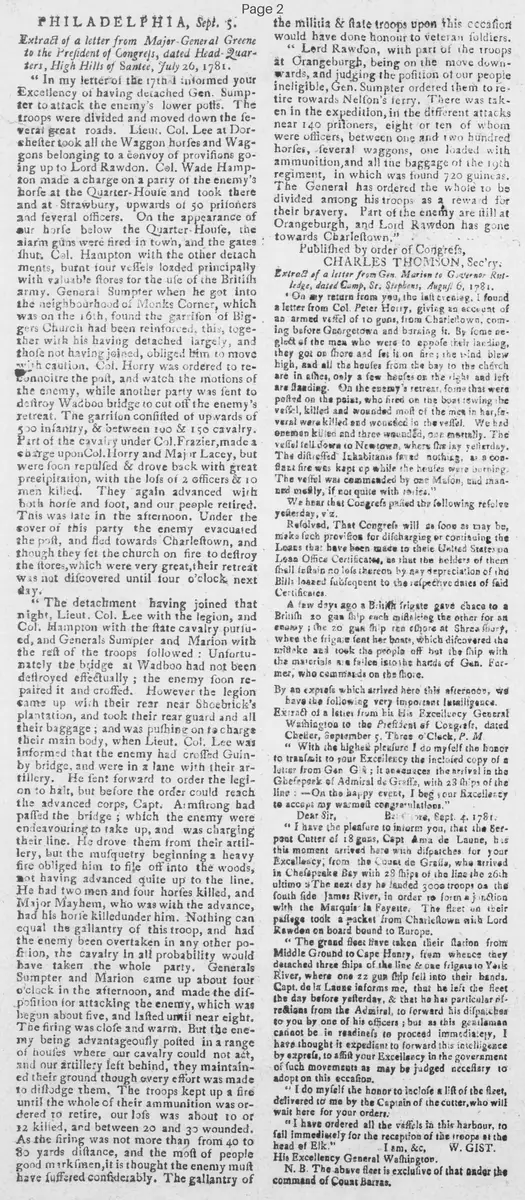
Extract of a letter from Major-General Greene to the President of Congress, dated Head-Quarters, High Hills of Santee, July 26, 1781.
"In my letter of the 17th I informed your Excellency of having detached Gen. Sumter to attack the enemy's lower posts. The troops were divided and moved down the several great roads. Lieut. Col. Lee at Dorchester took all the Wagon horses and Waggons belonging to a convoy of provisions going up to Lord Rawdon. Col. Wade Hampton made a charge on a party of the enemy's horse at the Quarter-House and took there and at Strawberry, upwards of 50 prisoners and several officers. On the appearance of Our horse below the Quarter-House, the alarm guns were fired in town, and the gates shut. Col. Hampton with the other detachments, burnt four vessels loaded principally with valuable stores for the use of the British army. General Sumter when he got into the neighbourhood of Monk's Corner, which was on the 16th, found the garrison of Biggin's Church had been reinforced. this, together with his having detached largely, and those not having joined, obliged him to move with caution. Col. Horry was ordered to reconnoitre the post, and watch the motions of the enemy, while another party was sent to destroy Wadboo bridge to cut off the enemy's retreat. The garrison consisted of upwards of 500 infantry, & between 100 & 150 cavalry. Part of the cavalry under Col. Frazier, made a charge upon Col. Horry and Majr Lacey, but were soon repulsed & drove back with great precipitation, with the loss of 2 officers & 10 men killed. They again advanced with both horse and foot, and our people retired. This was late in the afternoon. Under the cover of this party the enemy evacuated the post, and fled towards Charlestown, and though they set the church on fire to destroy the stores, which were very great, their retreat was not discovered until four o'clock next day.
"The detachment having joined that night, Lieut. Col. Lee with the legion, and Col. Hampton with the state cavalry pursued, and Generals Sumter and Marion with the rest of the troops followed: Unfortunately the bridge at Wadboo had not been destroyed effectually; the enemy soon repaired it and crossed. However the legion came up with their rear near Shoebrick's plantation, and took their rear guard and all their baggage; and was pushing on to charge their main body, when Lieut. Col. Lee was informed that the enemy had crossed Guinea bridge, and were in a lane with their artillery. He sent forward to order the legion to halt, but before the order could reach the advanced corps, Capt. Armstrong had passed the bridge; which the enemy were endeavouring to take up, and was charging their line. He drove them from their artillery, but the musquetry beginning a heavy fire obliged him to file off into the woods, not having advanced quite up to the line. He had two men and four horses killed, and Major Mayham, who was with the advance, had his horse killed under him. Nothing can equal the gallantry of this troop, and had the enemy been overtaken in any other position, the cavalry in all probability would have taken the whole party. Generals Sumpter and Marion came up about four o'clock in the afternoon, and made the disposition for attacking the enemy, which was begun about five, and lasted until near eight. The firing was close and warm. But the enemy being advantageously posted in a range of houses where our cavalry could not act, and our artillery left behind, they maintained their ground though every effort was made to dislodge them. The troops kept up a fire until the whole of their ammunition was ordered to retire, our loss was about 10 or 12 killed, and between 20 and 30 wounded. As the firing was not more than from 40 to 80 yards distance, and the most of people good marksmen, it is thought the enemy must have suffered considerably. The gallantry of the militia & state troops upon this occasion would have done honour to veteran soldiers.
"Lord Rawdon, with part of the troops at Orangeburgh, being on the move downwards, and judging the position of our people ineligible, Gen. Sumter ordered them to retire towards Nelson's ferry. There was taken in the expedition, in the different attacks near 140 prisoners, eight or ten of whom were officers, between one and two hundred horses, several waggons, one loaded with ammunition, and all the baggage of the 19th regiment, in which was found 720 guineas. The General has ordered the whole to be divided among his troops as a reward for their bravery.
Part of the enemy are still at Orangeburgh, and Lord Rawdon has gone towards Charlestown."
Published by order of Congress,
CHARLES THOMSON, Sec'y.
What sub-type of article is it?
What keywords are associated?
What entities or persons were involved?
Where did it happen?
Domestic News Details
Primary Location
South Carolina
Event Date
July 16 26, 1781
Key Persons
Outcome
american forces: 10-12 killed, 20-30 wounded. enemy: 140 prisoners (including 8-10 officers), 1-200 horses, wagons with ammunition, baggage of 19th regiment including 720 guineas; 2 officers and 10 men killed in one engagement. enemy evacuated posts and retreated to charlestown.
Event Details
Gen. Sumter's detachment attacked British lower posts, capturing wagons, horses, prisoners, and burning vessels. At Biggin's Church, after reconnaissance and failed bridge destruction, Americans pursued evacuating British forces, capturing rear guard and baggage near Shoebrick's plantation. Cavalry charged at Guinea Bridge but faced heavy fire. Later engagement lasted hours with Americans firing until out of ammunition; enemy held position. Expedition yielded significant captures; troops retired towards Nelson's ferry.