Thank you for visiting SNEWPapers!
Sign up free
Story
July 5, 1947
The Union Times
New Haven, New Haven County, Connecticut
What is this article about?
Gerard D. Reilly, former NLRB member, speaks at a printing industry luncheon in Washington on the Taft-Hartley Act, claiming it retains Wagner Act features and advising on charging the International Typographical Union with unfair practices if they push closed shop agreements without contracts.
Clipping
OCR Quality
98%
Excellent
Full Text
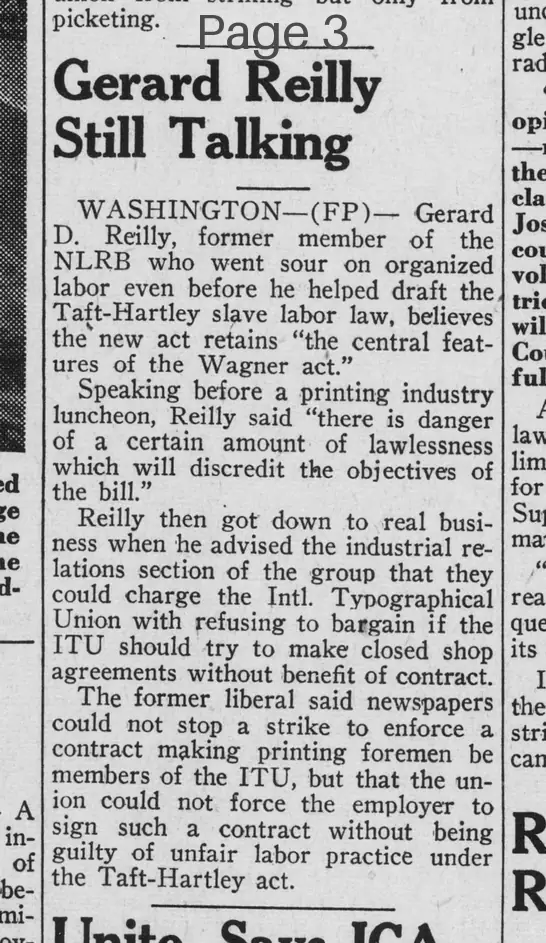
Gerard Reilly Still Talking
WASHINGTON-(FP)- Gerard D. Reilly, former member of the NLRB who went sour on organized labor even before he helped draft the Taft-Hartley slave labor law, believes the new act retains "the central features of the Wagner act."
Speaking before a printing industry luncheon, Reilly said "there is danger of a certain amount of lawlessness which will discredit the objectives of the bill."
Reilly then got down to real business when he advised the industrial relations section of the group that they could charge the Intl. Typographical Union with refusing to bargain if the ITU should try to make closed shop agreements without benefit of contract.
The former liberal said newspapers could not stop a strike to enforce a contract making printing foremen be members of the ITU, but that the union could not force the employer to sign such a contract without being guilty of unfair labor practice under the Taft-Hartley act.
WASHINGTON-(FP)- Gerard D. Reilly, former member of the NLRB who went sour on organized labor even before he helped draft the Taft-Hartley slave labor law, believes the new act retains "the central features of the Wagner act."
Speaking before a printing industry luncheon, Reilly said "there is danger of a certain amount of lawlessness which will discredit the objectives of the bill."
Reilly then got down to real business when he advised the industrial relations section of the group that they could charge the Intl. Typographical Union with refusing to bargain if the ITU should try to make closed shop agreements without benefit of contract.
The former liberal said newspapers could not stop a strike to enforce a contract making printing foremen be members of the ITU, but that the union could not force the employer to sign such a contract without being guilty of unfair labor practice under the Taft-Hartley act.
What sub-type of article is it?
Historical Event
What themes does it cover?
Justice
What keywords are associated?
Taft Hartley Act
Labor Law
Unions
Gerard Reilly
Printing Industry
Closed Shop
What entities or persons were involved?
Gerard D. Reilly
Intl. Typographical Union
Where did it happen?
Washington
Story Details
Key Persons
Gerard D. Reilly
Intl. Typographical Union
Location
Washington
Story Details
Gerard D. Reilly advises printing industry on Taft-Hartley Act implications for union bargaining, closed shops, and strikes involving the International Typographical Union.