Thank you for visiting SNEWPapers!
Sign up free
Kentucky Gazette And General Advertiser
Lexington, Fayette County, Kentucky
What is this article about?
Journal of Dr. Gowdery, an American captive in Tripoli, from Feb. 3 to June 27, detailing medical treatment for the Bashaw, the burning of the USS Philadelphia by Capt. Decatur on Feb. 16, increased security, interactions with guards, sightings of the U.S. squadron, and daily life under confinement during the Barbary War.
Merged-components note: Continuation of the same journal from Tripoli (international report); merged sequential parts and relabeled from story to foreign_news as it fits international reports better than narrative story
Clipping
OCR Quality
Full Text
OF
DR. GOWDERY
(Continued.)
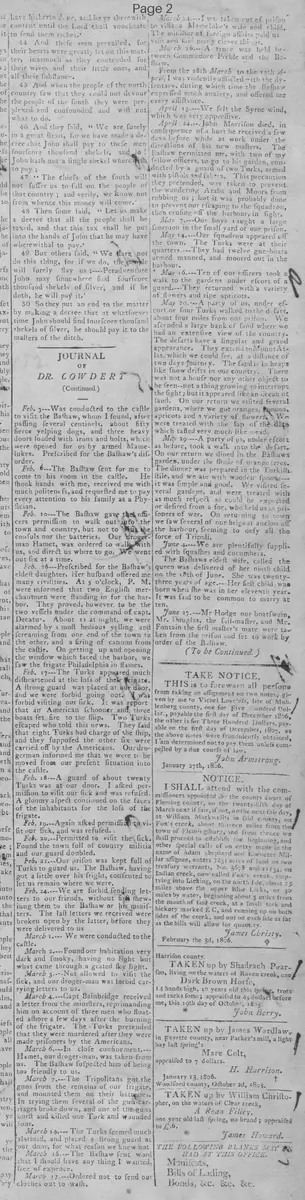
Feb. 3—Was conducted to the castle to visit the Bashaw, whom I found, after passing several sentinels, about fifty fierce yelping dogs, and three heavy doors loaded with irons and bolts, which were opened for us by armed Mamelukes. Prescribed for the Bashaw's disorder.
Feb. 6—The Bashaw sent for me to come to his room in the castle. He shook hands with me, received me with much politeness, and requested me to pay every attention to his family as a Physician.
Feb. 10—The Bashaw gave the officers permission to walk out into the town and country, but not to visit the consuls nor the batteries. Our dragerman Hamet, was ordered to walk with us, and direct us where to go. We went out six at a time.
Feb. 16—Prescribed for the Bashaw's eldest daughter. Her husband offered me many civilities. At 5 o'clock, P. M. were informed that two English merchantmen were standing in for the harbor. They proved, however, to be the two vessels under the command of Capt. Decatur. About 11 at night, we were alarmed by a most hideous yelling and screaming from one end of the town to the other, and a firing of cannon from the castle. On getting up and opening the window which faced the harbor, we saw the frigate Philadelphia in flames.
Feb. 17—The Turks appeared much disheartened at the loss of their frigate. A strong guard was placed at our door, and we were forbid going out. We was forbid visiting our sick. It was reported that an American schooner and three boats set fire to the ship. Two Turks escaped who told this news. They said that eight Turks had charge of the ship, and they supposed the other six were carried off by the Americans. Our dragerman informed me that we were to be moved from our present situation into the castle.
Feb. 18—A guard of about twenty Turks was at our door. I asked permission to visit our sick and was refused. A gloomy aspect continued on the faces of the inhabitants for the loss of the frigate.
Feb. 19—Again asked permission to visit our sick, and was refused.
Feb. 20—Permitted to visit the sick. Found the town full of country militia and our guard doubled.
Feb. 21—Our prison was kept full of Turks to guard us. The Bashaw, having got a little over his fright, consented to let us remain where we were.
Feb. 24—We are forbid sending letters to our friends, without first showing them to the Bashaw or his ministers. The last letters we received were broken open by the latter, before they were delivered to us.
March 1—We were conducted to the castle.
March 2—Found our habitation very dark and smoky, having no light but what came through a grated sky light.
March 3—Not allowed to visit the sick, and our dragerman was forbid carrying letters to us.
March 4—Capt. Bainbridge received a letter from the ministers, reprimanding him on account of three men who floated ashore a few days after the burning of the frigate. The Turks pretended that they were murdered after they were made prisoners by the Americans.
March 6—In close confinement.—Hamet, our dragerman, was taken from us. The Bashaw suspected him of being too friendly to us.
March 7—The Tripolitans got the guns from the remains of our frigate, and mounted them on their batteries. In trying them several of the gun-carriages broke down, and one of the guns burst and killed one Turk and wounded four.
March 14—The Turks seemed much alarmed, and placed a strong guard at our door, for what reason we knew not.
March 16—The Bashaw sent word that I should have any thing I wanted, free of expense.
March 17—Ordered not to send our clothes out to wash.
March 24—I was taken out of prison to visit a Mameluke's wife and child. The minister of foreign affairs paid us visit and said many clever things.
March 26—A truce was held between Commodore Preble and the Bashaw.
From the 28th March to the 15th April, I was violently afflicted with the dysentery, during which time the Bashaw expressed much anxiety, and offered me every assistance.
April 15—We felt the Siroc wind, which was very oppressive.
April 24—John Morrison died, in consequence of a hurt he received a few days before while at work under the directions of his new masters. The Bashaw permitted me, with two of my fellow officers, to go to his garden, conducted by a guard of two Turks, armed with pistols and sabres. This precaution they pretended, was taken to prevent the wandering Arabs and Moors from robbing us; but it was probably done to prevent our escaping to the squadron, then cruising off the harbour, in sight.
May 7—Our boys caught a large scorpion in the small yard of our prison.
May 14—Our squadron appeared off the town. The Turks were at their quarters.—They had twelve gun-boats armed manned, and moored out in the harbour.
May 16—Ten of our officers took a walk to the gardens under escort of a guard.—They returned with a variety of flowers and ripe apricots.
May 20—A party of us, under escort of four Turks walked to the desert, about four miles from our prison. We ascended a large bank of sand where we had an extensive view of the country. The deserts have a singular and grand appearance. They extend to Mount Atlas, which we could see, at a distance of two days journey. The sand is in heaps like snow drifts in our country. There was not a house nor any other object to be seen—not a thing growing to interrupt the sight; but it appeared like an ocean of sand. On our return we visited several gardens, where we got oranges, lemons, apricots and a variety of flowers. We were treated with the sap of the date which tasted very much like mead.
May 29—A party of us, under escort as before, took a walk into the desert. On our return we dined in the Bashaw's garden, under the shade of orange trees. The dinner was prepared in the Turkish style, and we ate with wooden spoons— it was simple and good. We visited several gardens, and were treated with as much respect as could be expected or desired from a foe, who held us as prisoners of war. On returning to town we saw several of our brigs at anchor off the harbour, seeming to defy all the force of Tripoli.
June 4—We are plentifully supplied with squashes and cucumbers. The Bashaw's eldest wife, called the queen was delivered of her ninth child on the 18th of June. She was twenty-three years of age.—Her first child was born when she was in her eleventh year. It was said to be common to marry at ten,
June 27—Mr. Hodge our boatswain, Mr. Douglas, the sail-maker, and Mr. Fontain the first master's mate were taken from the prison and set to work by order of the Bashaw.
(To be Continued.)
What sub-type of article is it?
What keywords are associated?
What entities or persons were involved?
Where did it happen?
Foreign News Details
Primary Location
Tripoli
Event Date
Feb. 3 To June 27
Key Persons
Outcome
burning of frigate philadelphia; eight turks in charge, two escaped, six possibly captured; one turk killed and four wounded by bursting gun; john morrison died from injury; bashaw's wife gave birth to ninth child.
Event Details
Dr. Gowdery's journal recounts captivity in Tripoli: medical treatment for Bashaw and family, burning of USS Philadelphia by Americans on Feb. 16, heightened security and restrictions, relocation to castle, truce on March 26, sightings of U.S. squadron, escorted walks to desert and gardens, daily hardships and interactions.