Thank you for visiting SNEWPapers!
Sign up free
Editorial
March 25, 1905
The Superior Times
Superior, Douglas County, Wisconsin
What is this article about?
An anonymous defender replies to Mr. Bok's criticisms of patent and proprietary medicines, arguing they are valuable, often superior to physician-prescribed remedies, and that concerns over alcohol and poisons are overstated. Emphasizes advertising success as proof of efficacy and widespread use in homes.
Clipping
OCR Quality
95%
Excellent
Full Text
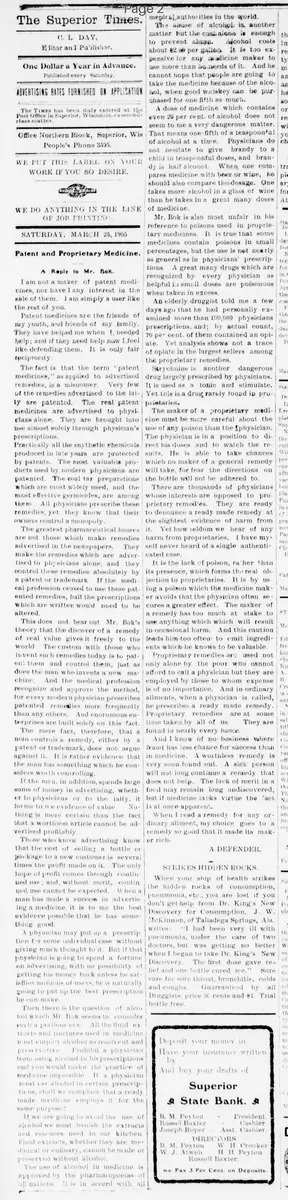
Patent and Proprietary Medicine.
A Reply to Mr. Bok.
I am not a maker of patent medicines, nor have I any interest in the sale of them. I am simply a user like the rest of you.
Patent medicines are the friends of my youth, and friends of my family.
They have helped me when I needed help; and if they need help now I feel like defending them. It is only fair reciprocity.
The fact is that the term "patent medicines," as applied to advertised remedies, is a misnomer. Very few of the remedies advertised to the laity are patented. The real patent medicines are advertised to physicians alone. They are brought into use almost solely through physician's prescriptions.
Practically all the synthetic chemicals produced in late years are protected by patents. The most valuable products used by modern physicians are patented. The coal tar preparations which are most widely used, and the most effective germicides, are among them. All physicians prescribe these remedies, yet they know that their owners control a monopoly.
The greatest pharmaceutical houses are not those which make remedies advertised in the newspapers. They make the remedies which are advertised to physicians alone, and they control these remedies absolutely by a patent or trademark. If the medical profession ceased to use these patented remedies, half the prescriptions which are written would need to be altered.
This does not bear out Mr. Bok's theory that the discoverer of a remedy of real value gives it freely to the world. The custom with those who invent such remedies today is to patent them and control them, just as does the man who invents a new machine. And the medical profession recognize and approve the method, for every modern physician prescribes patented remedies more frequently than any others. And enormous enterprises are built solely on this fact.
The mere fact, therefore, that a man controls a remedy, either by a patent or trademark, does not argue against it. It is rather evidence that the man has something which he considers worth controlling.
If the man, in addition, spends large sums of money in advertising, whether to physicians or to the laity, it forms no evidence of value. Nothing is more certain than the fact that a worthless article cannot be advertised profitably.
Those who know advertising know that the cost of selling a bottle or package to a new customer is several times the profit made on it. The only hope of profit comes through continued use; and, without merit, continued use cannot be expected. When a man has made a success in advertising a medicine, it is to me the best evidence possible that he has something good.
A physician may put up a prescription for some individual case without giving much thought to it. But if that physician is going to spend a fortune on advertising, with no possibility of getting his money back unless he satisfies millions of users, he is naturally going to put up the best prescription he can make.
Then there is the question of alcohol which Mr. Bok seems to consider such a perilous one. All the fluid extracts and tinctures used in medicine employ alcohol as resolvent and preservative. Prohibit a physician from using alcohol in his prescriptions and you would make the practice of medicine impossible. If a physician must use alcohol in certain prescriptions, shall we complain that a ready made medicine employs it for the same purpose?
If we are going to avoid the use of alcohol we must banish the extracts and essences used in our kitchen. Fluid extracts, whether they are medicinal or culinary, cannot be made or preserved without alcohol.
The use of alcohol in medicine is approved by the pharmacopoeias of all nations. It is in accord with all medical authorities in the world.
The abuse of alcohol is another matter, but the cost alone is enough to prevent abuse.
Alcohol costs about $2.00 per gallon. It is too expensive for any medicine maker to use more than he needs of it. And he cannot hope that people are going to take the medicine because of the alcohol, when good whiskey can be purchased for one-fifth as much.
A dose of medicine which contains even 20 per cent. of alcohol does not seem to me a very dangerous matter. That means one-fifth of a teaspoonful of alcohol at a time. Physicians do not hesitate to give brandy to a child in teaspoonful doses, and brandy is half alcohol. When one compares medicine with beer or wine, he should also compare the dosage. One takes more alcohol in a glass of wine than he takes in a great many doses of medicine.
Mr. Bok is also most unfair in his reference to poisons used in proprietary medicines. It is true that some medicines contain poisons in small percentages, but the use is not nearly as general as in physicians' prescriptions. A great many drugs which are recognized by every physician as helpful in small doses are poisonous when taken in excess.
An elderly druggist told me a few days ago that he had personally examined more than 100,000 physicians' prescriptions, and by actual count, 70 per cent. of them contained an opiate. Yet analysis shows not a trace of opiate in the largest sellers among the proprietary remedies.
Strychnine is another dangerous drug largely prescribed by physicians. It is used as a tonic and stimulant. Yet this is a drug rarely found in proprietaries.
The maker of a proprietary medicine must be more careful about the use of any poison than the physician. The physician is in a position to direct his doses and to watch the results. He is able to take chances which no maker of a general remedy will take, for fear the directions on the bottle will not be adhered to.
There are thousands of physicians whose interests are opposed to proprietary remedies. They are ready to denounce a ready made remedy at the slightest evidence of harm from it. Yet how seldom we hear of any harm from proprietaries. I have myself never heard of a single authenticated case.
It is the lack of poison, rather than its presence, which forms the real objection to proprietaries. It is by using a poison which the medicine maker avoids that the physician often secures a greater effect. The maker of a remedy has too much at stake to use anything which will result in occasional harm. And this caution leads him too often to omit ingredients which he knows to be valuable.
Proprietary remedies are used not only alone by the poor who cannot afford to call a physician but they are employed by those to whom expense is of no importance. And in ordinary ailments, when a physician is called, he prescribes a ready made remedy.
Proprietary remedies are at some time taken by all of us. They are found in nearly every home.
And I know of no business where fraud has less chance for success than in medicine. A worthless remedy is very soon found out. A sick person will not long continue a remedy that does not help. The lack of merit in a food may remain long undiscovered, but if medicine lacks virtue the fact is at once apparent.
When I read a remedy for any ordinary ailment, my choice goes to a remedy so good that it made its maker rich.
A DEFENDER.
A Reply to Mr. Bok.
I am not a maker of patent medicines, nor have I any interest in the sale of them. I am simply a user like the rest of you.
Patent medicines are the friends of my youth, and friends of my family.
They have helped me when I needed help; and if they need help now I feel like defending them. It is only fair reciprocity.
The fact is that the term "patent medicines," as applied to advertised remedies, is a misnomer. Very few of the remedies advertised to the laity are patented. The real patent medicines are advertised to physicians alone. They are brought into use almost solely through physician's prescriptions.
Practically all the synthetic chemicals produced in late years are protected by patents. The most valuable products used by modern physicians are patented. The coal tar preparations which are most widely used, and the most effective germicides, are among them. All physicians prescribe these remedies, yet they know that their owners control a monopoly.
The greatest pharmaceutical houses are not those which make remedies advertised in the newspapers. They make the remedies which are advertised to physicians alone, and they control these remedies absolutely by a patent or trademark. If the medical profession ceased to use these patented remedies, half the prescriptions which are written would need to be altered.
This does not bear out Mr. Bok's theory that the discoverer of a remedy of real value gives it freely to the world. The custom with those who invent such remedies today is to patent them and control them, just as does the man who invents a new machine. And the medical profession recognize and approve the method, for every modern physician prescribes patented remedies more frequently than any others. And enormous enterprises are built solely on this fact.
The mere fact, therefore, that a man controls a remedy, either by a patent or trademark, does not argue against it. It is rather evidence that the man has something which he considers worth controlling.
If the man, in addition, spends large sums of money in advertising, whether to physicians or to the laity, it forms no evidence of value. Nothing is more certain than the fact that a worthless article cannot be advertised profitably.
Those who know advertising know that the cost of selling a bottle or package to a new customer is several times the profit made on it. The only hope of profit comes through continued use; and, without merit, continued use cannot be expected. When a man has made a success in advertising a medicine, it is to me the best evidence possible that he has something good.
A physician may put up a prescription for some individual case without giving much thought to it. But if that physician is going to spend a fortune on advertising, with no possibility of getting his money back unless he satisfies millions of users, he is naturally going to put up the best prescription he can make.
Then there is the question of alcohol which Mr. Bok seems to consider such a perilous one. All the fluid extracts and tinctures used in medicine employ alcohol as resolvent and preservative. Prohibit a physician from using alcohol in his prescriptions and you would make the practice of medicine impossible. If a physician must use alcohol in certain prescriptions, shall we complain that a ready made medicine employs it for the same purpose?
If we are going to avoid the use of alcohol we must banish the extracts and essences used in our kitchen. Fluid extracts, whether they are medicinal or culinary, cannot be made or preserved without alcohol.
The use of alcohol in medicine is approved by the pharmacopoeias of all nations. It is in accord with all medical authorities in the world.
The abuse of alcohol is another matter, but the cost alone is enough to prevent abuse.
Alcohol costs about $2.00 per gallon. It is too expensive for any medicine maker to use more than he needs of it. And he cannot hope that people are going to take the medicine because of the alcohol, when good whiskey can be purchased for one-fifth as much.
A dose of medicine which contains even 20 per cent. of alcohol does not seem to me a very dangerous matter. That means one-fifth of a teaspoonful of alcohol at a time. Physicians do not hesitate to give brandy to a child in teaspoonful doses, and brandy is half alcohol. When one compares medicine with beer or wine, he should also compare the dosage. One takes more alcohol in a glass of wine than he takes in a great many doses of medicine.
Mr. Bok is also most unfair in his reference to poisons used in proprietary medicines. It is true that some medicines contain poisons in small percentages, but the use is not nearly as general as in physicians' prescriptions. A great many drugs which are recognized by every physician as helpful in small doses are poisonous when taken in excess.
An elderly druggist told me a few days ago that he had personally examined more than 100,000 physicians' prescriptions, and by actual count, 70 per cent. of them contained an opiate. Yet analysis shows not a trace of opiate in the largest sellers among the proprietary remedies.
Strychnine is another dangerous drug largely prescribed by physicians. It is used as a tonic and stimulant. Yet this is a drug rarely found in proprietaries.
The maker of a proprietary medicine must be more careful about the use of any poison than the physician. The physician is in a position to direct his doses and to watch the results. He is able to take chances which no maker of a general remedy will take, for fear the directions on the bottle will not be adhered to.
There are thousands of physicians whose interests are opposed to proprietary remedies. They are ready to denounce a ready made remedy at the slightest evidence of harm from it. Yet how seldom we hear of any harm from proprietaries. I have myself never heard of a single authenticated case.
It is the lack of poison, rather than its presence, which forms the real objection to proprietaries. It is by using a poison which the medicine maker avoids that the physician often secures a greater effect. The maker of a remedy has too much at stake to use anything which will result in occasional harm. And this caution leads him too often to omit ingredients which he knows to be valuable.
Proprietary remedies are used not only alone by the poor who cannot afford to call a physician but they are employed by those to whom expense is of no importance. And in ordinary ailments, when a physician is called, he prescribes a ready made remedy.
Proprietary remedies are at some time taken by all of us. They are found in nearly every home.
And I know of no business where fraud has less chance for success than in medicine. A worthless remedy is very soon found out. A sick person will not long continue a remedy that does not help. The lack of merit in a food may remain long undiscovered, but if medicine lacks virtue the fact is at once apparent.
When I read a remedy for any ordinary ailment, my choice goes to a remedy so good that it made its maker rich.
A DEFENDER.
What sub-type of article is it?
Science Or Medicine
What keywords are associated?
Proprietary Medicines
Patent Remedies
Medical Advertising
Alcohol In Medicine
Poisons In Prescriptions
Physician Remedies
What entities or persons were involved?
Mr. Bok
Physicians
Pharmaceutical Houses
Editorial Details
Primary Topic
Defense Of Patent And Proprietary Medicines
Stance / Tone
Strongly Supportive Of Proprietary Remedies
Key Figures
Mr. Bok
Physicians
Pharmaceutical Houses
Key Arguments
Term 'Patent Medicines' Is Misnomer; Real Patents Are For Physician Prescribed Remedies.
Patented Remedies Are Widely Used And Approved By Medical Profession.
Advertising Success Proves Merit, As Worthless Products Cannot Sustain Continued Use.
Alcohol In Medicines Is Necessary And Minimal, Approved By Pharmacopoeias.
Poisons Are Less Common In Proprietaries Than In Physician Prescriptions.
Proprietaries Are Safer Due To Caution In Formulation And Rare Reports Of Harm.
Fraud Is Unlikely In Medicine Due To Quick Detection By Users.