Thank you for visiting SNEWPapers!
Sign up free
Norfolk Gazette And Publick Ledger
Norfolk, Virginia
What is this article about?
Response to a Whig article signed A.B.C. accusing the Treasury Secretary of violating the Non-Intercourse Act by issuing a circular allowing trade beyond France, Britain, and dependencies. Writer argues the act limits to exclusive sovereignties of those nations, not allies like Spain, Holland, Naples; provides decrees and letters showing initial welcoming of American vessels in those ports until later restrictions.
Clipping
OCR Quality
Full Text
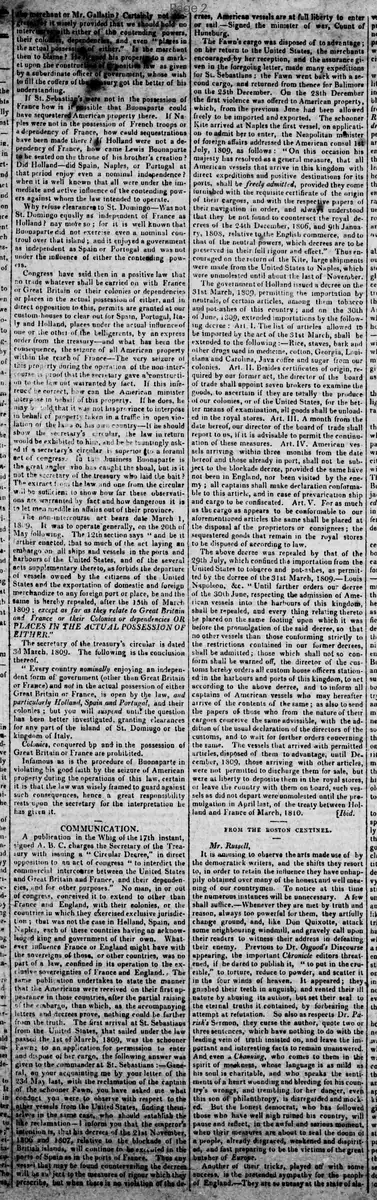
A publication in the Whig of the 17th instant, signed A. B. C. charges the Secretary of the Treasury with issuing a "Circular Decree," in direct opposition to an act of congress "to interdict the commercial intercourse between the United States and Great Britain and France, and their dependencies, and for other purposes."
No man, in or out of congress, conceived it to extend to other than France and England, with their colonies, or the countries in which they exercised exclusive jurisdiction; (but was not the case in Holland, Spain, and Naples, each of these countries having an acknowledged king and government of their own. Whatever influence France or England might have with the sovereigns of those, or other countries, was no part of a law, confined in its operation to the exclusive sovereignties of France and England.
The same publication undertakes to state the manner that the Americans were received on their first appearance in those countries, after the partial raising of the embargo, than which, as the accompanying letters and decrees prove, nothing could be farther from the truth.
The first arrival at St. Sebastians from the United States, that sailed under the law passed the 1st of March, 1809, was the schooner Fawn; to an application or permission to enter and dispose of her cargo, the following answer was given to the commander at St. Sebastians: General, on your acquainting me by your letter of the 23d May last, with the reclamation of the captain of the schooner Fawn, you have asked me what conduct you were to observe with respect to the other vessels from the United States, finding themselves in the same case, who should establish the like reclamation-- I inform you that the emperor's intention is, that his decrees of the 21st November, 1806 and 1807 relative to the blockade of the British islands, will continue to be executed in the ports of Spain as in the ports of France. Thus any vessel that may be found countervailing the decrees will be subject to the measures of rigour which they prescribe, but when there is no violation of the decrees, American vessels are at full liberty to enter or sail Signed the minister of war, Count of Huneburg.
The Fawn's cargo was disposed of to advantage; on her return to the United States, the merchants encouraged by her reception, and the assurance given in the foregoing letter, made many expeditions for St. Sebastians; the Fawn went back with a second cargo, and returned from thence for Baltimore on the 25th December.- On the 28th December the first violence was offered to American property, which, from the previous tone had been allowed freely to be imported and exported.
The schooner Kite arrived at Naples the first vessel, on application to admit her to enter, the Neapolitan minister of foreign affairs addressed the American consul 1st July, 1809, as follows: "On this occasion his majesty has resolved as a general measure, that all American vessels that arrive in this kingdom with direct expeditions and positive destinations or its ports, shall be freely admitted, provided they come furnished with the requisite certificate of the origin of their cargoes, and with the respective papers of their navigation in order, and always understood that they be not found to counteract the royal decrees of the 24th December, 1806, and 9th January, 1808, relative to the English commerce, and to that of the neutral powers, which decrees are to be preserved in their full rigour and effect."
Thus encouraged on the return of the Kite, large shipments were made from the United States to Naples, which were unmolested until about the last of November.
The government of Holland issued a decree on the 31st March, 1809, permitting the importation by neutrals, of certain articles, among them tobacco and pot-ashes of this country; and on the 30th of June, 1809, extended importations by the following decree: Art. I. The list of articles allowed to be imported by the act of the 31st March, shall be extended to the following :-Rice, staves, bark and other drugs used in medicine, cotton, Georgia, Louisiana and Carolina, Java coffee and sugar from our colonies.
Art. II. Besides certificates of origin, required by our former act, the director of the board of trade shall appoint seven brokers to examine the goods, to ascertain if they are totally the produce of our colonies, or of the United States, for the better means of examination, all goods shall be unloaded in the royal stores.
Art. III. A month from the date hereof, our director of the board of trade shall report to us, if it is advisable to permit the continuation of these measures.
Art. IV. American vessels arriving within three months from the date hereof and those already in port, shall not be subject to the blockade decree, provided the same have not been in England, nor been visited by the enemy; all captains shall make declaration conformable to this article, and in case of prevarication ship and cargo to be confiscated.
Art. V. For as much as the cargo as appears to be conformable to our aforementioned articles the same shall be placed at the disposal of the proprietors or consignees; the sequestered goods that remain in the royal stores to be disposed of according to law.
The above decree was repealed by that of the 29th July, which confined the importation from the United States to tobacco and pot-ashes, as permitted by the decree of the 31st March, 1809.-Louis Napoleon, &c. "Until farther orders our decree of the 30th June, respecting the admission of American vessels into the harbours of this kingdom, shall be repealed, and every thing relating thereto be placed on the same footing" upon which it was before the promulgation of the said decree, so that no other vessels than those conforming strictly to the restrictions contained in our former decrees, shall be admitted; those which shall not so conform shall be warned off, the director of the customs hereby orders all custom house officers stationed in the harbours and ports of this kingdom, to act according to the above decree, and to inform all captains of American vessels who may hereafter arrive of the contents of the same; as also to send the papers of those who from the nature of their cargoes conceive the same advisable, with the addition of the usual declaration of the directors of the customs, and to wait for further orders concerning the same.
The vessels that arrived with permitted articles, disposed of them to advantage, until December, 1809, those arriving with other articles, were not permitted to discharge them for sale, but were at liberty to deposite them in the royal stores, or leave the country with them on board, such vessels as did not depart were unmolested until the promulgation in April last, of the treaty between Holland and France of March, 1810.
[Ibid.
What sub-type of article is it?
What themes does it cover?
What keywords are associated?
Letter to Editor Details
Main Argument
the non-intercourse act applies only to france, britain, and their exclusive jurisdictions, not to independent nations like spain, holland, and naples despite influences; initial decrees in those ports welcomed american vessels, contradicting claims of hostility.
Notable Details