Thank you for visiting SNEWPapers!
Sign up free
Story
June 4, 1885
Yorkville Enquirer
York, York County, South Carolina
What is this article about?
An essay emphasizing the value of keen observation over mere book learning, illustrated by examples from savages, English shepherds, and natural phenomena like bird flights and plant signals for rain.
Clipping
OCR Quality
95%
Excellent
Full Text
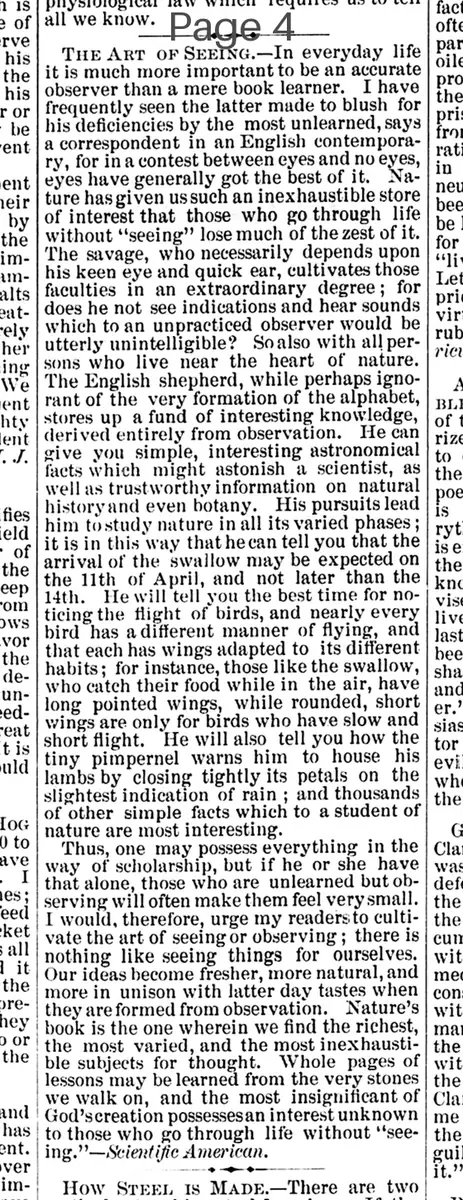
THE ART OF SEEING.—In everyday life it is much more important to be an accurate observer than a mere book learner. I have frequently seen the latter made to blush for his deficiencies by the most unlearned, says a correspondent in an English contemporary, for in a contest between eyes and no eyes, eyes have generally got the best of it. Nature has given us such an inexhaustible store of interest that those who go through life without "seeing" lose much of the zest of it. The savage, who necessarily depends upon his keen eye and quick ear, cultivates those faculties in an extraordinary degree; for does he not see indications and hear sounds which to an unpracticed observer would be utterly unintelligible? So also with all persons who live near the heart of nature. The English shepherd, while perhaps ignorant of the very formation of the alphabet, stores up a fund of interesting knowledge, derived entirely from observation. He can give you simple, interesting astronomical facts which might astonish a scientist, as well as trustworthy information on natural history and even botany. His pursuits lead him to study nature in all its varied phases; it is in this way that he can tell you that the arrival of the swallow may be expected on the 11th of April, and not later than the 14th. He will tell you the best time for noticing the flight of birds, and nearly every bird has a different manner of flying, and that each has wings adapted to its different habits; for instance, those like the swallow, who catch their food while in the air, have long pointed wings, while rounded, short wings are only for birds who have slow and short flight. He will also tell you how the tiny pimpernel warns him to house his lambs by closing tightly its petals on the slightest indication of rain: and thousands of other simple facts which to a student of nature are most interesting.
Thus, one may possess everything in the way of scholarship, but if he or she have that alone, those who are unlearned but observing will often make them feel very small. I would, therefore, urge my readers to cultivate the art of seeing or observing; there is nothing like seeing things for ourselves. Our ideas become fresher, more natural, and more in unison with latter day tastes when they are formed from observation. Nature's book is the one wherein we find the richest, the most varied, and the most inexhaustible subjects for thought. Whole pages of lessons may be learned from the very stones we walk on, and the most insignificant of God's creation possesses an interest unknown to those who go through life without "seeing."—Scientific American.
Thus, one may possess everything in the way of scholarship, but if he or she have that alone, those who are unlearned but observing will often make them feel very small. I would, therefore, urge my readers to cultivate the art of seeing or observing; there is nothing like seeing things for ourselves. Our ideas become fresher, more natural, and more in unison with latter day tastes when they are formed from observation. Nature's book is the one wherein we find the richest, the most varied, and the most inexhaustible subjects for thought. Whole pages of lessons may be learned from the very stones we walk on, and the most insignificant of God's creation possesses an interest unknown to those who go through life without "seeing."—Scientific American.
What sub-type of article is it?
Curiosity
What themes does it cover?
Moral Virtue
Nature
What keywords are associated?
Observation
Nature Study
English Shepherd
Bird Flight
Pimpernel Rain
Scientific American
Story Details
Story Details
The article argues that observation trumps book learning, using examples of savages and English shepherds who gain profound knowledge of nature through keen senses, such as predicting swallow arrivals, bird flight adaptations, and pimpernel signaling rain.