Thank you for visiting SNEWPapers!
Sign up free
The Wilmingtonian, And Delaware Register
Wilmington, New Castle County, Delaware
What is this article about?
Demonstration of Mr. H. R. Palmer's suspension railway at Cheshunt, Hertfordshire, opened for public inspection on Saturday last, successfully transporting passengers and goods with one horse.
Clipping
OCR Quality
Full Text
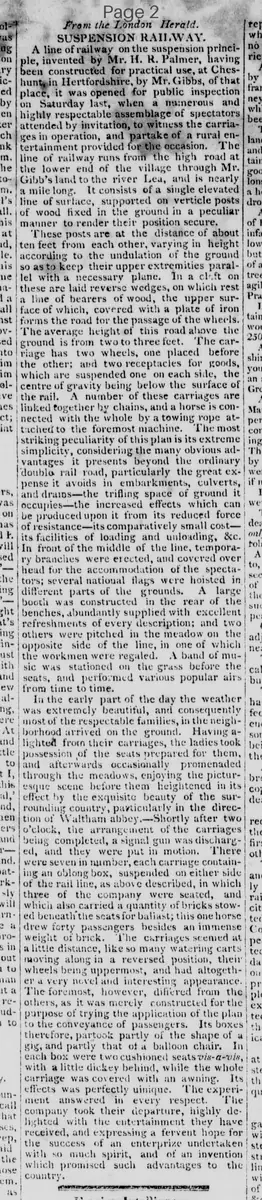
SUSPENSION RAILWAY.
A line of railway on the suspension principle, invented by Mr. H. R. Palmer, having been constructed for practical use, at Cheshunt, in Hertfordshire, by Mr. Gibbs, of that place, it was opened for public inspection on Saturday last, when a numerous and highly respectable assemblage of spectators attended by invitation, to witness the carriages in operation, and partake of a rural entertainment provided for the occasion. The line of railway runs from the high road at the lower end of the village through Mr. Gibbs's land to the river Lea, and is nearly a mile long. It consists of a single elevated line of surface, supported on vertical posts of wood fixed in the ground in a peculiar manner to render their position secure. These posts are at the distance of about ten feet from each other, varying in height according to the undulation of the ground so as to keep their upper extremities parallel with a necessary plane. In a cleft on these are laid reverse wedges, on which rest a line of bearers of wood, the upper surface of which, covered with a plate of iron forms the road for the passage of the wheels. The average height of this road above the ground is from two to three feet. The carriage has two wheels, one placed before the other; and two receptacles for goods, which are suspended one on each side, the centre of gravity being below the surface of the rail. A number of these carriages are linked together by chains, and a horse is connected with the whole by a towing rope attached to the foremost machine. The most striking peculiarity of this plan is its extreme simplicity, considering the many obvious advantages it presents beyond the ordinary double rail road, particularly the great expense it avoids in embankments, culverts, and drains—the trifling space of ground it occupies—the increased effects which can be produced upon it from its reduced force of resistance—its comparatively small cost—its facilities of loading and unloading, &c.
In front of the middle of the line, temporary branches were erected, and covered overhead for the accommodation of the spectators; several national flags were hoisted in different parts of the grounds. A large booth was constructed in the rear of the benches, abundantly supplied with excellent refreshments of every description; and two others were pitched in the meadow on the opposite side of the line, in one of which the workmen were regaled. A band of music was stationed on the grass before the seats, and performed various popular airs from time to time.
In the early part of the day the weather was extremely beautiful, and consequently most of the respectable families, in the neighborhood arrived on the ground. Having alighted from their carriages, the ladies took possession of the seats prepared for them, and afterwards occasionally promenaded through the meadows, enjoying the picturesque scene before them heightened in its effect by the exquisite beauty of the surrounding country, particularly in the direction of Waltham abbey.—Shortly after two o'clock, the arrangement of the carriages being completed, a signal gun was discharged, and they were put in motion. There were seven in number, each carriage containing an oblong box, suspended on either side of the rail line, as above described, in which three of the company were seated, and which also carried a quantity of bricks stowed beneath the seats for ballast: this one horse drew forty passengers besides an immense weight of brick. The carriages seemed at a little distance, like so many watering carts moving along in a reversed position, their wheels being uppermost, and had altogether a very novel and interesting appearance. The foremost, however, differed from the others, as it was merely constructed for the purpose of trying the application of the plan to the conveyance of passengers. Its boxes therefore, partook partly of the shape of a gig, and partly that of a balloon chair. In each box were two cushioned seats vis-a-vis, with a little dickey behind, while the whole carriage was covered with an awning. Its effect was perfectly unique. The experiment answered in every respect. The company took their departure, highly delighted with the entertainment they have received, and expressing a fervent hope for the success of an enterprize undertaken with so much spirit, and of an invention which promised such advantages to the country.
What sub-type of article is it?
What keywords are associated?
What entities or persons were involved?
Where did it happen?
Foreign News Details
Primary Location
Cheshunt, Hertfordshire
Event Date
Saturday Last
Key Persons
Outcome
the experiment answered in every respect; company highly delighted and hopeful for success.
Event Details
A suspension railway invented by Mr. H. R. Palmer was constructed by Mr. Gibbs at Cheshunt, Hertfordshire, and opened for public inspection. The nearly one-mile line runs from the high road through Mr. Gibbs's land to the river Lea, elevated on wooden posts with iron-plated surface. Carriages with suspended boxes for goods and passengers, linked by chains, drawn by one horse, carried forty passengers and bricks. Demonstration successful with novel appearance and advantages in simplicity, cost, and space.