Thank you for visiting SNEWPapers!
Sign up free
The Siftings Herald
Arkadelphia, Clark County, Arkansas
What is this article about?
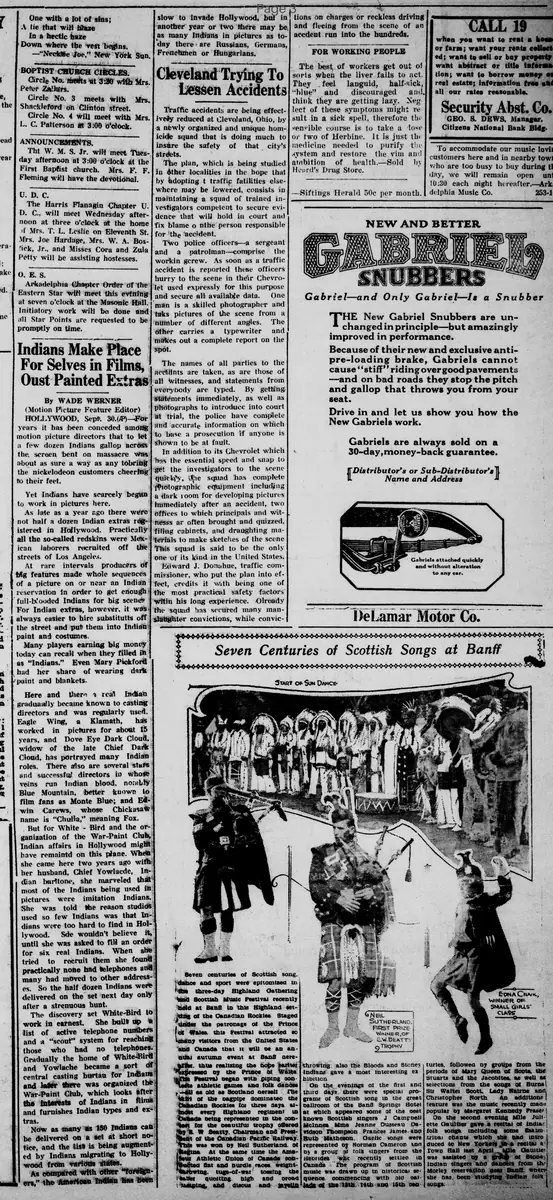
Native Americans are increasingly securing roles as extras and actors in Hollywood films, transitioning from using Mexican substitutes. White-Bird and Chief Yowlachie organized the War-Paint Club to supply real Indians, now providing up to 150 at short notice. Notable figures include Monte Blue and Edwin Carewe with Indian heritage.
Merged-components note: Images are spatially adjacent to the story on Indians in films and likely serve as illustrations for the article.
Clipping
OCR Quality
Full Text
Most Painted Extras
By WADE WERNER
(Motion Picture Feature Editor)
HOLLYWOOD, Sept. 30.(P)-For years it has been conceded among motion picture directors that to let a few dozen Indians gallop across the screen bent on massacre was about as sure a way as any to bring the nickelodeon customers cheering to their feet.
Yet Indians have scarcely begun to work in pictures here.
As late as a year ago there were not half a dozen Indian extras registered in Hollywood. Practically all the so-called redskins were Mexican laborers recruited off the streets of Los Angeles.
At rare intervals producers of big features made whole sequences of a picture on or near an Indian reservation in order to get enough full-blooded Indians for big scenes For Indian extras, however, it was always easier to hire substitutes off the street and put them into Indian paint and costumes.
Many players earning big money today can recall when they filled in as "Indians." Even Mary Pickford had her share of wearing dark paint and blankets.
Here and there a real Indian gradually became known to casting directors and was regularly used. Eagle Wing, a Klamath, has worked in pictures for about 15 years, and Dove Eye Dark Cloud, widow of the late Chief Dark Cloud, has portrayed many Indian roles. There also are several stars and successful directors in whose veins run Indian blood, notably Blue Mountain, better known to film fans as Monte Blue: and Edwin Carewe, whose Chickasaw name is "Chulla," meaning Fox.
But for White-Bird and the organization of the War-Paint Club, Indian affairs in Hollywood might have remained on this plane. When she came here two years ago with her husband, Chief Yowlachie, Indian baritone, she marveled that most of the Indians being used in pictures were imitation Indians.
She was told the reason studios used so few Indians was that Indians were too hard to find in Hollywood. She wouldn't believe it until she was asked to fill an order for six real Indians. When she tried to recruit them she found practically none had telephones and many had moved to other addresses. So the half dozen Indians were delivered on the set next day only after a strenuous hunt.
The discovery set White-Bird to work in earnest. She built up a list of active telephone numbers and a "scout" system for reaching those who had no telephones.
Gradually the home of White-Bird and Yowlachie became a sort of central casting bureau for Indians and later there was organized the War-Paint Club, which looks after the interests of Indians in films and furnishes Indian types and extras.
Now as many as 150 Indians can be delivered on a set at short notice, and the list is being augmented by Indians migrating to Hollywood from various states.
As compared with other "foreigners," the American Indian has been slow to invade Hollywood, but in another year or two there may be as many Indians in pictures as today there are Russians, Germans, Frenchmen or Hungarians.
What sub-type of article is it?
What themes does it cover?
What keywords are associated?
What entities or persons were involved?
Where did it happen?
Story Details
Key Persons
Location
Hollywood
Story Details
Native Americans gradually integrate into Hollywood film industry as real extras and actors, replacing imitation substitutes, through efforts of White-Bird and the War-Paint Club which organizes and supplies Indian talent to studios.