Thank you for visiting SNEWPapers!
Sign up free
Portland Gazette, And Maine Advertiser
Portland, Cumberland County, Maine
What is this article about?
Proceedings of the Twelfth Congress, First Session, in the U.S. Senate and House of Representatives from May 11-13, 1812, covering passage of bills, debates on repealing the Non-Intercourse Law due to French aggressions, discussions on the Embargo, petitions from merchants and others, and motions regarding war preparations and trade restrictions with Britain and France.
Merged-components note: Continuous reports on congressional proceedings, including Senate debates and House sessions, as a unified domestic political update.
Clipping
OCR Quality
Full Text
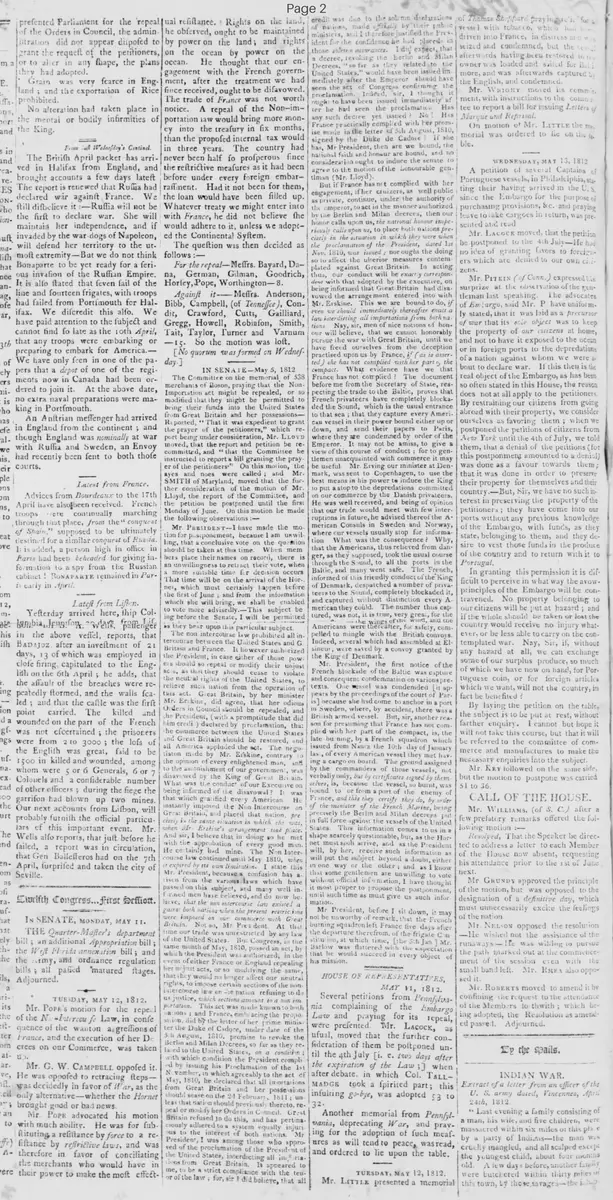
IN SENATE, MONDAY, MAY 11.
THE Quarter-Master's department bill; an additional Appropriation bill; the West Florida annexation bill; and the army, and ordnance regulation bills; all passed matured stages.
Adjourned.
TUESDAY, MAY 12, 1812.
Mr. Pope's motion for the repeal of the Non-Intercourse Law, in consequence of the wanton aggressions of France, and the execution of her Decrees on our Commerce, was taken up.
Mr. G. W. Campbell opposed it. He was opposed to retracing steps—was decidedly in favor of War, as the only alternative—whether the Hornet brought good or bad news.
Mr. Pope advocated his motion with much ability. He was for substituting a resistance by force to a resistance by restrictive laws, and was therefore in favor of conciliating the merchants who would have in their power to make the most effectual resistance. Rights on the land, be observed, ought to be maintained by power on the land; and rights on the ocean by power on the ocean. He thought that our engagement with the French government, after the treatment we had since received, ought to be disavowed.
The trade of France was not worth notice. A repeal of the Non-importation law would bring more money into the treasury in six months, than the proposed internal tax would in three years. The country had never been half so prosperous since the restrictive measures as it had been before under every foreign embarrassment. Had it not been for them, the loan would have been filled up.
Whatever treaty we might enter into with France, he did not believe she would adhere to it, unless we adopted the Continental System.
The question was then decided as follows:--
For the repeal--Messrs. Bayard, Dana, German, Gilman, Goodrich, Horsey, Pope, Worthington--8.
Against it--Messrs. Anderson, Bibb, Campbell, (of Tennessee), Condit, Crawford, Cutts, Gailliard, Gregg, Howell, Robinson, Smith, Tait, Taylor, Turner and Varnum--15. So the motion was lost.
[No quorum was formed on Wednesday.]
IN SENATE--May 5, 1812
The Committee on the memorial of 538 merchants of Boston, praying that the Non-Importation act might be repealed, or so modified that they might be permitted to bring their funds into the United States from Great Britain and her possessions--
Reported, "That it was expedient to grant the prayer of the petitioners," which report being under consideration, Mr. Lloyd moved, that the report and petition be recommitted, and "that the Committee be instructed to report a bill granting the prayer of the petitioners" On this motion, the ayes and noes were called: and Mr. SMITH of Maryland, moved that the further consideration of the motion of Mr. Lloyd, the report of the Committee, and the petition be postponed until the first Monday of June. On this motion he made the following observations:--
Mr. President--I have made the motion for postponement, because I am unwilling, that a conclusive vote on the question should be taken at this time. When members place their names on record, there is an unwillingness to retract their vote, when a more suitable time for decision occurs. That time will be on the arrival of the Hornet, which must certainly happen before the first of June: and from the information which she will bring, we shall be enabled to vote more advisedly.--This subject being before the Senate, I will be permitted to make a few observations, as they bear upon this particular subject.
The non intercourse law prohibited all intercourse between the United States and Great Britain and France. It however authorized the President, in case either of those powers should so repeal or modify their unjust acts, as that they should cease to violate the neutral rights of the United States, to relieve such nation from the operation of this act. Great Britain, by her minister Mr. Erskine, did agree, that her odious Orders in Council should be repealed, and the President, (with a promptitude that did him credit) declared by proclamation, that the commerce between the United States and Great Britain should be restored, and all America applauded the act. The negotiation made by Mr. Erskine, contrary to the opinion of every enlightened man, and to the astonishment of our government, was disavowed by the King of Great Britain.
What was the conduct of our Executive on being informed of the disavowal? It was that which gratified every American. He instantly imposed the Non Intercourse on Great Britain, and placed that nation precisely in the same situation in which she was when Mr Erskine's arrangement took place. And sir, I believe that in doing so he met with the approbation of every good man. He certainly had mine. The Non Intercourse law continued until May 1810, when it expired by its own limitation. I state this Mr. President. because a confusion has arisen from the various laws which have passed on this subject, and many well informed men have believed, and do now believe, that the non intercourse law existed against both nations when the present restrictions were imposed on our commerce with Great Britain. Not so. Mr President. At that time our trade was unrestricted by any law of the United States. But Congress, in the same month of May, 1810, passed an act, by which the President was authorized, in the event of either France or England repealing her unjust acts, or so modifying the same, that they would no longer affect our neutral rights, to impose certain sections of the non-intercourse law on the nation refusing to do us justice, which sections amount to a non importation. This act was made known to both nations; and France, embracing the proposition, did by the letter of her prime minister the Duke of Cadore, under date of the 5th August, 1810. promise to revoke the Berlin and Milan Decrees, so far as they related to the United States, on a condition; with which condition the President complied by issuing his Proclamation of the 1st November, in which agreeably to the act of May, 1810, he declared that all importations from Great Britain and her possessions should cease on the 2d February, 1811; unless that nation should previously thereto, repeal or modify her Orders in Council. Great Britain refused to do this, and has pertinaciously adhered to a system equally injurious to the interest of both nations. Mr. President, I was among those who approved of the proclamation of the President of the United States, interdicting all importations from Great Britain. It appeared to me, to be a strict compliance with the tenor of the law; for, sir I did believe, that all credit was due to the solemn declarations of nations, made officially by their public ministers, and I therefore justified the President for the confidence he had placed in those solemn assurances. I did expect, that a decree, revoking the Berlin and Milan Decrees, "so far as they related to the United States," would have been issued immediately after the Emperor should have seen the act of Congress confirming the proclamation. Indeed, sir, I thought it ought to have been issued immediately after he had seen the proclamation. Has any such decree yet issued? No! Has France practically complied with her promise made in the letter of 5th August, 1810, signed by the Duke de Cadore? If she has, Mr President, then are we bound, the national faith and honour are bound, and no consideration ought to induce the senate to agree to the motion of the Honourable gentleman (Mr. Lloyd).
But if France has not complied with her engagement, if her cruizers, as well public as private, continue, under the authority of the emperor, to act in the manner authorized by the Berlin and Milan decrees, then our honor calls upon us, the national honour imperiously calls upon us, to place both nations precisely in the situation in which they were when the proclamation of the President, dated 1st Nov. 1810, was issued; nor ought the doing so to affect the ulterior measures contemplated against Great Britain. In acting thus, our conduct will be exactly correspondent with that adopted by the executive, on being informed that Great Britain had disavowed the arrangement entered into with Mr. Erskine. This we are bound to do, if even we should immediately thereafter enact a law interdicting all importations from both nations. Nay, sir, men of nice notions of honour will believe, that we cannot honorably pursue the war with Great Britain, until we have freed ourselves from the deception practised upon us by France, if (as is asserted) she has not complied with her part of the compact. What evidence have we that France has not complied? The document before me from the Secretary of State, respecting the trade to the Baltic, proves that French privateers have completely blockaded the Sound, which is the usual entrance to that sea; that they capture every American vessel in their power bound either up or down, and send their papers to Paris, where they are condemned by order of the Emperor. It may not be amiss, to give a view of this course of conduct; for to gentlemen unacquainted with commerce it may be useful. Mr. Erving our minister at Denmark, was sent to Copenhagen, to use the best means in his power to induce the King to put a stop to the depredations committed on our commerce by the Danish privateers. He was well received, and being of opinion that our trade would meet with few interruptions in future, he advised thereof the American Consuls in Sweden and Norway, where our vessels usually stop for information. What was the consequence? Why, that the Americans, thus relieved from danger, as they supposed, took the usual course through the Sound, to all the ports in the Baltic, and many went safe. The French, informed of this friendly conduct of the King of Denmark, despatched a number of privateers to the Sound, completely blockaded it, and captured without distinction every American they could. The number thus captured, was not, it is true, very great, for the Americans were thereafter, for safety, compelled to mingle with the British convoys. Indeed, several which had assembled at Elsinore, were saved by a convoy granted by the King of Denmark.
Mr. President, the first notice of the French blockade of the Baltic was capture and consequent condemnation on various pretexts. One vessel was condemned [it appears by the proceedings of the court of Paris] because she had come to anchor in a port in Sweden, where, by accident, there was a British armed vessel. But, sir, another reason for presuming that France has not complied with her part of the compact, is, the late burning, by a French squadron which issued from Nantes the 10th day of January last, of every American vessel they met having a cargo on board. The ground assigned by the commanders of those vessels, not verbally only, but by certificates signed by themselves, is, because the vessel, so burnt, was bound to or from a port of the enemy of France, and this they certify they do, by order of the minister of the French Marine, being precisely the Berlin and Milan decrees put in full force against the vessels of the United States. This information comes to us in a shape scarcely questionable, but, as the Hornet must soon arrive, and as the President will, by her, receive such information as will put the subject beyond a doubt, either in one way or the other; and as I know that some gentlemen are unwilling to vote without official information, I have thought it most proper to propose the postponement, until such time as must give us such information.
Mr President, before I sit down, it may not be unworthy of remark, that the French burning squadron left France five days after the departure therefrom, of the frigate Constitution, at which time, [the 5th Jan.] Mr. Barlow was flattered with the expectation that he would succeed in every object of his mission.
HOUSE OF REPRESENTATIVES,
May 11, 1812.
Several petitions from Pennsylvania complaining of the Embargo Law and praying for its repeal, were presented. Mr. Lacock, as usual, moved that the further consideration of them be postponed until the 4th July [i. e. two days after the expiration of the Law;] when after debate, in which Col. Talmadge took a spirited part; this insulting go-bye, was adopted 53 to 32.
Another memorial from Pennsylvania, deprecating War, and praying for the adoption of such measures as will tend to peace, was read, and ordered to lie upon the table.
TUESDAY, MAY 12, 1812.
Mr. Little presented a memorial of Thomas Shepard praying compensation for a vessel with tobacco, which had been driven into France, in distress and seized and condemned, but the vessel afterwards having been restored to the owner was loaded and sailed for Baltimore, and was afterwards captured by the English, and condemned.
Mr. Newton moved its commitment, with instructions to the committee to report a bill for issuing Letters of Marque and Reprisal.
On motion of Mr. Little the memorial was ordered to lie on the table.
WEDNESDAY, MAY 13, 1812
A petition of several Captains of Portuguese vessels, in Philadelphia, stating their having arrived in the U. S. since the Embargo for the purpose of purchasing provisions, &c. and praying leave to take cargoes in return, was presented and read.
Mr. Lacock moved, that the petition be postponed to the 4th July—He had no idea of granting favors to foreigners which are denied to our own citizens.
Mr. Pitkin (of Conn.) expressed his surprise at the observation of the gentleman last speaking. The advocates of Embargo, said Mr. P. have uniformly stated, that it was laid as a precursor of war that its sole object was to keep the property of our citizens at home and not to have it exposed to the ocean or in foreign ports to the depredations of a nation against whom we were about to declare war. If this then is the real object of the Embargo, as has been so often stated in this House, the reason does not at all apply to the petitioners. By restraining our citizens from going abroad with their property, we consider ourselves as favoring them; when we postponed the petitions of citizens from New York until the 4th of July, we told them, that a denial of the petitions (for this postponement amounted to a denial) was done as a favour towards them; that it was done in order to preserve their property for themselves and their country.—But, Sir, we have no such interest in preserving the property of the petitioners; they have come into our ports without any previous knowledge of the Embargo, with funds, as they state, belonging to them, and they desire to vest those funds in the produce of the country and to return with it to Portugal.
In granting this permission it is difficult to perceive in what way the avowed principles of the Embargo will be contravened. No property belonging to our citizens will be put at hazard; and if the whole should be taken or lost the country would receive no injury whatever, or be less able to carry on the contemplated war. Nay, Sir, if, without any hazard at all, we can exchange some of our surplus produce, so much of which we have now on hand, for Portuguese coin, or for foreign articles which we want, will not the Country, in fact be benefited?
By laying the petition on the table, the subject is to be put at rest, without farther enquiry. I cannot but hope it will not take this course, but that it will be referred to the committee of commerce and manufactures to make the necessary enquiries into the subject.
Mr. Key followed on the same side. but the motion to postpone was carried 51 to 36.
CALL OF THE HOUSE.
Mr. Williams, (of S. C.) after a few prefatory remarks offered the following motion:--
Resolved, That the Speaker be directed to address a letter to each Member of the House now absent, requesting his attendance prior to the 1st of June next.
Mr. Grumpy approved the principle of the motion, but was opposed to the designation of a definitive day, which must unnecessarily excite the feelings of the nation.
Mr. Newton opposed the resolution—He wished not the assistance of the runaways—He was willing to pursue the path marked out at the commencement of the session even with the small band left. Mr. Rhea also opposed it.
Mr. Roberts moved to amend it by confining the request to the attendance of the Members forthwith; which being adopted, the Resolution as amended passed. Adjourned.
What sub-type of article is it?
What keywords are associated?
What entities or persons were involved?
Domestic News Details
Event Date
May 11 13, 1812
Key Persons
Outcome
several bills passed matured stages; mr. pope's motion for repeal of non-intercourse law lost 8-15; report on boston merchants' memorial postponed to june; petitions from pennsylvania postponed to july 4 or laid on table; portuguese captains' petition postponed to july 4; resolution for calling absent house members passed as amended.
Event Details
Senate debates on repealing Non-Intercourse Law due to French aggressions, with speeches by Pope and Campbell; vote on repeal; earlier May 5 discussion by Smith of Maryland on postponing consideration of merchants' petition pending Hornet's arrival, detailing history of non-intercourse, French non-compliance with decrees, and captures of American vessels; House presents petitions against Embargo and for peace, memorials for compensation, Portuguese trade petition; debates and postponements; call for absent members.