Thank you for visiting SNEWPapers!
Sign up free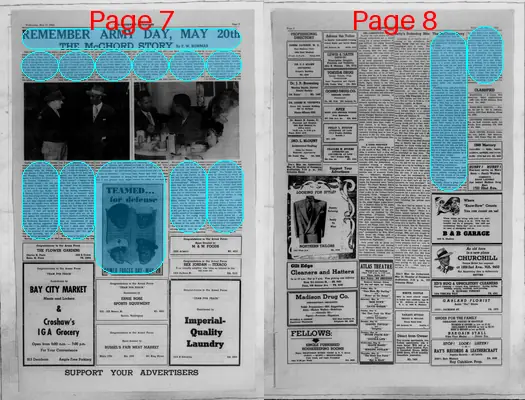
The Northwest Enterprise
Seattle, King County, Washington
What is this article about?
In May 1950, journalist F.W. Bowmar, skeptical of military desegregation, visits McChord Air Force Base near Tacoma, WA, with Sgt. Leo Helling. He observes integrated operations, interviews Negro and white personnel, and concludes the non-segregation policy is succeeding, promoting equality and efficiency.
Merged-components note: Merged continuation of McChord Air Force Base story across pages based on explicit 'Continued on Page 8' text.
Clippings
1 of 2
OCR Quality
Full Text
THE McCHORD STORY
By F. W. BOWMAR
This week, throughout the world, many of us will be taken back a few years to those many of us spent in one of the Armed Forces, for it is during this week that all of the Armed Forces will be putting on their best fronts, showing us what has taken place toward unification, and the many other things so important to all of us in maintaining our security and the peace of the world.
During the past week remembrances of those few years past were brought back to your writer personally when he visited the home station of the 325th Fighter (Air Warning) Wing, recently assigned to McChord Air Force Base, near Tacoma, Washington. However, before I can tell you that story, I shall first need to tell you how it was made possible. A few weeks ago, M/Sgt. Leo B. Helling, U.S.A.F. Army and Air Force Recruiting Service, came to our office with a story regarding the fact that Negroes could now enlist in the regular army without restriction or limitation heretofore imposed upon the Negro for enlistment. I read, and agreed to print his article, and many of you good people will remember it appeared in the April 26th issue of The Northwest Enterprise. It was then Sgt. Helling suggested that I visit one of the military installations nearby, and see for myself that the program of non-segregation was operating, and that it was operating successfully. Having been a member of the Armed Forces, I felt quite a bit skeptical about the wonders, of "The new Army and Air Force" as related to me by the Sergeant. So, after discussing this proposition over a couple of cups of coffee, and the necessity that we had to change our plans a couple of times, it was agreed that we would drop in at one of the installations on May 9th. Naturally, I felt that this had been a "pre-arranged" affair.
but I found later that it was not, for bright and early on the morning of the 9th on arriving at the office, I found the sergeant waiting for our trip. On the way out of Seattle, the Sgt. casually asked: "Which shall it be, McChord Field or Fort Lewis?" I replied to the effect that since he perhaps had his "orders" from the higher-ups, it didn't make much difference. Well, Sgt. Helling immediately let me know in no uncertain words that this tour was entirely a plan between him and me - where we went or what we did would be according to my wishes, and would I please tell him which I chose? It was then that I began to believe that this perhaps might not be a publicity stunt after all, so the lot fell to McChord Air Force Base. I was influenced toward McChord since my remembrance of good old Fort Lewis centered around the time I spent there when I began my Army career, and those remembrances aren't too generous. We arrived at the gate guarding the air base at 10:15, and the first airman I saw was a sharp, snappily dressed military policeman. He recognized the official staff car and gave us the high sign to enter, and we had arrived at McChord Air Force Base. This airman safeguarding the gate was a Negro, and you could tell that he had a lot of pride in himself and his job. Our first stop was at the headquarters of the station, where I was introduced to and cordially greeted by officers and enlisted men alike, and here I received my second surprise - my color seemed to make no difference - for everyone seemed interested in seeing that I was granted every single wish. Altho the commanding officer was not in his office at the moment, his staff informed me to go wherever I wished, talk to whomever I desired, either Negro or white, and to do just exactly what I wished in order that I might reach an unbiased opinion as to whether or not the program of Negro equality within the service was working. So, we started around the base.
and observing a group of airmen working in seeding a new lawn. We stopped to talk to them. It was a mixed group and I talked to both, Negro and white regardless their personal feelings and views toward the policy of non-segregation.
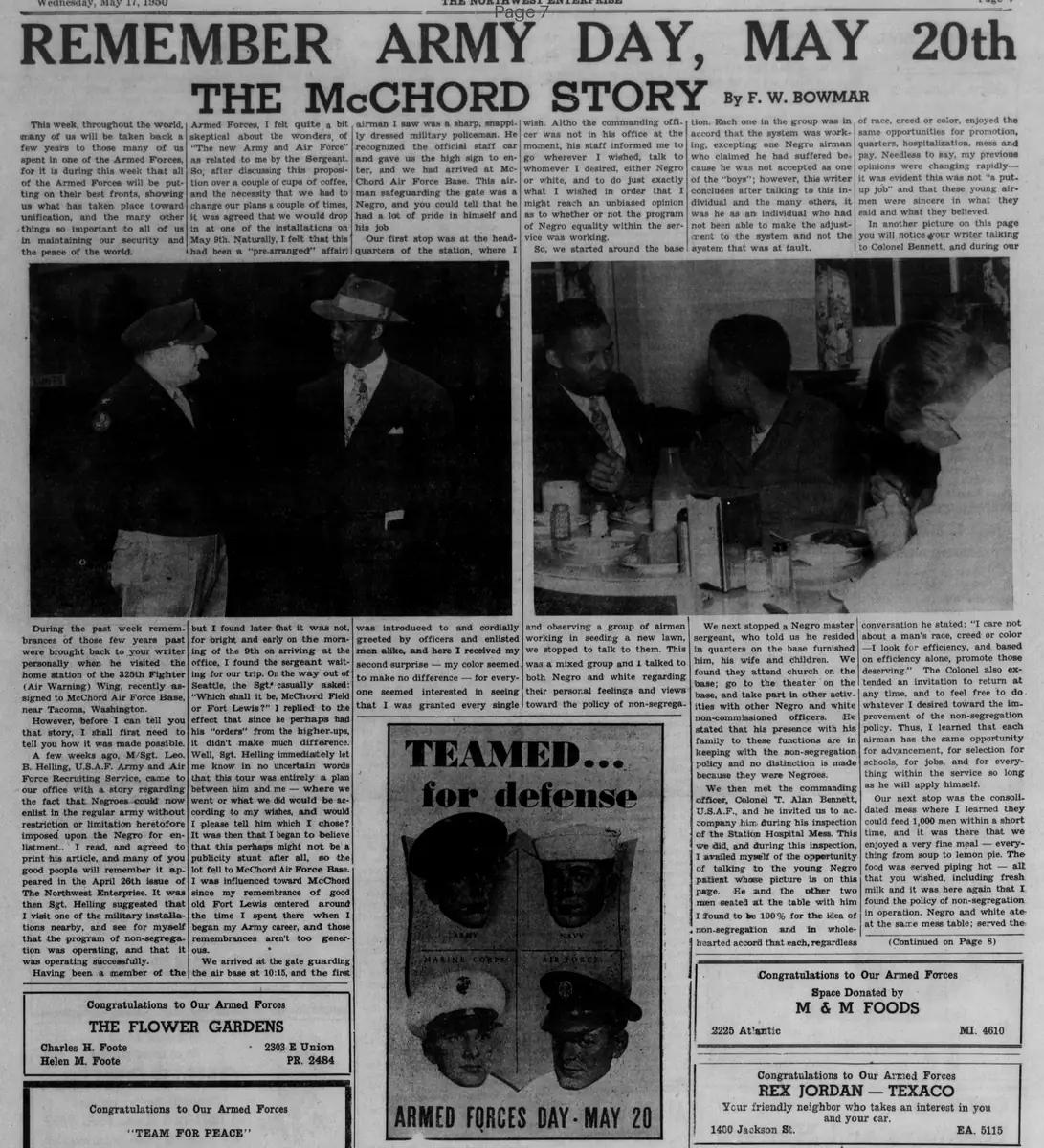
We next stopped a Negro master sergeant, who told us he resided in quarters on the base furnished him, his wife and children. We found they attend church on the base; go to the theater on the base, and take part in other activities with other Negro and white non-commissioned officers. He stated that his presence with his family to these functions are in keeping with the non-segregation policy and no distinction is made because they were Negroes. We then met the commanding officer, Colonel T. Alan Bennett, U.S.A.F., and he invited us to accompany him during his inspection of the Station Hospital Mess. This we did, and during this inspection, I availed myself of the opportunity of talking to the young Negro patient whose picture is on this page. He and the other two men seated at the table with him I found to be 100% for the idea of non-segregation and in whole-hearted accord that each, regardless of race, creed or color, enjoyed the same opportunities for promotion, quarters, hospitalization, mess and pay. Needless to say, my previous opinions were changing rapidly - it was evident this was not "a put-up job" and that these young airmen were sincere in what they said and what they believed. In another picture on this page you will notice your writer talking to Colonel Bennett, and during our conversation he stated: "I care not about a man's race, creed or color - I look for efficiency, and based on efficiency alone, promote those deserving." The Colonel also extended an invitation to return at any time, and to feel free to do whatever I desired toward the improvement of the non-segregation policy. Thus, I learned that each airman has the same opportunity for advancement, for selection for schools, for jobs, and for everything within the service so long as he will apply himself. Our next stop was the consolidated mess where I learned they could feed 1,000 men within a short time, and it was there that we enjoyed a very fine meal - everything from soup to lemon pie. The food was served piping hot - all that you wished, including fresh milk and it was here again that I found the policy of non-segregation in operation. Negro and white ate at the same mess table; served the same food and that Negro food service technicians worked alongside the white.
(Continued on Page 8)
The McChord Story
(Continued on Page 8)
I found that the mess sergeant is required to take examinations relating to his field quite frequently, and should he fail to maintain himself with the standards established, he will be stepped down to a lower rank until he reaches the rank he can pass the examination. What a difference between the mess sergeant of the regular service and those of my acquaintance during the war!!! I wonder how many of our war time mess sergeants could pass muster under the standards of today?
Finishing mess, and after talking to several in the mess hall, where the reactions to this policy were the same as previously experienced, we again started our tour of the base, when I spotted two Negro WAF's. This was a complete surprise. Sgt. Helling called them over to the car, asked where they worked. and offered them a ride to their work in order that I might talk to them without taking them from their jobs. One of them was a supply clerk and the other a typist. Their views of life in the service was great, excepting that one of the girls had recently been stationed in Illinois, where she had married just prior to her transfer, and she was lonesome for her husband. While there seems to be no provisions at the moment making it possible for the assignment of husband and wife who are both in the service to the same station for duty it is hoped that the Air Force will soon meet this problem as it has the many others.
Following our interview with the Negro WAF's we returned to Seattle and from this tour, I draw the following conclusions:
First, the services have made wonderful improvements in promotion policies, training possibilities, and the morale of the troops has improved markedly, especially for the Negro.
Secondly, there a great deal of absence of discrimination because of color, creed or race. For the most part men are all treated with the same justice and equality.
Third, while there is still room for improvement in the service, much is being done to improve the selection. The policy of equality for all in regard to race and religion shows immense improvement.
I could not close this article without expressing my appreciation to Colonel T. Allan Bennett, the officers, men and women of McChord A.F. Base, and M/Sgt. Leo B. Helling, for to them I owe deep gratitude. I am proud that I was offered the opportunity of seeing for myself, and to all you readers. I urge: Visit one of our military installations during this week, or as often as you can, and see for yourselves. I did, and I'm convinced.
TEAMED for defense
ARMED FORCES DAY - MAY 20
Wednesday, May 17, 1950
What sub-type of article is it?
What themes does it cover?
What keywords are associated?
What entities or persons were involved?
Where did it happen?
Story Details
Key Persons
Location
Mcchord Air Force Base, Near Tacoma, Washington
Event Date
May 9, 1950
Story Details
Skeptical journalist F.W. Bowmar visits McChord AFB with Sgt. Helling, observes non-segregated operations including gate guard, headquarters, lawn work, family quarters, hospital mess, consolidated mess, and WAFs; interviews personnel who affirm equality; changes views positively on desegregation policy.