Thank you for visiting SNEWPapers!
Sign up free
Editorial
August 30, 1816
Daily National Intelligencer
Washington, District Of Columbia
What is this article about?
The editorial supports James Monroe's election to the Presidency, highlighting it as evidence of the United States' stable republican government maintaining consistent public policy for over 20 years, contrasting with the frequent changes in European nations. It refutes monarchist claims of popular fickleness.
Clipping
OCR Quality
98%
Excellent
Full Text
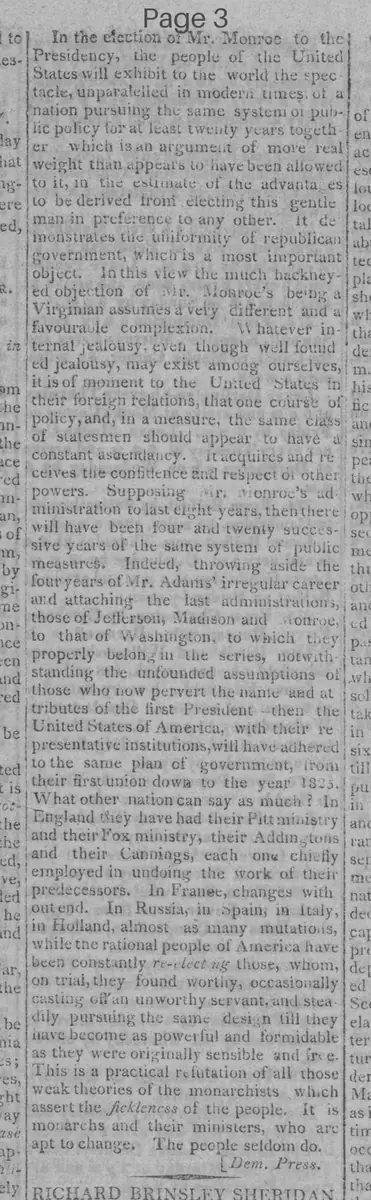
In the election of Mr. Monroe to the Presidency, the people of the United States will exhibit to the world the spectacle, unparallelled in modern times, of a nation pursuing the same system of public policy for at least twenty years together which is an argument of more real weight than appears to have been allowed to it, in the estimate of the advantages to be derived from electing this gentleman in preference to any other. It demonstrates the uniformity of republican government, which is a most important object. In this view the much hackneyed objection of Mr. Monroe's being a Virginian assumes a very different and a favourable complexion. Whatever internal jealousy, even though well founded jealousy, may exist among ourselves, it is of moment to the United States in their foreign relations, that one course of policy, and, in a measure, the same class of statesmen should appear to have a constant ascendancy. It acquires and receives the confidence and respect of other powers. Supposing Mr. Monroe's administration to last eight years, then there will have been four and twenty successive years of the same system of public measures. Indeed, throwing aside the four years of Mr. Adams' irregular career and attaching the last administrations, those of Jefferson, Madison and Monroe, to that of Washington, to which they properly belong in the series, notwithstanding the unfounded assumptions of those who now pervert the name and attributes of the first President—then the United States of America, with their representative institutions, will have adhered to the same plan of government, from their first union down to the year 1825. What other nation can say as much? In England they have had their Pitt ministry and their Fox ministry, their Addingtons and their Cannings, each one chiefly employed in undoing the work of their predecessors. In France, changes without end. In Russia, in Spain, in Italy, in Holland, almost as many mutations, while the rational people of America have been constantly re-electing those, whom, on trial, they found worthy, occasionally casting off an unworthy servant, and steadily pursuing the same design till they have become as powerful and formidable as they were originally sensible and free.
This is a practical refutation of all those weak theories of the monarchists which assert the fickleness of the people. It is monarchs and their ministers, who are apt to change. The people seldom do.
Dem. Press.
This is a practical refutation of all those weak theories of the monarchists which assert the fickleness of the people. It is monarchs and their ministers, who are apt to change. The people seldom do.
Dem. Press.
What sub-type of article is it?
Partisan Politics
Constitutional
What keywords are associated?
Monroe Election
Republican Stability
Policy Continuity
American Government
Foreign Relations
Monarchist Refutation
What entities or persons were involved?
Mr. Monroe
Jefferson
Madison
Washington
Mr. Adams
Pitt
Fox
Addington
Canning
Editorial Details
Primary Topic
Election Of James Monroe And Continuity Of Republican Policy
Stance / Tone
Supportive Of Monroe's Election Emphasizing Governmental Stability
Key Figures
Mr. Monroe
Jefferson
Madison
Washington
Mr. Adams
Pitt
Fox
Addington
Canning
Key Arguments
Election Of Monroe Shows 20+ Years Of Consistent Public Policy
Demonstrates Uniformity Of Republican Government
Addresses Objection To Monroe Being Virginian Favorably
Consistency Aids Foreign Relations And Respect From Other Powers
Links Administrations Of Washington, Jefferson, Madison, Monroe To 1825
Contrasts Us Stability With Changes In England, France, Russia, Spain, Italy, Holland
Refutes Monarchist Theories Of Popular Fickleness