Thank you for visiting SNEWPapers!
Sign up free
Editorial
August 15, 1795
Gazette Of The United States
Philadelphia, Philadelphia County, Pennsylvania
What is this article about?
A Federalist essay in the Columbian Centinel refutes Boston's objections to the 1794 Jay Treaty with Britain. It defends the constitutional process of Senate ratification, argues that all US complaints were considered in negotiations, and contends that demanding indemnity for British retention of western posts was impractical, prioritizing treaty benefits over unattainable compensation.
Clipping
OCR Quality
95%
Excellent
Full Text
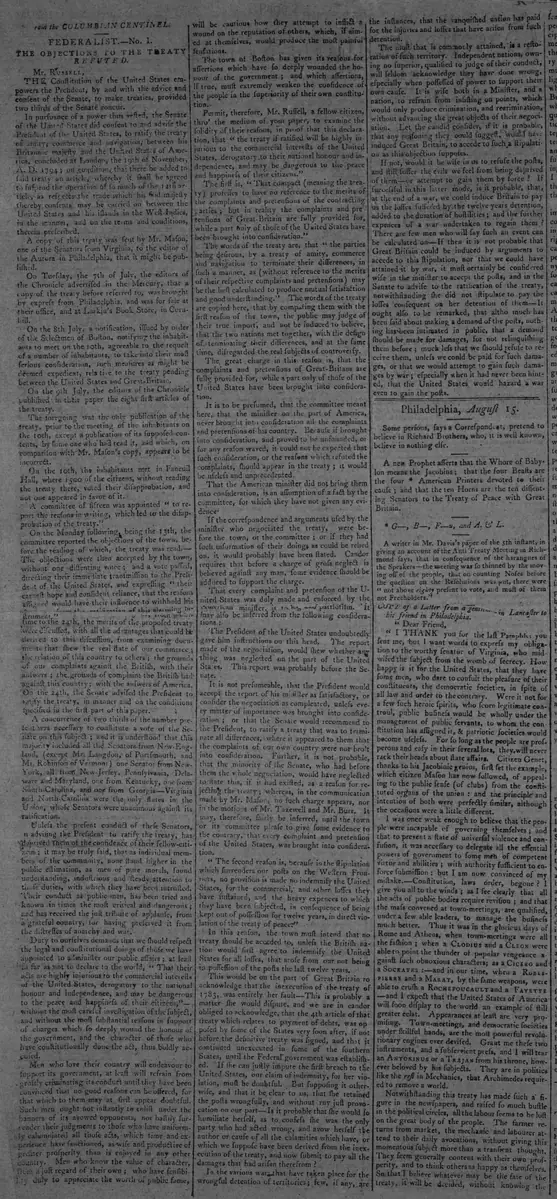
From the COLUMBIAN CENTINEL:
FEDERALIST.—NO. I.
THE OBJECTIONS TO THE TREATY
REFUTED.
Mr. RUSSELL,
THE Constitution of the United States empowers the President, by and with the advice and consent of the Senate, to make treaties, provided two thirds of the Senate concur.
In pursuance of a power thus vested, the Senate of the United States did consent to and advise the President of the United States, to ratify the treaty of amity, commerce and navigation, between his Britannic majesty and the United States of America, concluded at London, the 19th of November, A. D. 1794; on condition, that there be added to said treaty an article; whereby it shall be agreed to suspend the operation of so much of the 12th article, as respects the trade which his said majesty consents may be carried on between the United States and his islands in the West-Indies, in the manner, and on the terms and conditions, therein prescribed.
A copy of this treaty was sent by Mr. Mason, one of the Senators from Virginia, to the editor of the Aurora in Philadelphia, that it might be published.
On Tuesday, the 7th of July, the editors of the Chronicle advertised in the Mercury, that a copy of the treaty before referred to, was brought by express from Philadelphia, and was for sale at their office, and at Larkin's Book Store, in Cornhill.
On the 8th July, a notification, issued by order of the Selectmen of Boston, notifying the inhabitants to meet on the 10th, agreeable to the request of a number of inhabitants, to take into their most serious consideration, such measures as might be deemed expedient, relative to the treaty pending between the United States and Great-Britain.
On the 9th July, the editors of the Chronicle published in their paper the first eight articles of the treaty.
The foregoing was the only publication of the treaty, prior to the meeting of the inhabitants on the 10th, except a publication of its supposed contents, by some one who had read it, and which, on comparison with Mr. Mason's copy, appears to be incorrect.
On the 10th, the inhabitants met in Faneuil Hall, where 1800 of the citizens, without reading the treaty there, voted their disapprobation, and not one appeared in favor of it.
A committee of fifteen was appointed "to report the reasons in writing, which led to the disapprobation of the treaty."
On the Monday following, being the 12th, the committee reported the objections of the town, before the reading of which, the treaty was read.—The objections were then accepted by the town, without one dissenting voice; and a vote passed, directing their immediate transmission to the President of the United States, and expressing "their earnest hope and confident reliance, that the reasons adduced would have their influence to withhold his approbation of this alarming instrument."
From which time to the 24th, the merits of the proposed treaty were discussed, with all the advantages that could be derived to this discussion, from examining documents that show the real state of our commerce; the relation of this country to others; the grounds of our complaints against the British, with their answers; the grounds of complaint the British had against this country; with the answers of America.
On the 24th, the Senate advised the President to ratify the treaty, in manner and on the conditions specified in the first part of this paper.
A concurrence of two thirds of the number present was necessary to constitute a vote of the Senate on this subject; and it is understood that this majority included all the Senators from New-England, (except Mr. Langdon, of Portsmouth, and Mr. Robinson of Vermont) one Senator from New-York, all from New-Jersey, Pennsylvania, Delaware and Maryland, one from Kentucky, one from South Carolina, and one from Georgia. Virginia and North-Carolina were the only states in the Union, whose Senators were unanimous against its ratification.
Unless the present conduct of these Senators, in advising the President to ratify the treaty, has deprived them of the confidence of their fellow-citizens; it may be truly said, that as individual members of the community, none stand higher in the public estimation, as men of pure morals, sound understanding, industrious and steady attention to those duties, with which they have been intrusted.
Their conduct as public men, has been tried and known in times the most critical and dangerous; and has received the just tribute of applause, from a grateful country, for having preserved it from the distresses of anarchy and war.
Duty to ourselves demands that we should respect the legal and constitutional doings of those we have appointed to administer our public affairs; at least so far as not to declare to the world, "That their acts are highly injurious to the commercial interests of the United States, derogatory to the national honour and independence, and may be dangerous to the peace and happiness of their citizens,"—without the most careful investigation of the subject, and without the most substantial reasons in support of charges which so deeply wound the honour of the government, and the character of those who have constitutionally done the act, thus boldly accused.
Men who love their country will endeavour to support its government, at least will refrain from grossly criminating its conduct until they have been convinced that no good reasons can be offered, or that which to them may at first appear doubtful.
Such men ought not hastily to enlist under the banners of its avowed opponents, nor hastily surrender their judgments to those who have uniformly calumniated all those acts, which time and experience have sanctioned, as wise and productive of greater prosperity than is enjoyed in any other country. Men who know the value of character from a just regard of their own; who have sensibility duly to appreciate the worth of public fame, will be cautious how they attempt to inflict a wound on the reputation of others, which, if aimed at themselves, would produce the most painful sensations.
The town of Boston has given its reasons for assertions which have so deeply wounded the honour of the government; and which assertions, if true, must extremely weaken the confidence of the people in the superiority of their own constitution.
Permit, therefore, Mr. Russell, a fellow citizen, thro' the medium of your paper, to examine the solidity of their reasons, in proof that this declaration, that "the treaty if ratified will be highly injurious to the commercial interests of the United States, derogatory to their national honour and independence, and may be dangerous to the peace and happiness of their citizens."
The first is, "That compact (meaning the treaty) professes to have no reference to the merits of the complaints and pretensions of the contracting parties; but in reality the complaints and pretensions of Great-Britain are fully provided for, while a part only of those of the United States have been brought into consideration."
The words of the treaty are, that "the parties being desirous, by a treaty of amity, commerce and navigation to terminate their differences, in such a manner, as (without reference to the merits of their respective complaints and pretensions) may be the best calculated to produce mutual satisfaction and good understanding." The words of the treaty are copied here, that by comparing them with the first reason of the town, the public may judge of their true import, and not be induced to believe, that the two nations met together, with the design of terminating their differences, and at the same time, disregarded the real subjects of controversy.
The great charge in this reason is, that the complaints and pretensions of Great-Britain are fully provided for, while a part only of those of the United States have been brought into consideration.
It is to be presumed, that the committee meant here, that the minister on the part of America, never brought into consideration all the complaints and pretensions of his country. Because if brought into consideration, and proved to be unfounded, or for any reason waived, it could not be expected that such consideration, or the reasons which refuted the complaints, should appear in the treaty; it would be useless and unprecedented.
That the American minister did not bring them into consideration, is an assumption of a fact by the committee, for which they have not given any evidence.
If the correspondence and arguments used by the minister who negotiated the treaty, were before the town, or the committee; or if they had such information of their doings as could be relied on, it would probably have been stated. Candor requires that before a charge of gross neglect is believed against any man, some evidence should be adduced to support the charge.
That every complaint and pretension of the United States was duly made and enforced by the American minister, is to be sure patriotism. It may also be inferred from the following considerations:
The President of the United States undoubtedly gave him instructions on this head. The report made of the negotiation, would show whether anything was neglected on the part of the United States. This report was probably before the Senate.
It is not presumable, that the President would accept the report of his minister as satisfactory, or consider the negotiation as completed, unless every matter of importance was brought into consideration; or that the Senate would recommend to the President, to ratify a treaty that was to terminate all differences, where it appeared to them that the complaints of our own country were not bro't into consideration. Further, it is not probable, that the minority of the Senate, who had before them the whole negotiation, would have neglected to state this, if it had existed, as a reason for rejecting the treaty; whereas, in the communication made by Mr. Mason, no such charge appears, nor in the motions of Mr. Tazewell and Mr. Burr. It may, therefore, fairly be inferred, until the town or its committee please to give some evidence to the contrary, that every complaint and pretension of the United States, was brought into consideration.
"The second reason is, because in the stipulation which surrenders our posts on the Western Frontiers, no provision is made to indemnify the United States, for the commercial, and other loss they have sustained, and the heavy expenses to which they have been subjected, in consequence of being kept out of possession for twelve years, in direct violation of the treaty of peace."
In this reason, the town must intend that no treaty should be acceded to, unless the British nation would first agree to indemnify the United States for all loss, that arose from our not being in possession of the posts the last twelve years.
This would be on the part of Great Britain to acknowledge that the inexecution of the treaty of 1783, was entirely her fault—This is probably a matter she would dispute, and we are in candor obliged to acknowledge, that the 4th article of that treaty which relates to payment of debts, was opposed by some of the States very soon after, if not before the definitive treaty was signed, and that it continued unexecuted in some of the southern States, until the Federal government was established. If she can justly impute the first breach to the United States, our claim of indemnity, for her violation, must be doubtful. But supposing it otherwise, and that it be clear to us, that she retained the posts wrongfully, and without any just provocation on our part—Is it probable that she would so humiliate herself, as to confess she was the only party who had acted wrong, and avow herself the author or cause of all the calamities which have, or which we suppose have been derived from the inexecution of the treaty, and now submit to pay all the damages that had arisen therefrom?
In the various wars that have taken place for the wrongful detention of territories; few, if any, are the instances, that the vanquished nation has paid for the injuries and loss that have arisen from such detention.
The most that is commonly attained, is a restoration of such territory. Independent nations, owning no superior, qualified to judge of their conduct, will seldom acknowledge they have done wrong, especially when possessed of power to support their own cause. It is wise both in a Minister, and a nation, to refrain from insisting on points, which would only produce crimination, and recrimination, without advancing the great objects of their negotiation. Let the candid consider, if it is probable, that any reasoning they could suggest, would have induced Great Britain, to accede to such a stipulation as this objection supposes.
If not, would it be wise in us to refuse the posts, and still suffer the evils we feel from being deprived of them—or attempt to gain them by force? If successful in this latter mode, is it probable, that, at the end of a war, we could induce Britain to pay us the loss suffered by the twelve years detention, added to the duration of hostilities; and the further expenses of a war undertaken to regain them?
There are few men who will say such an event can be calculated on—If then it is not probable that Great Britain could be induced by arguments to accede to this stipulation, nor that we could have attained it by war, it must certainly be considered wise in the minister to accept the posts, and in the Senate to advise to the ratification of the treaty, notwithstanding he did not stipulate to pay the losses consequent on her detention of them—It ought also to be remarked, that altho much has been said about making a demand of the posts, nothing has been intimated in public, that a demand should be made for damages, for not relinquishing them before: much less that we should refuse to receive them, unless we could be paid for such damages, or that we would attempt to gain such damages by war; especially when it had never been hinted, that the United States would hazard a war even to gain the posts.
FEDERALIST.—NO. I.
THE OBJECTIONS TO THE TREATY
REFUTED.
Mr. RUSSELL,
THE Constitution of the United States empowers the President, by and with the advice and consent of the Senate, to make treaties, provided two thirds of the Senate concur.
In pursuance of a power thus vested, the Senate of the United States did consent to and advise the President of the United States, to ratify the treaty of amity, commerce and navigation, between his Britannic majesty and the United States of America, concluded at London, the 19th of November, A. D. 1794; on condition, that there be added to said treaty an article; whereby it shall be agreed to suspend the operation of so much of the 12th article, as respects the trade which his said majesty consents may be carried on between the United States and his islands in the West-Indies, in the manner, and on the terms and conditions, therein prescribed.
A copy of this treaty was sent by Mr. Mason, one of the Senators from Virginia, to the editor of the Aurora in Philadelphia, that it might be published.
On Tuesday, the 7th of July, the editors of the Chronicle advertised in the Mercury, that a copy of the treaty before referred to, was brought by express from Philadelphia, and was for sale at their office, and at Larkin's Book Store, in Cornhill.
On the 8th July, a notification, issued by order of the Selectmen of Boston, notifying the inhabitants to meet on the 10th, agreeable to the request of a number of inhabitants, to take into their most serious consideration, such measures as might be deemed expedient, relative to the treaty pending between the United States and Great-Britain.
On the 9th July, the editors of the Chronicle published in their paper the first eight articles of the treaty.
The foregoing was the only publication of the treaty, prior to the meeting of the inhabitants on the 10th, except a publication of its supposed contents, by some one who had read it, and which, on comparison with Mr. Mason's copy, appears to be incorrect.
On the 10th, the inhabitants met in Faneuil Hall, where 1800 of the citizens, without reading the treaty there, voted their disapprobation, and not one appeared in favor of it.
A committee of fifteen was appointed "to report the reasons in writing, which led to the disapprobation of the treaty."
On the Monday following, being the 12th, the committee reported the objections of the town, before the reading of which, the treaty was read.—The objections were then accepted by the town, without one dissenting voice; and a vote passed, directing their immediate transmission to the President of the United States, and expressing "their earnest hope and confident reliance, that the reasons adduced would have their influence to withhold his approbation of this alarming instrument."
From which time to the 24th, the merits of the proposed treaty were discussed, with all the advantages that could be derived to this discussion, from examining documents that show the real state of our commerce; the relation of this country to others; the grounds of our complaints against the British, with their answers; the grounds of complaint the British had against this country; with the answers of America.
On the 24th, the Senate advised the President to ratify the treaty, in manner and on the conditions specified in the first part of this paper.
A concurrence of two thirds of the number present was necessary to constitute a vote of the Senate on this subject; and it is understood that this majority included all the Senators from New-England, (except Mr. Langdon, of Portsmouth, and Mr. Robinson of Vermont) one Senator from New-York, all from New-Jersey, Pennsylvania, Delaware and Maryland, one from Kentucky, one from South Carolina, and one from Georgia. Virginia and North-Carolina were the only states in the Union, whose Senators were unanimous against its ratification.
Unless the present conduct of these Senators, in advising the President to ratify the treaty, has deprived them of the confidence of their fellow-citizens; it may be truly said, that as individual members of the community, none stand higher in the public estimation, as men of pure morals, sound understanding, industrious and steady attention to those duties, with which they have been intrusted.
Their conduct as public men, has been tried and known in times the most critical and dangerous; and has received the just tribute of applause, from a grateful country, for having preserved it from the distresses of anarchy and war.
Duty to ourselves demands that we should respect the legal and constitutional doings of those we have appointed to administer our public affairs; at least so far as not to declare to the world, "That their acts are highly injurious to the commercial interests of the United States, derogatory to the national honour and independence, and may be dangerous to the peace and happiness of their citizens,"—without the most careful investigation of the subject, and without the most substantial reasons in support of charges which so deeply wound the honour of the government, and the character of those who have constitutionally done the act, thus boldly accused.
Men who love their country will endeavour to support its government, at least will refrain from grossly criminating its conduct until they have been convinced that no good reasons can be offered, or that which to them may at first appear doubtful.
Such men ought not hastily to enlist under the banners of its avowed opponents, nor hastily surrender their judgments to those who have uniformly calumniated all those acts, which time and experience have sanctioned, as wise and productive of greater prosperity than is enjoyed in any other country. Men who know the value of character from a just regard of their own; who have sensibility duly to appreciate the worth of public fame, will be cautious how they attempt to inflict a wound on the reputation of others, which, if aimed at themselves, would produce the most painful sensations.
The town of Boston has given its reasons for assertions which have so deeply wounded the honour of the government; and which assertions, if true, must extremely weaken the confidence of the people in the superiority of their own constitution.
Permit, therefore, Mr. Russell, a fellow citizen, thro' the medium of your paper, to examine the solidity of their reasons, in proof that this declaration, that "the treaty if ratified will be highly injurious to the commercial interests of the United States, derogatory to their national honour and independence, and may be dangerous to the peace and happiness of their citizens."
The first is, "That compact (meaning the treaty) professes to have no reference to the merits of the complaints and pretensions of the contracting parties; but in reality the complaints and pretensions of Great-Britain are fully provided for, while a part only of those of the United States have been brought into consideration."
The words of the treaty are, that "the parties being desirous, by a treaty of amity, commerce and navigation to terminate their differences, in such a manner, as (without reference to the merits of their respective complaints and pretensions) may be the best calculated to produce mutual satisfaction and good understanding." The words of the treaty are copied here, that by comparing them with the first reason of the town, the public may judge of their true import, and not be induced to believe, that the two nations met together, with the design of terminating their differences, and at the same time, disregarded the real subjects of controversy.
The great charge in this reason is, that the complaints and pretensions of Great-Britain are fully provided for, while a part only of those of the United States have been brought into consideration.
It is to be presumed, that the committee meant here, that the minister on the part of America, never brought into consideration all the complaints and pretensions of his country. Because if brought into consideration, and proved to be unfounded, or for any reason waived, it could not be expected that such consideration, or the reasons which refuted the complaints, should appear in the treaty; it would be useless and unprecedented.
That the American minister did not bring them into consideration, is an assumption of a fact by the committee, for which they have not given any evidence.
If the correspondence and arguments used by the minister who negotiated the treaty, were before the town, or the committee; or if they had such information of their doings as could be relied on, it would probably have been stated. Candor requires that before a charge of gross neglect is believed against any man, some evidence should be adduced to support the charge.
That every complaint and pretension of the United States was duly made and enforced by the American minister, is to be sure patriotism. It may also be inferred from the following considerations:
The President of the United States undoubtedly gave him instructions on this head. The report made of the negotiation, would show whether anything was neglected on the part of the United States. This report was probably before the Senate.
It is not presumable, that the President would accept the report of his minister as satisfactory, or consider the negotiation as completed, unless every matter of importance was brought into consideration; or that the Senate would recommend to the President, to ratify a treaty that was to terminate all differences, where it appeared to them that the complaints of our own country were not bro't into consideration. Further, it is not probable, that the minority of the Senate, who had before them the whole negotiation, would have neglected to state this, if it had existed, as a reason for rejecting the treaty; whereas, in the communication made by Mr. Mason, no such charge appears, nor in the motions of Mr. Tazewell and Mr. Burr. It may, therefore, fairly be inferred, until the town or its committee please to give some evidence to the contrary, that every complaint and pretension of the United States, was brought into consideration.
"The second reason is, because in the stipulation which surrenders our posts on the Western Frontiers, no provision is made to indemnify the United States, for the commercial, and other loss they have sustained, and the heavy expenses to which they have been subjected, in consequence of being kept out of possession for twelve years, in direct violation of the treaty of peace."
In this reason, the town must intend that no treaty should be acceded to, unless the British nation would first agree to indemnify the United States for all loss, that arose from our not being in possession of the posts the last twelve years.
This would be on the part of Great Britain to acknowledge that the inexecution of the treaty of 1783, was entirely her fault—This is probably a matter she would dispute, and we are in candor obliged to acknowledge, that the 4th article of that treaty which relates to payment of debts, was opposed by some of the States very soon after, if not before the definitive treaty was signed, and that it continued unexecuted in some of the southern States, until the Federal government was established. If she can justly impute the first breach to the United States, our claim of indemnity, for her violation, must be doubtful. But supposing it otherwise, and that it be clear to us, that she retained the posts wrongfully, and without any just provocation on our part—Is it probable that she would so humiliate herself, as to confess she was the only party who had acted wrong, and avow herself the author or cause of all the calamities which have, or which we suppose have been derived from the inexecution of the treaty, and now submit to pay all the damages that had arisen therefrom?
In the various wars that have taken place for the wrongful detention of territories; few, if any, are the instances, that the vanquished nation has paid for the injuries and loss that have arisen from such detention.
The most that is commonly attained, is a restoration of such territory. Independent nations, owning no superior, qualified to judge of their conduct, will seldom acknowledge they have done wrong, especially when possessed of power to support their own cause. It is wise both in a Minister, and a nation, to refrain from insisting on points, which would only produce crimination, and recrimination, without advancing the great objects of their negotiation. Let the candid consider, if it is probable, that any reasoning they could suggest, would have induced Great Britain, to accede to such a stipulation as this objection supposes.
If not, would it be wise in us to refuse the posts, and still suffer the evils we feel from being deprived of them—or attempt to gain them by force? If successful in this latter mode, is it probable, that, at the end of a war, we could induce Britain to pay us the loss suffered by the twelve years detention, added to the duration of hostilities; and the further expenses of a war undertaken to regain them?
There are few men who will say such an event can be calculated on—If then it is not probable that Great Britain could be induced by arguments to accede to this stipulation, nor that we could have attained it by war, it must certainly be considered wise in the minister to accept the posts, and in the Senate to advise to the ratification of the treaty, notwithstanding he did not stipulate to pay the losses consequent on her detention of them—It ought also to be remarked, that altho much has been said about making a demand of the posts, nothing has been intimated in public, that a demand should be made for damages, for not relinquishing them before: much less that we should refuse to receive them, unless we could be paid for such damages, or that we would attempt to gain such damages by war; especially when it had never been hinted, that the United States would hazard a war even to gain the posts.
What sub-type of article is it?
Foreign Affairs
Constitutional
Partisan Politics
What keywords are associated?
Jay Treaty
British Treaty
Senate Ratification
Boston Objections
Western Posts
Treaty Negotiation
Federalist Defense
What entities or persons were involved?
President Of The United States
Senate
Great Britain
Boston Inhabitants
Mr. Mason
American Minister
Editorial Details
Primary Topic
Refutation Of Objections To The Jay Treaty
Stance / Tone
Defensive Support For Treaty Ratification
Key Figures
President Of The United States
Senate
Great Britain
Boston Inhabitants
Mr. Mason
American Minister
Key Arguments
Constitution Empowers President And Senate To Make Treaties With Two Thirds Concurrence.
Senate Advised Ratification On June 24, 1795, With Conditions Suspending West Indies Trade Provisions.
Boston Disapproved Treaty Without Full Reading, Based On Partial Publication.
All Us Complaints Were Brought Into Consideration By The American Minister, As Inferred From Presidential Instructions And Senate Review.
Demanding Indemnity For Western Posts Retention Is Impractical, As Britain Unlikely To Admit Fault Or Pay Damages.
Better To Secure Posts Via Treaty Than Risk War Without Gaining Compensation.
Critics Should Respect Constitutional Government Actions Without Hasty Accusations.