Thank you for visiting SNEWPapers!
Sign up free
Editorial
June 17, 1895
The Herald
Los Angeles, Los Angeles County, California
What is this article about?
This editorial mocks the inaccuracies in English journalism about U.S. events, including Admiral Meade's retirement due to criticizing President Cleveland, and a satirical London Times piece on Coxey's Industrial Army misrepresenting American geography and politics.
Clipping
OCR Quality
98%
Excellent
Full Text
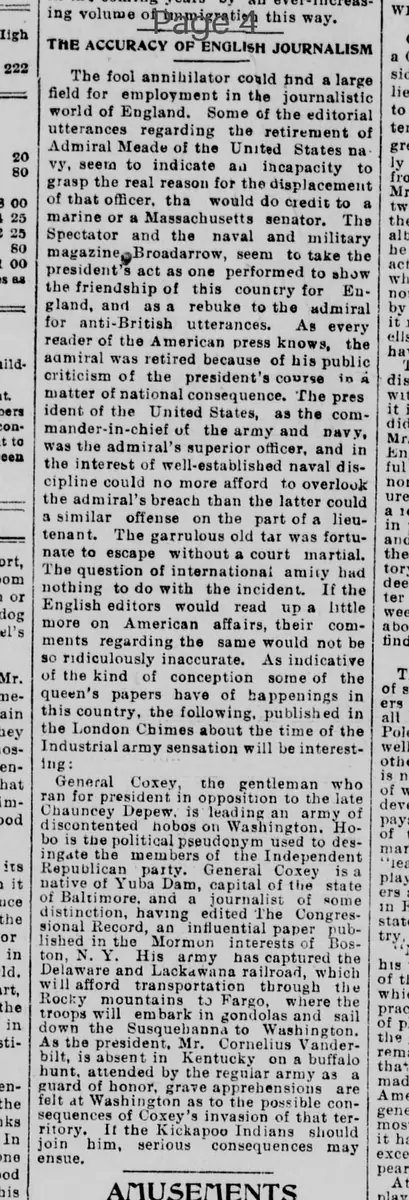
THE ACCURACY OF ENGLISH JOURNALISM
The fool annihilator could find a large field for employment in the journalistic world of England. Some of the editorial utterances regarding the retirement of Admiral Meade of the United States navy, seem to indicate an incapacity to grasp the real reason for the displacement of that officer, that would do credit to a marine or a Massachusetts senator. The Spectator and the naval and military magazine Broad Arrow, seem to take the president's act as one performed to show the friendship of this country for England, and as a rebuke to the admiral for anti-British utterances. As every reader of the American press knows, the admiral was retired because of his public criticism of the president's course in a matter of national consequence. The president of the United States, as the commander-in-chief of the army and navy, was the admiral's superior officer, and in the interest of well-established naval discipline could no more afford to overlook the admiral's breach than the latter could a similar offense on the part of a lieutenant. The garrulous old tar was fortunate to escape without a court martial. The question of international amity had nothing to do with the incident. If the English editors would read up a little more on American affairs, their comments regarding the same would not be so ridiculously inaccurate. As indicative of the kind of conception some of the queen's papers have of happenings in this country, the following, published in the London Times about the time of the Industrial army sensation will be interesting:
"General Coxey, the gentleman who ran for president in opposition to the late Chauncey Depew, is leading an army of discontented hobos on Washington. Hobo is the political pseudonym used to designate the members of the Independent Republican party. General Coxey is a native of Yuba Dam, capital of the state of Baltimore, and a journalist of some distinction, having edited the Congressional Record, an influential paper published in the Mormon interests of Boston, N. Y. His army has captured the Delaware and Lackawanna railroad, which will afford transportation through the Rocky mountains to Fargo, where the troops will embark in gondolas and sail down the Susquehanna to Washington. As the president, Mr. Cornelius Vanderbilt, is absent in Kentucky on a buffalo hunt, attended by the regular army as a guard of honor, grave apprehensions are felt at Washington as to the possible consequences of Coxey's invasion of that territory. If the Kickapoo Indians should join him, serious consequences may ensue."
The fool annihilator could find a large field for employment in the journalistic world of England. Some of the editorial utterances regarding the retirement of Admiral Meade of the United States navy, seem to indicate an incapacity to grasp the real reason for the displacement of that officer, that would do credit to a marine or a Massachusetts senator. The Spectator and the naval and military magazine Broad Arrow, seem to take the president's act as one performed to show the friendship of this country for England, and as a rebuke to the admiral for anti-British utterances. As every reader of the American press knows, the admiral was retired because of his public criticism of the president's course in a matter of national consequence. The president of the United States, as the commander-in-chief of the army and navy, was the admiral's superior officer, and in the interest of well-established naval discipline could no more afford to overlook the admiral's breach than the latter could a similar offense on the part of a lieutenant. The garrulous old tar was fortunate to escape without a court martial. The question of international amity had nothing to do with the incident. If the English editors would read up a little more on American affairs, their comments regarding the same would not be so ridiculously inaccurate. As indicative of the kind of conception some of the queen's papers have of happenings in this country, the following, published in the London Times about the time of the Industrial army sensation will be interesting:
"General Coxey, the gentleman who ran for president in opposition to the late Chauncey Depew, is leading an army of discontented hobos on Washington. Hobo is the political pseudonym used to designate the members of the Independent Republican party. General Coxey is a native of Yuba Dam, capital of the state of Baltimore, and a journalist of some distinction, having edited the Congressional Record, an influential paper published in the Mormon interests of Boston, N. Y. His army has captured the Delaware and Lackawanna railroad, which will afford transportation through the Rocky mountains to Fargo, where the troops will embark in gondolas and sail down the Susquehanna to Washington. As the president, Mr. Cornelius Vanderbilt, is absent in Kentucky on a buffalo hunt, attended by the regular army as a guard of honor, grave apprehensions are felt at Washington as to the possible consequences of Coxey's invasion of that territory. If the Kickapoo Indians should join him, serious consequences may ensue."
What sub-type of article is it?
Satire
Foreign Affairs
What keywords are associated?
English Journalism
Admiral Meade
Coxey Army
Press Inaccuracy
Us Uk Perceptions
What entities or persons were involved?
Admiral Meade
President Of The United States
The Spectator
Broad Arrow
London Times
General Coxey
Editorial Details
Primary Topic
Critique Of English Press Inaccuracies On American Affairs
Stance / Tone
Mocking British Journalistic Errors
Key Figures
Admiral Meade
President Of The United States
The Spectator
Broad Arrow
London Times
General Coxey
Key Arguments
English Press Misinterprets Admiral Meade's Retirement As Pro English Gesture And Rebuke For Anti British Views
Meade Was Actually Retired For Publicly Criticizing The President's National Policy
As Commander In Chief, The President Enforced Naval Discipline
International Amity Unrelated To The Incident
English Editors Should Study American Affairs To Avoid Inaccuracies
London Times Published Absurd Satirical Account Of Coxey's Army