Thank you for visiting SNEWPapers!
Sign up free
Massachusetts Spy And Worcester Advertiser
Worcester, Worcester County, Massachusetts
What is this article about?
Opening of the first session of the 18th U.S. Congress on December 1, 1823, with Senate and House proceedings including elections and appointments, followed by President James Monroe's annual message on December 2 addressing foreign relations, finances, military affairs, internal improvements, and opposition to European colonization in the Americas.
Merged-components note: Continuation of the President's Message to Congress across pages; relabeled the second part from foreign_news to domestic_news as it pertains to U.S. domestic and foreign policy but is fundamentally a U.S. government document.
Clippings
1 of 2
OCR Quality
Full Text
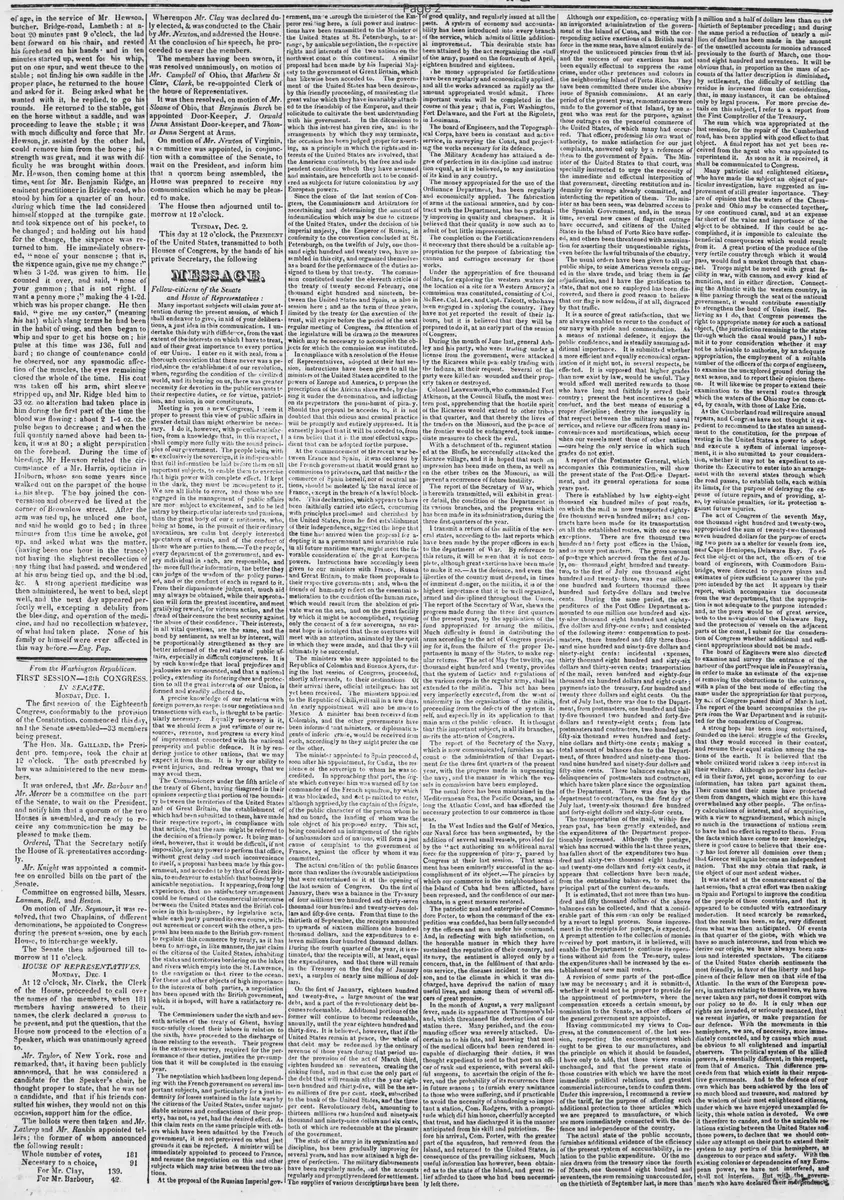
FIRST SESSION--18th CONGRESS.
IN SENATE.
Monday, Dec. 1.
The first session of the Eighteenth Congress, conformably to the provision of the Constitution, commenced this day, and the Senate assembled--33 members being present.
The Hon. Mr. Gaillard, the President pro. tempore, took the chair at 12 o'clock. The oath prescribed by law was administered to the new members.
It was ordered, that Mr. Barbour and Mr. Mercer be a committee on the part of the Senate, to wait on the President, and notify him that a quorum of the two Houses is assembled, and ready to receive any communication he may be pleased to make them.
Ordered, That the Secretary notify the House of Representatives accordingly.
Mr. Knight was appointed a committee on enrolled bills on the part of the Senate.
Committee on engrossed bills, Messrs. Lanman, Bell, and Benton.
On motion of Mr. Seymour, it was resolved, that two Chaplains, of different denominations, be appointed to Congress during the present session, one by each House, to interchange weekly.
The Senate then adjourned till to-morrow at 11 o'clock.
HOUSE OF REPRESENTATIVES.
Monday, Dec. 1.
At 12 o'clock, Mr. Clark, the Clerk of the House, proceeded to call over the names of the members, when 181 members having answered to their names, the clerk declared a quorum to be present, and put the question, that the House now proceed to the election of a Speaker, which was unanimously agreed to.
Mr. Taylor, of New York, rose and remarked, that, it having been publicly announced, that he was considered a candidate for the Speaker's chair, he thought proper to state, that he was not a candidate, and that if his friends consulted his wishes, they would not on this occasion, support him for the office.
The ballots were then taken and Mr. Lathrop and Mr. Rankin appointed tellers; the former of whom announced the following result:
Whole number of votes, 181
Necessary to a choice, 91
For Mr. Clay, 139.
For Mr. Barbour, 42.
Whereupon Mr. Clay was declared duly elected, & was conducted to the Chair by Mr. Newton, and addressed the House.
At the conclusion of his speech, he proceeded to swear the members.
The members having been sworn, it was resolved unanimously, on motion of Mr. Campbell of Ohio, that Mathew St. Clair Clarke, Clerk, be re-appointed Clerk of the House of Representatives.
It was then resolved, on motion of Mr. Sloane of Ohio, that Benjamin Burch be appointed Door-Keeper, J. Oswald Dunn Assistant Door-keeper, and Thomas Dunn Sergeant at Arms.
On motion of Mr. Newton of Virginia, a committee was appointed, in conjunction with a committee of the Senate, to wait on the President, and inform him that a quorum being assembled, the House was prepared to receive any communication which he may be pleased to make.
The House then adjourned until to-morrow at 12 o'clock.
Tuesday, Dec. 2.
This day at 12 o'clock, the President of the United States, transmitted to both Houses of Congress, by the hands of his private Secretary, the following
MESSAGE.
Fellow-citizens of the Senate and House of Representatives:
Many important subjects will claim your attention during the present session, of which I shall endeavor to give, in aid of your deliberations, a just idea in this communication. I undertake this duty with diffidence, from the vast extent of the interests on which I have to treat, and of their great importance to every portion of our Union. I enter on it with zeal, from a thorough conviction that there never was a period, since the establishment of our revolution, when, regarding the condition of the civilized world, and its bearing on us, there was greater necessity for devotion in the public servants to their respective duties, or for virtue, patriotism, and union, in our constituents.
Meeting in you a new Congress, I deem it proper to present this view of public affairs in greater detail than might otherwise be necessary. I do it, however, with peculiar satisfaction, from a knowledge that, in this respect, I shall comply more fully with the sound principles of our government. The people being with us exclusively the sovereign, it is indispensable that full information be laid before them on all important subjects, to enable them to exercise that high power with complete effect. If kept in the dark, they must be incompetent to it. We are all liable to error, and those who are engaged in the management of public affairs are more subject to excitement, and to be led astray by their particular interests and passions, than the great body of our constituents, who, being at home, in the pursuit of their ordinary avocations, are calm but deeply interested spectators of events, and of the conduct of those who are parties to them.--To the people, every department of the government, and every individual in each, are responsible, and the more full their information, the better they can judge of the wisdom of the policy pursued, and of the conduct of each in regard to it. From their dispassionate judgment, much aid may always be obtained, while their approbation will form the greatest incentive, and most gratifying reward, for virtuous action, and the dread of their censure the best security against the abuse of their confidence. Their interests, in all vital questions, are the same, and the bond by sentiment, as well as by interest, will be proportionably strengthened as they are better informed of the real state of public affairs, especially in difficult conjunctures. It is by such knowledge that local prejudices and jealousies are surmounted, and that a national policy, extending its fostering care and protection to all the great interests of our Union, is formed and steadily adhered to.
A precise knowledge of our relations with foreign powers, as respects our negotiations and transactions with each, is thought to be particularly necessary. Equally necessary is it, that we should form a just estimate of our resources, revenue, and progress in every kind of improvement connected with the national prosperity and public defence. It is by rendering justice to other nations, that we may expect it from them. It is by our ability to resent injuries, and redress wrongs, that we may avoid them.
The Commissioners under the fifth article of the treaty of Ghent, having disagreed in their opinions respecting that portion of the boundary between the territories of the United States and of Great Britain, the establishment of which had been submitted to them, have made their respective reports, in compliance with that article, that the same might be referred to the decision of a friendly power. It being manifest, however, that it would be difficult, if not impossible, for any power to perform that office, without great delay and much inconvenience to itself, a proposal has been made by this government, and acceded to by that of Great Britain, to endeavour to establish that boundary by amicable negotiation. It appearing, from long experience, that no satisfactory arrangement could be formed of the commercial intercourse between the United States and the British colonies in this hemisphere, by legislative acts, while each party pursued its own course, without agreement or concert with the other, a proposal has been made to the British government to regulate this commerce by treaty, as it has been to arrange, in like manner, the just claims of the citizens of the United States, inhabiting the states and territories bordering on the lakes and rivers which empty into the St. Lawrence, to the navigation of that river to the ocean. For these and other objects of high importance to the interests of both parties, a negotiation has been opened with the British government, which it is hoped, will have a satisfactory result.
The Commissioners under the sixth and seventh articles of the treaty of Ghent, having successfully closed their labors in relation to the sixth, have proceeded to the discharge of those relating to the seventh. Their progress in the extensive survey, required for the performance of their duties, justifies the presumption that it will be completed in the ensuing year.
The negotiation which had been long depending with the French government on several important subjects, and particularly for a just indemnity for losses sustained in the late wars by the citizens of the United States, under unjustifiable seizures and confiscations of their property, has not, as yet, had the desired effect. As this claim rests on the same principle with others which have been admitted by the French government, it is not perceived on what just grounds it can be rejected. A minister will be immediately appointed to proceed to France, and resume the negotiation on this and other subjects which may arise between the two nations.
At the proposal of the Russian Imperial government, made through the minister of the Emperor residing here, a full power and instructions have been transmitted to the Minister of the United States at St. Petersburgh, to arrange, by amicable negotiation, the respective rights and interests of the two nations on the northwest coast of this continent. A similar proposal had been made by his Imperial Majesty to the government of Great Britain, which has likewise been acceded to. The government of the United States has been desirous, by this friendly proceeding, of manifesting the great value which they have invariably attached to the friendship of the Emperor, and their solicitude to cultivate the best understanding with his government. In the discussions to which this interest has given rise, and in the arrangements by which they may terminate, the occasion has been judged proper for asserting, as a principle in which the rights and interests of the United States are involved, that the American continents, by the free and independent condition which they have assumed and maintain, are henceforth not to be considered as subjects for future colonization by any European powers.
Since the close of the last session of Congress, the Commissioners and Arbitrators for ascertaining and determining the amount of indemnification which may be due to citizens of the United States, under the decision of his imperial majesty, the Emperor of Russia, in conformity to the convention concluded at St. Petersburgh, on the twelfth of July, one thousand eight hundred and twenty two, have assembled in this city, and organized themselves as a board for the performance of the duties assigned to them by that treaty. The commission constituted under the eleventh article of the treaty of twenty second February, one thousand eight hundred and nineteen, between the United States and Spain, is also in session here: and as the term of three years, limited by the treaty for the execution of the trust, will expire before the period of the next regular meeting of Congress, the attention of the legislature will be drawn to the measures which may be necessary to accomplish the objects for which the commission was instituted.
In compliance with a resolution of the House of Representatives, adopted at their last session, instructions have been given to all the ministers of the United States accredited to the powers of Europe and America, to propose the proscription of the African slave trade, by classing it under the denomination, and inflicting on its perpetrators the punishment of piracy. Should this proposal be acceded to, it is not doubted that this odious and criminal practice will be promptly and entirely suppressed. It is earnestly hoped that it will be acceded to, from a firm belief that it is the most effectual expedient that can be adopted for the purpose.
At the commencement of the recent war between France and Spain, it was declared by the French government that it would grant no commissions to privateers, and that neither the commerce of Spain herself, nor of neutral nations, should be molested by the naval force of France, except in the breach of a lawful blockade. This declaration, which appears to have been faithfully carried into effect, concurring with principles proclaimed and cherished by the United States, from the first establishment of their independence, suggested the hope that the time had arrived when the proposal for adopting it as a permanent and invariable rule in all future maritime wars, might meet the favorable consideration of the great European powers. Instructions have accordingly been given to our ministers with France, Russia and Great Britain, to make those proposals to their respective governments; and, when the friends of humanity reflect on the essential amelioration to the condition of the human race, which would result from the abolition of private war on the sea, and on the great facility by which it might be accomplished, requiring only the consent of a few sovereigns, an earnest hope is indulged that these overtures will meet with an attention, animated by the spirit in which they were made, and that they will ultimately be successful.
The ministers who were appointed to the Republics of Colombia and Buenos Ayres, during the last session of Congress, proceeded, shortly afterwards, to their destinations. Of their arrival there, official intelligence has not yet been received. The ministers appointed to the Republic of Chili, will sail in a few days. An early appointment will also be made to Mexico. A minister has been received from Colombia, and the other governments have been informed that ministers, or diplomatic agents of inferior grade, would be received from each, accordingly as they might prefer the one or the other.
The minister appointed to Spain proceeded, soon after his appointment, for Cadiz, the residence of the sovereign to whom he was accredited. In approaching that port, the frigate which conveyed him was warned off by the commander of the French squadron, by which it was blockaded, and not permitted to enter, although apprised, by the captain of the frigate, of the public character of the person whom he had on board, the landing of whom was the sole object of his proposed entry. This act, being considered an infringement of the rights of ambassadors and of nations, will form a just cause of complaint to the government of France, against the officer by whom it was committed.
The actual condition of the public finances more than realizes the favourable anticipations that were entertained of it at the opening of the last session of Congress. On the first of January, there was a balance in the Treasury of four millions two hundred and thirty-seven thousand four hundred and twenty-seven dollars and fifty-five cents. From that time to the thirtieth of September, the receipts amounted to upwards of sixteen millions one hundred thousand dollars, and the expenditures to eleven millions four hundred thousand dollars. During the fourth quarter of the year, it is estimated, that the receipts will, at least, equal the expenditures, and that there will remain in the Treasury on the first day of January next, a surplus of nearly nine millions of dollars.
On the first of January, eighteen hundred and twenty-five, a large amount of the war debt, and a part of the revolutionary debt becomes redeemable. Additional portions of the former will continue to become redeemable annually, until the year eighteen hundred and thirty-five. It is believed, however, that if the United States remain at peace, the whole of that debt may be redeemed by the ordinary revenue of those years during that period under the provision of the act of March third, eighteen hundred and seventeen, creating the sinking fund, and in that case the only part of the debt that will remain after the year eighteen hundred and thirty-five, will be the seven millions of five per cent. stock, subscribed to the bank of the United States, and the three per cent. Revolutionary debt, amounting to thirteen millions two hundred and ninety-six thousand and ninety-nine dollars and six cents, both of which are redeemable at the pleasure of the government.
The state of the army in its organization and discipline, has been gradually improving for several years, and has now attained a high degree of perfection. The military disbursements have been regularly made, and the accounts regularly and promptly rendered for settlement. The supplies of various descriptions have been of good quality, and regularly issued at all the posts. A system of economy and accountability has been introduced into every branch of the service, which admits of little additional improvement. This desirable state has been attained by the act reorganizing the staff of the army, passed on the fourteenth of April, eighteen hundred and eighteen.
The money appropriated for fortifications have been regularly and economically applied, and all the works advanced as rapidly as the amount appropriated would admit. Three important works will be completed in the course of this year; that is, Fort Washington, Fort Delaware, and the Fort at the Rigolets, in Louisiana.
The board of Engineers, and the Topographical Corps, have been in constant and active service, in surveying the Coast, and projecting the works necessary for its defence.
The Military Academy has attained a degree of perfection in its discipline and instruction equal, as it is believed, to any institution of its kind in any country.
The money appropriated for the use of the Ordinance Department, has been regularly and economically applied. The fabrication of arms at the national armories, and by contract with the Department, has been gradually improving in quality and cheapness. It is believed that their quality is now such as to admit of but little improvement.
The completion of the Fortifications renders it necessary that there should be a suitable appropriation for the purpose of fabricating the cannon and carriages necessary for those works.
Under the appropriation of five thousand dollars, for exploring the western waters for the location of a site for a Western Armory; a commission was constituted, consisting of Col. McRee, Col. Lee, and Capt. Talcott, who have been engaged in exploring the country. They have not yet reported the result of their labours, but it is believed that they will be prepared to do it, at an early part of the session of Congress.
During the month of June last, general Ashley and his party, who were trading under a license from the government, were attacked by the Ricarees while peaceably trading with the Indians, at their request. Several of the party were killed and wounded and their property taken or destroyed.
Colonel Leavenworth, who commanded Fort Atkinson, at the Council Bluffs, the most western post, apprehending that the hostile spirit of the Ricarees would extend to other tribes in that quarter, and that thereby the lives of the traders on the Missouri, and the peace of the frontier would be endangered, took immediate measures to check the evil.
With a detachment of the regiment stationed at the Bluffs, he successfully attacked the Ricaree village, and it is hoped that such an impression has been made on them, as well as on the other tribes on the Missouri, as will prevent a recurrence of future hostility.
The report of the Secretary of War, which is herewith transmitted, will exhibit in greater detail, the condition of the Department in its various branches, and the progress which has been made in its administration, during the three first quarters of the year.
I transmit a return of the militia of the several states, according to the last reports which have been made by the proper officers in each to the department of War. By reference to this return, it will be seen that it is not complete, although great exertions have been made to make it so.--As the defence, and even the liberties of the country must depend, in times of imminent danger, on the militia, it is of the highest importance that it be well organized, armed and disciplined throughout the Union.
The report of the Secretary of War, shews the progress made during the three first quarters of the present year, by the application of the fund appropriated for arming the militia.
Much difficulty is found in distributing the arms according to the act of Congress providing for it, from the failure of the proper Departments in many of the States, to make regular returns. The act of May the twelfth, one thousand eight hundred and twenty, provides that the system of tactics and regulations of the various corps in the regular army, shall be extended to the militia. This act has been very imperfectly executed, from the want of uniformity in the organization of the militia, proceeding from the defects of the system itself, and especially in its application to that main arm of the public defence. It is thought that this important subject, in all its branches, merits the attention of Congress.
The report of the Secretary of the Navy, which is now communicated, furnishes an account of the administration of that Department for the three first quarters of the present year, with the principle made in augmenting the navy, and the manner in which the vessels in commission have been employed.
The usual force has been maintained in the Mediterranean Sea, the Pacific Ocean, and along the Atlantic Coast, and has afforded the necessary protection to our commerce in those seas.
In the West Indies and the Gulf of Mexico, our Naval force has been augmented, by the addition of several small vessels, provided for by the act authorizing an additional naval force for the suppression of piracy, passed by Congress at their last session. That armament has been eminently successful in the accomplishment of its object.--The piracies by which our commerce in the neighbourhood of the Island of Cuba had been afflicted, have been repressed, and the confidence of our merchants, in a great measure restored.
The patriotic zeal and enterprise of Commodore Porter, to whom the command of the expedition was confided, has been fully seconded by the officers and men under his command. And, in reflecting with high satisfaction, on the honorable manner in which they have sustained the reputation of their country, and its navy, the sentiment is alloyed only by a concern, that, in the fulfilment of that arduous service, the diseases incident to the season, and to the climate in which it was discharged, have deprived the nation of many useful lives, and among them of several officers of great promise.
In the month of August, a very malignant fever, made its appearance at Thompson's Island, which threatened the destruction of our station there. Many perished, and the commanding officer was severely attacked. Uncertain as to his fate, and knowing that most of the medical officers had been rendered incapable of discharging their duties, it was thought expedient to send to that post an officer of rank and experience, with several skilful surgeons, to ascertain the origin of the fever, and the probability of its recurrence there in future seasons; to furnish every assistance to those who were suffering, and if practicable to avoid the necessity of abandoning so important a station, Com. Rodgers, with a promptitude which did him honor, cheerfully accepted that trust, and has discharged it in the manner anticipated from his skill and patriotism. Before his arrival, Com. Porter, with the greater part of the squadron, had removed from the Island, and returned to the United States, in consequence of the prevailing sickness. Much useful information has however, been obtained as to the state of the Island, and great relief afforded to those who had been necessarily left there.
Although our expedition, co-operating with an invigorated administration of the government of the Island of Cuba, and with the corresponding active exertions of a British naval force in the same seas, have almost entirely destroyed the unlicenced piracies from that island, the success of our exertions has not been equally effectual to suppress the same crime, under other pretences and colours in the neighbouring Island of Porto Rico. They have been committed there under the abusive issue of Spanish commissions. At an early period of the present year, remonstrances were made to the governor of that Island, by an agent who was sent for the purpose, against those outrages on the peaceful commerce of the United States, of which many had occurred. That officer, professing his own want of authority, to make satisfaction for our just complaints, answered only by a reference of them to the government of Spain. The Minister of the United States to that court, was specially instructed to urge the necessity of the immediate and effectual interposition of that government, directing restitution and indemnity for wrongs already committed, and interdicting the repetition of them. The minister as has been seen, was debarred access to the Spanish Government, and, in the mean time, several new cases of flagrant outrage have occurred, and citizens of the United States in the Island of Porto Rico have suffered, and others been threatened with assassination for asserting their unquestionable rights, even before the lawful tribunals of the country.
The usual orders have been given to all our public ships, to seize American vessels engaged in the slave trade, and bring them in for adjudication, and I have the gratification to state, that not one so employed has been discovered, and there is good reason to believe that our flag is now seldom, if at all, disgraced by that traffic.
It is a source of great satisfaction, that we are always enabled to recur to the conduct of our navy with pride and commendation. As a means of national defence, it enjoys the public confidence, and is steadily assuming additional importance. It is submitted whether a more efficient and equally economical organization of it might not, in several respects, be effected. It is supposed that higher grades than now exist by law, would be useful. They would afford well merited rewards to those who have long and faithfully served their country; present the best incentives to good conduct, and the best means of ensuring a proper discipline; destroy the inequality in that respect between the military and naval services, and relieve our officers from many inconveniences and mortifications, which occur when our vessels meet those of other nations--ours being the only service in which such grades do not exist.
A report of the Postmaster General, which accompanies this communication, will show the present state of the Post-Office Department, and its general operations for some years past.
There is established by law eighty-eight thousand six hundred miles of post roads, on which the mail is now transported eighty-five thousand seven hundred miles; and contracts have been made for its transportation on all the established routes, with one or two exceptions. There are five thousand two hundred and forty post offices in the Union, and as many post masters. The gross amount of postage which accrued from the first of July, one thousand eight hundred and twenty two, to the first of July one thousand eight hundred and twenty-three, was one million one hundred and fourteen thousand three hundred and forty-five dollars and twelve cents. During the same period, the expenditures of the Post Office Department amounted to one million one hundred and sixty-nine thousand eight hundred and eighty-five dollars and fifty-one cents; and consisted of the following items: compensation to postmasters, three hundred and fifty three thousand nine hundred and ninety-five dollars and ninety-eight cents: incidental expenses, thirty thousand eight hundred and sixty-six dollars and thirty-seven cents; transportation of the mail, seven hundred and eighty-four thousand six hundred dollars and eight cents: payments into the treasury, four hundred and twenty three dollars and eight cents. (On the first of July last, there was due to the Department, from postmasters, one hundred and thirty-five thousand two hundred and forty-five dollars and twenty-eight cents; from late postmasters and contractors, two hundred and fifty-six thousand seven hundred and forty-nine dollars and thirty-one cents; making a total amount of balances due to the Department, of three hundred and ninety-one thousand nine hundred and ninety-four dollars and fifty-nine cents. These balances embrace all delinquencies of postmasters and contractors, which have taken place since the organization of the Department. There was due by the department to contractors, on the first day of July last, twenty-six thousand five hundred and forty-eight dollars and sixty-four cents.
The transportation of the mail, within five years past, has been greatly extended, and the expenditures of the Department proportionably increased. Although the postage, which has accrued within the last three years, has fallen short of the expenditures two hundred and sixty-two thousand eight hundred and twenty-one dollars and forty-six cents, it appears that collections have been made, from the outstanding balances, to meet the principal part of the current demands.
It is estimated, that not more than two hundred and fifty thousand dollars of the above balances can be collected, and that a considerable part of this sum can only be realized by a resort to legal process. Some improvement in the receipts for postage, is expected. A prompt attention to the collection of monies received by post masters, it is believed, will enable the Department to continue its operations without aid from the Treasury, unless the expenditures shall be increased by the establishment of new mail routes.
A revision of some parts of the post-office law may be necessary; and it is submitted, whether it would not be proper to provide for the appointment of postmasters, where the compensation exceeds a certain amount, by nomination to the Senate, as other officers of the general government are appointed.
Having communicated my views to Congress, at the commencement of the last session, respecting the encouragement which ought to be given to our manufactures, and the principle on which it should be founded, I have only to add, that those views remain unchanged, and that the present state of those countries with which we have the most immediate political relations, and greatest commercial intercourse, tends to confirm them. Under this impression, I recommend a review of the tariff, for the purpose of affording such additional protection to those articles which we are prepared to manufacture, or which are more immediately connected with the defence and independence of the country.
The actual state of the public accounts, furnishes additional evidence of the efficiency of the present system of accountability, in relation to the public expenditure. Of the monies drawn from the treasury since the fourth of March, one thousand eight hundred and seventeen, the sum remaining unaccounted for, on the thirtieth of September last, is more than a million and a half of dollars less than on the thirtieth of September preceding: and during the same period a reduction of nearly a million of dollars has been made in the amount of the unsettled accounts for monies advanced previously to the fourth of March, one thousand eight hundred and seventeen. It will be obvious that, in proportion as the mass of accounts of the latter description is diminished, by settlement, the difficulty of settling the residue is increased from the consideration, that, in many instances, it can be obtained only by legal process. For more precise details on this subject, I refer to a report from the First Comptroller of the Treasury.
The sum which was appropriated at the last session, for the repair of the Cumberland road, has been applied with good effect to that object. A final report has not yet been received from the agent who was appointed to superintend it. As soon as it is received, it shall be communicated to Congress.
Many patriotic and enlightened citizens, who have made the subject an object of particular investigation, have suggested an improvement of still greater importance. They are of opinion that the waters of the Chesapeake and Ohio may be connected together, by one continued canal, and at an expense far short of the value and importance of the object to be obtained. If this could be accomplished, it is impossible to calculate the beneficial consequences which would result from it. A great portion of the produce of the very fertile country through which it would pass, would find a market through that channel. Troops might be moved with great facility in war, with cannon, and every kind of munition, and in either direction. Connecting the Atlantic with the western country, in a line passing through the seat of the national government, it would contribute essentially to strengthen the bond of Union itself. Believing as I do, that Congress possesses the right to appropriate money for such a national object, (the jurisdiction remaining to the states through which the canal would pass,) I submit it to your consideration whether it may not be advisable to authorize, by an adequate appropriation, the employment of a suitable number of the officers of the corps of engineers, to examine the unexplored ground during the next season, and to report their opinion thereon. It will likewise be proper to extend their examination to the several routes through which the waters of the Ohio may be connected, by canals, with those of Lake Erie.
As the Cumberland road will require annual repairs, and Congress have not thought it expedient to recommend to the states an amendment to the constitution, for the purpose of vesting in the United States a power to adopt and execute a system of internal improvement, it is also submitted to your consideration, whether it may not be expedient to authorize the Executive to enter into an arrangement with the several states through which the road passes, to establish tolls, each within its limits, for the purpose of defraying the expense of future repairs, and of providing, also, by suitable penalties, for its protection against future injuries.
The act of Congress of the seventh May one thousand eight hundred and twenty-two, appropriated the sum of twenty-two thousand seven hundred dollars for the purpose of erecting two piers as a shelter for vessels from ice, near Cape Henlopen, Delaware Bay. To effect the object of the act, the officers of the board of engineers, with Commodore Bainbridge, were directed to prepare plans and estimates of piers sufficient to answer the purpose intended by the act. It appears by their report, which accompanies the documents from the war department, that the appropriation is not adequate to the purpose intended: and, as the piers would be of great service, both to the navigation of the Delaware Bay, and the protection of vessels on the adjacent parts of the coast, I submit for the consideration of Congress whether additional and sufficient appropriations should not be made.
The board of Engineers were also directed to examine and survey the entrance of the harbour of the port Presque Isle in Pennsylvania, in order to make an estimate of the expense of removing the obstructions to the entrance, with a plan of the best mode of effecting the same under the appropriation for that purpose, by act of Congress passed third of March last. The report of the board accompanies the papers from the War Department and is submitted for the consideration of Congress.
A strong hope has been long entertained, founded on the heroic struggle of the Greeks that they would succeed in their contest, and resume their equal station among the nations of the earth. It is believed that the whole civilized world takes a deep interest in their welfare. Although no power has declared in their favor, yet none, according to our information, has taken part against them. Their cause and their name have protected them from dangers, which might ere this have overwhelmed any other people. The ordinary calculations of interest, and of acquisition, with a view to aggrandizement, which mingle so much in the transactions of nations seem to have had no effect in regard to them. From the facts which have come to our knowledge, there is good cause to believe that their enemy has lost forever all dominion over them; that Greece will again become an independent nation. That she may obtain that rank, is the object of our most ardent wishes.
It was stated at the commencement of the last session, that a great effort was then making in Spain and Portugal to improve the condition of the people of those countries, and that it appeared to be conducted with extraordinary moderation. It need scarcely be remarked, that the result has been, so far, very different from what was then anticipated. Of events in that quarter of the globe, with which we have so much intercourse, and from which we derive our origin, we have always been anxious and interested spectators. The citizens of the United States cherish sentiments the most friendly, in favor of the liberty and happiness of their fellow men on that side of the Atlantic. In the wars of the European powers, in matters relating to themselves, we have never taken any part, nor does it comport with our policy so to do. It is only when our rights are invaded, or seriously menaced, that we resent injuries, or make preparation for our defence. With the movements in this hemisphere, we are, of necessity, more immediately connected, and by causes which must be obvious to all enlightened and impartial observers. The political system of the allied powers is essentially different, in this respect, from that of America. This difference proceeds from that which exists in their respective governments. And to the defence of our own, which has been achieved by the loss of so much blood and treasure, and matured by the wisdom of their most enlightened citizens, under which we have enjoyed unexampled felicity, this whole nation is devoted. We owe it therefore to candor, and to the amicable relations existing between the United States and those powers, to declare that we should consider any attempt on their part to extend their system to any portion of this hemisphere, as dangerous to our peace and safety. With the existing colonies or dependencies of any European power, we have not interfered, and shall not interfere. But with the governments who have declared their independence and maintained it, and whose independence we have, on great consideration and on just principles, acknowledged, we could not view any interposition for the purpose of oppressing them, or controlling in any other manner their destiny, by any European power, in any other light than as the manifestation of an unfriendly disposition toward the United States. In the war between those new governments and Spain, we declared our neutrality at the time of their recognition, and to this we have adhered, and shall continue to adhere, provided no change shall occur which may make a corresponding change necessary on our part.
The late events in Spain and Portugal, shew that Europe is still unsettled. Of this important fact, no stronger proof can be adduced, than that the allied powers should have thought it proper, on any principle satisfactory to themselves, to have interposed, by force, in the internal concerns of Spain. To what extent such interposition may be carried, on the same principle, is a question, in which all independent powers, whose governments differ from theirs, are interested; even those most remote, and surely none more so than the United States. Our policy, in regard to Europe, which was adopted at an early stage of the wars which have so long agitated that quarter of the globe, nevertheless remains the same, which is, not to interfere in the internal concerns of any of its powers; to consider the government de facto as the legitimate government for us; to cultivate friendly relations with it, and to preserve those relations by a frank, firm, and manly policy, meeting, in all instances, the just claims of every power; submitting to injuries from none. But, in regard to these continents, circumstances are eminently and conspicuously different. It is impossible that the allied powers should extend their political system to any portion of either continent, without endangering our peace and happiness: nor can any one believe that our Southern Brethren, if left to themselves, would adopt it of their own accord. It is equally impossible, therefore, that we should behold such interposition, in any form, with indifference. If we look to the comparative strength and resources of Spain and those new governments, and their distance from each other, it must be obvious that she can never subdue them. It is still the true policy of the United States, to leave the parties to themselves in the hope that other powers, will pursue the same course.
If we compare the present condition of our Union with its actual state at the close of our Revolution, the history of the world furnishes no example of a progress, in improvement in all the important circumstances which constitute the happiness of a nation, which bears any resemblance to it. At the first epoch, our population did not exceed three millions. By the last census it amounted to about ten millions. and, what is more extraordinary, it is almost altogether native-for the emigration from other countries has been inconsiderable. At the first epoch, half the territory within our acknowledged limits was uninhabited and a wilderness Since then, new territory has been acquired, of vast extent, comprising within it many rivers, particularly the Mississippi, the navigation of which to the ocean was of the highest importance to the original states. Over this territory our population has expanded in every direction, and new states have been established, almost equal in number, to those which formed the first bond of our Union. This expansion of our population, and accession of new states to our Union, have had the happiest effect on all its highest interests. That it has eminently augmented our resources, and added to our strength and respectability as a power, is admitted by all. But, it is not in these important circumstances only, that this happy effect is felt. It is manifest that, by enlarging the basis of our system and increasing the number of States, the system itself has been greatly strengthened in both its branches. Consolidation and disunion have thereby been rendered equally impracticable. --Each government, confiding in its own strength, has less to apprehend from the other, and, in consequence, each enjoying a greater freedom of action, is rendered more efficient for all the purposes for which it was instituted. It is unnecessary to treat, here, of the vast improvement made in the system itself. by the adoption of this constitution and of its happy effect in elevating the character and in protecting the rights of the nation, as well as of individuals. To what then do we owe these blessings? It is known to all, that we derive them from the excellence of our institutions. Ought we not then to adopt every measure, which may be necessary to perpetuate them?
JAMES MONROE.
Washington, December 2, 1823.
What sub-type of article is it?
What keywords are associated?
What entities or persons were involved?
Where did it happen?
Domestic News Details
Primary Location
Washington
Event Date
Dec. 1 2, 1823
Key Persons
Outcome
henry clay elected speaker of the house with 139 votes; mathew st. clair clarke re-appointed clerk; benjamin burch appointed door-keeper, j. oswald dunn assistant door-keeper, thomas dunn sergeant at arms; president's message transmitted outlining national affairs, finances with surplus near nine million dollars, military improvements, anti-piracy successes, and foreign policy principles.
Event Details
The first session of the 18th Congress opened on December 1, 1823, in Washington. Senate assembled with 33 members under President pro tempore Gaillard; oaths to new members; committees appointed to notify President and for bills; chaplains resolved. House with 181 members elected Henry Clay Speaker; members sworn; officers appointed. On December 2, President Monroe's message addressed foreign negotiations with Britain, France, Russia, Spain; slave trade suppression; navy anti-piracy efforts; finances, army, navy, post office status; tariff review recommendation; internal improvements like canals; opposition to European colonization in Americas.