Thank you for visiting SNEWPapers!
Sign up free
Editorial
September 11, 1846
Southern Christian Advocate
Charleston, Charleston County, South Carolina
What is this article about?
This editorial reflects on the ancient Christian practice of commemorating departed saints via obituaries, emphasizing its role in easing fears of death, fostering spiritual connection, and counterbalancing earthly losses with heavenly reunions. It urges brief, skillful obituary writing for the periodical.
Clipping
OCR Quality
98%
Excellent
Full Text
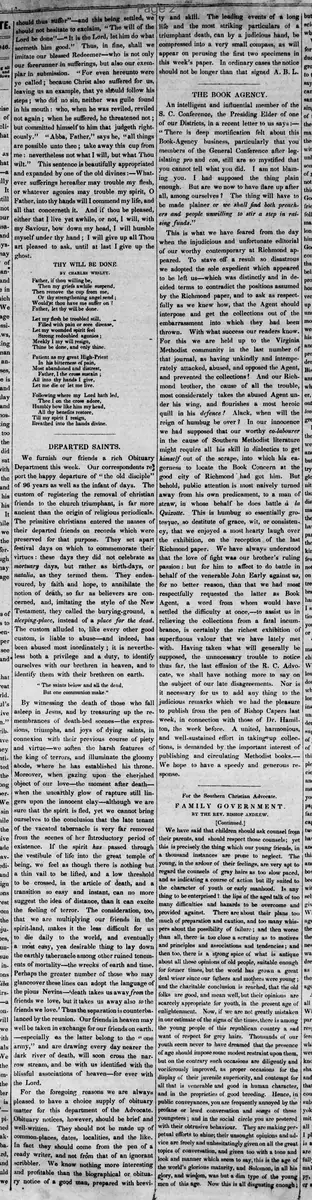
DEPARTED SAINTS.
We furnish our friends a rich Obituary Department this week. Our correspondents report the happy departure of "the old disciple" of 96 years as well as the infant of days. The custom of registering the removal of Christian friends to the church triumphant, is far more ancient than the origin of religious periodicals. The primitive Christians entered the names of their departed friends on records which were preserved for that purpose. They set apart festival days on which to commemorate their virtues: these days they did not celebrate as mortuary days, but rather as birth-days, or natalia, as they termed them. They endeavoured, by faith and hope, to annihilate the notion of death, so far as believers are concerned, and, imitating the style of the New Testament, they called the burying-ground, a sleeping-place, instead of a place for the dead.
The custom alluded to, like every other good custom, is liable to abuse—and indeed, has been abused most inordinately; it is nevertheless both a privilege and a duty, to identify ourselves with our brethren in heaven, and to identify them with their brethren on earth.
"The saints below and all the dead,
But one communion make."
By witnessing the death of those who fall asleep in Jesus, and by treasuring up the remembrances of death-bed scenes—the expressions, triumphs, and joys of dying saints, in connexion with their previous course of piety and virtue—we soften the harsh features of the king of terrors, and illuminate the gloomy abode, where he has established his throne.
Moreover, when gazing upon the cherished object of our love—the moment after death—when the unearthly glow of rapture still lingers upon the innocent clay—although we are sure that the spirit is fled, yet we cannot bring ourselves to the conclusion that the late tenant of the vacated tabernacle is very far removed from the scenes of her introductory period of existence. If the spirit has passed through the vestibule of life into the great temple of being, we feel as though there is nothing but a thin veil to be lifted, and a low threshold to be crossed, in the article of death, and a transition so easy and instant, can no more suggest the idea of distance, than it can excite the feeling of terror. The consideration, too, that we are multiplying our friends in the spirit-land, makes it the less difficult for us to die daily to the world, and eventually a most easy, yea desirable thing to lay down the earthly tabernacle among other ruined tenements of mortality—the wrecks of earth and time.
Perhaps the greater number of those who may glance over these lines can adopt the language of the pious Nevins—'death takes us away from the friends we love, but it takes us away also to the friends we love.' Thus the separation is counterbalanced by the reunion. Our friends in heaven may well be taken in exchange for our friends on earth.—especially as the latter belong to the "one army," and are drawing every day nearer the dark river of death, will soon cross the narrow stream, and be with us identified with the blissful associations of heaven—for ever with the Lord.
For the foregoing reasons we are always pleased to have a choice supply of obituary matter for this department of the Advocate. Obituary notices, however, should be brief and well-written. They should not be made up of common-places, dates, localities, and the like. In fact they should come from the pen of a ready writer, and not from that of an ignorant scribbler. We know nothing more interesting and profitable than the biographical or obituary notice of a good man, prepared with brevity and skill. The leading events of a long life and the most striking particulars of a triumphant death, can by a judicious hand, be compressed into a very small compass, as will appear on perusing the first two specimens in this week's paper. In ordinary cases the notice should not be longer than that signed A. B. L.
We furnish our friends a rich Obituary Department this week. Our correspondents report the happy departure of "the old disciple" of 96 years as well as the infant of days. The custom of registering the removal of Christian friends to the church triumphant, is far more ancient than the origin of religious periodicals. The primitive Christians entered the names of their departed friends on records which were preserved for that purpose. They set apart festival days on which to commemorate their virtues: these days they did not celebrate as mortuary days, but rather as birth-days, or natalia, as they termed them. They endeavoured, by faith and hope, to annihilate the notion of death, so far as believers are concerned, and, imitating the style of the New Testament, they called the burying-ground, a sleeping-place, instead of a place for the dead.
The custom alluded to, like every other good custom, is liable to abuse—and indeed, has been abused most inordinately; it is nevertheless both a privilege and a duty, to identify ourselves with our brethren in heaven, and to identify them with their brethren on earth.
"The saints below and all the dead,
But one communion make."
By witnessing the death of those who fall asleep in Jesus, and by treasuring up the remembrances of death-bed scenes—the expressions, triumphs, and joys of dying saints, in connexion with their previous course of piety and virtue—we soften the harsh features of the king of terrors, and illuminate the gloomy abode, where he has established his throne.
Moreover, when gazing upon the cherished object of our love—the moment after death—when the unearthly glow of rapture still lingers upon the innocent clay—although we are sure that the spirit is fled, yet we cannot bring ourselves to the conclusion that the late tenant of the vacated tabernacle is very far removed from the scenes of her introductory period of existence. If the spirit has passed through the vestibule of life into the great temple of being, we feel as though there is nothing but a thin veil to be lifted, and a low threshold to be crossed, in the article of death, and a transition so easy and instant, can no more suggest the idea of distance, than it can excite the feeling of terror. The consideration, too, that we are multiplying our friends in the spirit-land, makes it the less difficult for us to die daily to the world, and eventually a most easy, yea desirable thing to lay down the earthly tabernacle among other ruined tenements of mortality—the wrecks of earth and time.
Perhaps the greater number of those who may glance over these lines can adopt the language of the pious Nevins—'death takes us away from the friends we love, but it takes us away also to the friends we love.' Thus the separation is counterbalanced by the reunion. Our friends in heaven may well be taken in exchange for our friends on earth.—especially as the latter belong to the "one army," and are drawing every day nearer the dark river of death, will soon cross the narrow stream, and be with us identified with the blissful associations of heaven—for ever with the Lord.
For the foregoing reasons we are always pleased to have a choice supply of obituary matter for this department of the Advocate. Obituary notices, however, should be brief and well-written. They should not be made up of common-places, dates, localities, and the like. In fact they should come from the pen of a ready writer, and not from that of an ignorant scribbler. We know nothing more interesting and profitable than the biographical or obituary notice of a good man, prepared with brevity and skill. The leading events of a long life and the most striking particulars of a triumphant death, can by a judicious hand, be compressed into a very small compass, as will appear on perusing the first two specimens in this week's paper. In ordinary cases the notice should not be longer than that signed A. B. L.
What sub-type of article is it?
Moral Or Religious
What keywords are associated?
Departed Saints
Obituaries
Christian Death
Religious Commemoration
Death Bed Scenes
Heavenly Reunion
What entities or persons were involved?
Primitive Christians
Pious Nevins
Editorial Details
Primary Topic
Commemoration Of Departed Christian Saints Through Obituaries
Stance / Tone
Reflective And Encouraging Promotion Of Obituary Customs
Key Figures
Primitive Christians
Pious Nevins
Key Arguments
Ancient Christian Custom Of Recording Departed Saints As Birth Days Rather Than Mortuary Days
Commemorating Virtues Softens Death's Terror And Fosters Heavenly Connection
Obituaries Should Be Brief, Skillful, And Focus On Piety And Triumphs Rather Than Common Details
Death Reunites Believers With Loved Ones In Heaven, Counterbalancing Earthly Separations