Thank you for visiting SNEWPapers!
Sign up free
Story
May 26, 1949
The Potters Herald
East Liverpool, Columbiana County, Ohio
What is this article about?
In Flora, Ill., publisher Charles A. Crowder resists businessmen's foreclosure on his pro-labor paper for supporting a union strike; local unions unite to raise loans to buy mortgages and save it.
Clipping
OCR Quality
98%
Excellent
Full Text
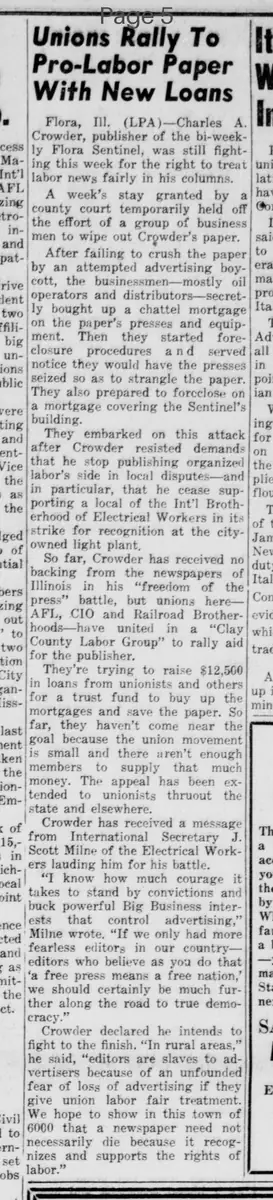
Unions Rally To Pro-Labor Paper With New Loans
Flora, Ill. (LPA)—Charles A. Crowder, publisher of the bi-weekly Flora Sentinel, was still fighting this week for the right to treat labor news fairly in his columns.
A week's stay granted by a county court temporarily held off the effort of a group of businessmen to wipe out Crowder's paper.
After failing to crush the paper by an attempted advertising boycott, the businessmen—mostly oil operators and distributors—secretly bought up a chattel mortgage on the paper's presses and equipment. Then they started foreclosure procedures and served notice they would have the presses seized so as to strangle the paper.
They also prepared to foreclose on a mortgage covering the Sentinel's building.
They embarked on this attack after Crowder resisted demands that he stop publishing organized labor's side in local disputes—and in particular, that he cease supporting a local of the Int'l Brotherhood of Electrical Workers in its strike for recognition at the city-owned light plant.
So far, Crowder has received no backing from the newspapers of Illinois in his "freedom of the press" battle, but unions here—AFL, CIO and Railroad Brotherhoods—have united in a "Clay County Labor Group" to rally aid for the publisher.
They're trying to raise $12,500 in loans from unionists and others for a trust fund to buy up the mortgages and save the paper. So far, they haven't come near the goal because the union movement is small and there aren't enough members to supply that much money. The appeal has been extended to unionists thruout the state and elsewhere.
Crowder has received a message from International Secretary J. Scott Milne of the Electrical Workers lauding him for his battle.
"I know how much courage it takes to stand by convictions and buck powerful Big Business interests that control advertising," Milne wrote. "If we only had more fearless editors in our country—editors who believe as you do that 'a free press means a free nation,' we should certainly be much further along the road to true democracy."
Crowder declared he intends to fight to the finish. "In rural areas," he said, "editors are slaves to advertisers because of an unfounded fear of loss of advertising if they give union labor fair treatment. We hope to show in this town of 6000 that a newspaper need not necessarily die because it recognizes and supports the rights of labor."
Flora, Ill. (LPA)—Charles A. Crowder, publisher of the bi-weekly Flora Sentinel, was still fighting this week for the right to treat labor news fairly in his columns.
A week's stay granted by a county court temporarily held off the effort of a group of businessmen to wipe out Crowder's paper.
After failing to crush the paper by an attempted advertising boycott, the businessmen—mostly oil operators and distributors—secretly bought up a chattel mortgage on the paper's presses and equipment. Then they started foreclosure procedures and served notice they would have the presses seized so as to strangle the paper.
They also prepared to foreclose on a mortgage covering the Sentinel's building.
They embarked on this attack after Crowder resisted demands that he stop publishing organized labor's side in local disputes—and in particular, that he cease supporting a local of the Int'l Brotherhood of Electrical Workers in its strike for recognition at the city-owned light plant.
So far, Crowder has received no backing from the newspapers of Illinois in his "freedom of the press" battle, but unions here—AFL, CIO and Railroad Brotherhoods—have united in a "Clay County Labor Group" to rally aid for the publisher.
They're trying to raise $12,500 in loans from unionists and others for a trust fund to buy up the mortgages and save the paper. So far, they haven't come near the goal because the union movement is small and there aren't enough members to supply that much money. The appeal has been extended to unionists thruout the state and elsewhere.
Crowder has received a message from International Secretary J. Scott Milne of the Electrical Workers lauding him for his battle.
"I know how much courage it takes to stand by convictions and buck powerful Big Business interests that control advertising," Milne wrote. "If we only had more fearless editors in our country—editors who believe as you do that 'a free press means a free nation,' we should certainly be much further along the road to true democracy."
Crowder declared he intends to fight to the finish. "In rural areas," he said, "editors are slaves to advertisers because of an unfounded fear of loss of advertising if they give union labor fair treatment. We hope to show in this town of 6000 that a newspaper need not necessarily die because it recognizes and supports the rights of labor."
What sub-type of article is it?
Historical Event
Personal Triumph
What themes does it cover?
Bravery Heroism
Justice
Moral Virtue
What keywords are associated?
Labor Support
Newspaper Foreclosure
Freedom Of Press
Union Rally
Advertising Boycott
What entities or persons were involved?
Charles A. Crowder
J. Scott Milne
Where did it happen?
Flora, Ill. (Clay County)
Story Details
Key Persons
Charles A. Crowder
J. Scott Milne
Location
Flora, Ill. (Clay County)
Story Details
Publisher Charles A. Crowder fights businessmen's attempt to foreclose on his pro-labor newspaper after he supports a union strike; unions rally with loans to save the paper.