Thank you for visiting SNEWPapers!
Sign up free
Grand Forks Daily Herald
Grand Forks, Grand Forks County, North Dakota
What is this article about?
The British government has successfully nationalized the railways of Great Britain for the war effort, coordinating them into a unified system under an executive committee chaired by Sir H. A. Walker. This allows instant mobilization for military needs, with smooth operations despite heavy troop transport demands.
Clipping
OCR Quality
Full Text
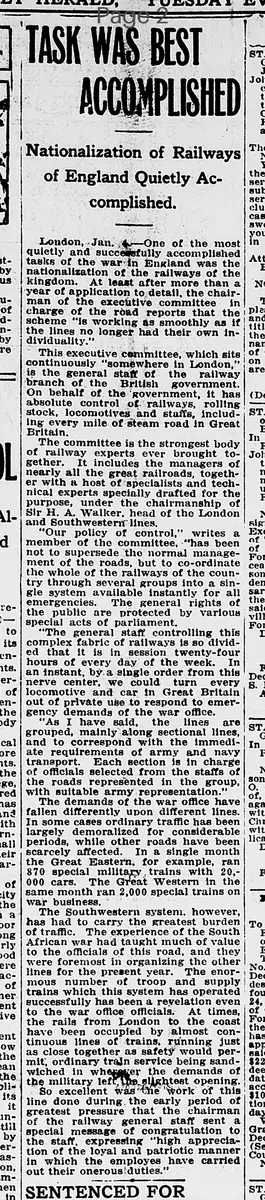
Nationalization of Railways of England Quietly Accomplished.
London, Jan. 4.--One of the most quietly and successfully accomplished tasks of the war in England was the nationalization of the railways of the kingdom. At least after more than a year of application to detail, the chairman of the executive committee in charge of the road reports that the scheme "is working as smoothly as if the lines no longer had their own individuality." This executive committee, which sits continuously "somewhere in London," is the general staff of the railway branch of the British government. On behalf of the government, it has absolute control of railways, rolling stock, locomotives and staffs, including every mile of steam road in Great Britain. The committee is the strongest body of railway experts ever brought together. It includes the managers of nearly all the great railroads, together with a host of specialists and technical experts specially drafted for the purpose, under the chairmanship of Sir H. A. Walker, head of the London and Southwestern lines. "Our policy of control" writes a member of the committee, "has been not to supersede the normal management of the roads, but to co-ordinate the whole of the railways of the country through several groups into a single system available instantly for all emergencies." The general rights of the public are protected by various special acts of parliament. "The general staff controlling this complex fabric of railways is so divided that it is in session twenty-four hours of every day of the week. In an instant, by a single order from this nerve center, we could turn every locomotive and car in Great Britain out of private use to respond to emergency demands of the war office. "As I have said, the lines are grouped, mainly along sectional lines, and to correspond with the immediate requirements of army and navy transport. Each section is in charge of officials selected from the staffs of the roads represented in the group, with suitable army representation." The demands of the war office have fallen differently upon different lines. In some cases ordinary traffic has been largely demoralized for considerable periods, while other roads have been scarcely affected. In a single month the Great Eastern, for example, ran 870 special military trains with 20,000 cars. The Great Western in the same month ran 2,000 special trains on war business. The Southwestern system, however, has had to carry the greatest burden of traffic. The experience of the South African war had taught much of value to the officials of this road, and they were foremost in organizing the other lines for the present war. The enormous number of troop and supply trains which this system has operated successfully has been a revelation even to the war office officials. At times, the rails from London to the coast have been occupied by almost continuous lines of trains, running just as close together as safety would permit, ordinary train service being sandwiched in wherever the demands of the military left no slightest opening. So excellent was the work of this line done during the early period of greatest pressure that the chairman of the railway general staff sent a special message of congratulation to the staff, expressing high appreciation of the loyal and patriotic manner in which the employes have carried out their onerous duties.
What sub-type of article is it?
What keywords are associated?
What entities or persons were involved?
Where did it happen?
Foreign News Details
Primary Location
London
Event Date
Jan. 4
Key Persons
Outcome
the nationalization scheme is working smoothly, enabling instant mobilization for war office demands; heavy military transport handled successfully without reported casualties.
Event Details
The British government nationalized the railways of Great Britain through an executive committee chaired by Sir H. A. Walker, coordinating lines into groups for war emergencies. The committee controls all railways, rolling stock, and staff, operating 24 hours a day. Specific lines like Great Eastern, Great Western, and Southwestern handled thousands of special military trains, with Southwestern bearing the heaviest burden and receiving commendation.