Thank you for visiting SNEWPapers!
Sign up free
Palladium Of Virginia And The Pacific Monitor
Lewisburg, Greenbrier County, West Virginia
What is this article about?
Extract from circular letter by Dr. Thomas H. Hall of North Carolina defending his participation in February 1 Republican Caucus at the Capitol, advocating for William H. Crawford as President due to his qualifications and southern ties amid sectional divisions, and asserting caucus nominations as a freeman's right.
Clipping
OCR Quality
Full Text
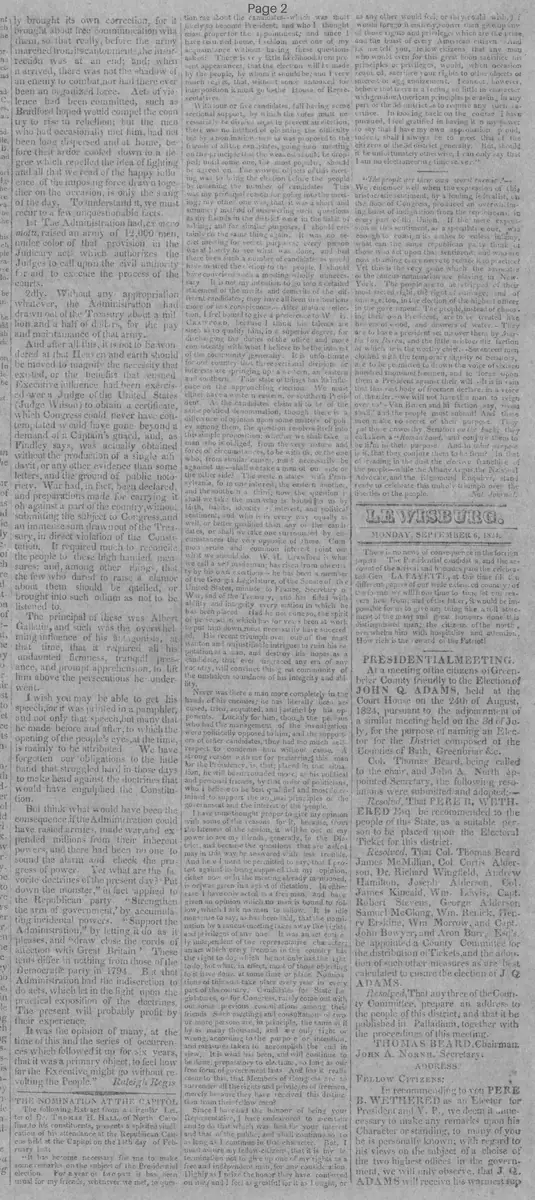
The following Extract from a Circular Letter of Dr. Thomas H. Hall, of North Carolina, to his constituents, presents a spirited vindication of his attendance at the Republican Caucus held at the Capitol on the 1st day of February last;
"It has become necessary for me to make some remarks on the subject of the Presidential election. For a year or two past it has been usual for my friends, whenever we met, to question me about the candidates--which was most likely to become President, and who I thought most proper for the appointment; and since I returned home, I seldom meet one of my acquaintance without having these questions asked: There is very little likelihood from present appearances, that the election will be made by the people, by whom it should be, and I very much regret, that, without some unlooked for interposition it must go to the House of Representatives.
With four or five candidates, all having some sectional support, by which the votes must necessarily be divided so as to prevent an election, there was no method of obviating the difficulty but by a nomination such as was proposed to the friends of all the candidates, going into meeting on the principle that the weakest should be dropped; until some one, the most popular, should be agreed on. The avowed objects of this meeting was to bring the election before the people by lessening the number of candidates. This was my principal reason for going into the meeting; nay other one was, that it was a short and summary method of answering such questions as my friends in the district were in the habit of asking; and for similar purposes, I should certainly do the same thing again. It was no secret meeting for secret purposes; every person was at liberty to see what was done, and had there been such a number of candidates as would have insured the election to the people, I should have conceived such a meeting wholly unnecessary. It is not my intention to go into a detailed statement of the merits and demerits of the different candidates; they have all been in situations more or less conspicuous. After mature reflection, I feel bound to give a preference to Wm. H. Crawford, because I think his talents are such as to qualify him, in a superior degree, for discharging the duties of the office and more consistently with what I believe to be the interest of the community generally. It is unfortunate for our country that these sectional divisions or interests are springing up: a western, an eastern and southern. This state of things has its influence on the approaching election. We must either have a western, eastern, or southern President. As the candidates claim all to be of the same political denomination, though there is a difference of opinion upon some matters of policy among them, the question resolves itself into this simple proposition: whether we shall take a man who is obliged, from the very nature and force of circumstances, to be with us, or the one who, from similar causes, must necessarily be against us--shall we take a man on our side or the other side? The western states with Pennsylvania, form one interest, the eastern another, and the southern a third: now the question is shall we take the man who is bound to us by birth, habit, identity interest, and political sentiment, and who is in every way equally as well, or better qualified than any of the candidates, or shall we take one surrounded by circumstances the very opposite of these. Common sense and common interest point out what we should do. W. H. Crawford is what we call a self made man: has risen from obscurity by his own exertions--he has been a member of the Georgia Legislature, of the Senate of the United States, minister to France, Secretary of War, and of the Treasury, and has filled with ability and integrity every station in which he has been placed. Had he not done so, the spirit of persecution which has forever been at work to put him down, must necessarily have succeeded. His recent triumph over one of the most wanton and unjustifiable intrigues to ruin his reputation as a man, and destroy his hopes as a candidate, that ever disgraced any era of any country, will convince this great community of the unshaken soundness of his integrity and ability.
Never was there a man more completely in the hands of his enemies: he has literally been accused, tried, acquitted, and justified by his opponents. Luckily for him, though the persons who had the management of the investigation were politically opposed to him, and the supporters of other candidates, they had too much self respect to condemn him without cause. A strong reason with me for preferring this man for the Presidency, is, that, placed in that situation, he will be surrounded more, as his political and personal friends, by that order of politicians, who I believe to be best qualified and most determined to support the original principles of the government and the interest of the people. I have thus thought proper to give my opinion with some of the reasons for it, because, from the lateness of the session, it will be out of my power to see my friends, generally, in the District, and because the questions that are asked may in this way be answered with less trouble. And here I must be permitted to say, that I protest against its being supposed that my opinion, either now or in the meeting already mentioned, is or was given in a spirit of dictation. In either case I have only acted as a free man, and have given an opinion which no man is bound to follow, which I ask no man to follow. It is idle nonsense to say, as has been said, that the nomination by a caucus meeting takes away the rights and privileges of any one. It was an act entirely independent of the representative character; an act which every freeman in the country has the right to do, which he not only has the right to do, but what, in effect, most of those objecting to it have done, at some time or place. Nominations of this sort take place every year in every part of the country. Candidates for State Legislatures, or for Congress, rarely come out without some previous consultations among their friends. Such meetings and consultations of two or more persons are, in principle, the same as if by as many thousand, and are only right or wrong, according to the purpose or intention, and measures taken to accomplish the end in view. It is what has been, and will continue to be done, preparatory to elections, so long as our free form of government lasts. And has it really come to this, that Members of Congress are to surrender all their rights and privileges of freemen, merely because they have received this distinction from their fellow men?
Since I have had the honour of being your Representative, I have endeavored to ascertain and to do that which was best for your interest and that of the public, and shall continue so to do as long as I continue in that character. But, I must assure my fellow-citizens, that it is my determination not to give up one of my rights as a free and independent man, for any consideration. Highly as I prize the honor they have conferred on me, (and I feel as grateful for it as I ought, or as any other would feel, or they could wish,) I would forego it entirely, sooner than give up any of those rights and privileges which are the pride and the boast of every American citizen. And it will tell you, fellow citizens that any man who would even for this great boon sacrifice his principles or privileges, would, when occasion required, sacrifice your rights to other objects of interest or aggrandizement. I cannot, however, believe that there is a feeling so little in character with genuine American principles prevailing in any part of the 3d district as to require any such sacrifice. In looking back on the course I have pursued, I feel gratified in having it in my power to say that I have my own approbation proud, indeed, shall I always be to meet that of the citizens of the 3d district generally. But, should it be unfortunately otherwise, I can only say that I am no electioneering time server."
What sub-type of article is it?
What themes does it cover?
What keywords are associated?
What entities or persons were involved?
Letter to Editor Details
Author
Dr. Thomas H. Hall
Recipient
His Constituents
Main Argument
dr. hall defends his attendance at the republican caucus to nominate a single candidate for president, preferring william h. crawford for his qualifications, integrity, and alignment with southern interests amid sectional divisions, arguing such meetings are legitimate and do not infringe on rights.
Notable Details