Thank you for visiting SNEWPapers!
Sign up free
Editorial
August 26, 1803
The National Intelligencer And Washington Advertiser
Washington, District Of Columbia
What is this article about?
An editorial critiques a Boston Palladium piece urging resistance to France and implying tribute via the Louisiana Purchase. It defends American neutrality, warns against British dominance if France falls, and criticizes Federalist leanings toward Britain, echoing Washington's farewell.
Merged-components note: Continuation of the editorial responding to and critiquing the Palladium piece on paying tribute to Caesar in relation to the Louisiana purchase.
Clipping
OCR Quality
95%
Excellent
Full Text
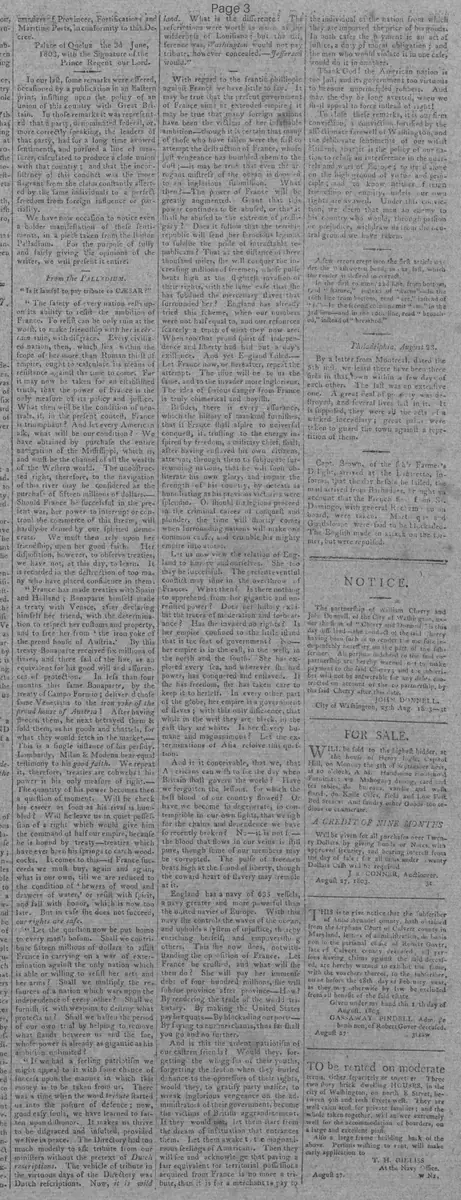
In our last, some remarks were offered, occasioned by a publication in an Eastern print, insisting upon the policy of an union of this country with Great Britain. In those remarks it was represented that a party, denominated federal, or more correctly speaking, the leaders of that party, had for a long time avowed sentiments, and pursued a line of measures, calculated to produce a close union with that country: and that the inconsistency of this conduct was the more flagrant from the claim constantly asserted by the same individuals to a perfect freedom from foreign influence or partiality.
We have now occasion to notice even a bolder manifestation of these sentiments, in a piece taken from the Boston Palladium. For the purpose of fully and fairly giving the opinions of the writer, we will present it entire.
From the PALLADIUM.
"Is it lawful to pay tribute to CAESAR?"
The safety of every nation rests upon its ability to resist the ambition of France. To resist can be only ruin at the worst, to make friendship with her is certain ruin, with disgrace. Every civilized nation, then, which lies within the scope of her more than Roman thirst of empire, ought to calculate its means of resistance against the time to come. For it may now be taken for an established truth, that the power of France is the only measure of its policy and justice.
What then will be the Condition of neutrals, if, in the present contest, France is triumphant? And let every American ask, what will be our condition? We have obtained by purchase the entire navigation of the Mississippi, which is, and must be the channel of all the wealth of the Western world. The unobstructed right, therefore, to the navigation of this river may be considered as the purchase of Fifteen millions of dollars. Should France be successful in the present war, her power to interrupt or control the commerce of this stream, will hardly be denied by our spirited democrats. We must then rely upon her friendship, upon her good faith. Her disposition, however, to observe treaties, we have not, at this day, to learn. It is recorded in the destruction of too many who have placed confidence in them.
France has made treaties with Spain and Holland; Bonaparte himself made a treaty with Venice, after declaring himself her friend, with the determination to respect her customs and property, and to free her from 'the iron yoke of the proud house of Austria.' By this treaty Bonaparte received six millions of livres, and three sail of the line, as an equivalent for his good will and assurances of protection. In less than four months this same Bonaparte, by the treaty of Campo Formio; delivered those same Venetians to the iron yoke of the proud house of Austria! After having fleeced them, he next betrayed them & sold them, as his goods and chattels, or what they would fetch in the market.
This is a single instance of his perfidy. Lombardy, Milan & Modena bear equal testimony to his good faith. We repeat it, therefore, treaties are cobwebs: his power is his only measure of right. The quantity of his power becomes then a question of moment. Will he check his career as soon as his rival is humbled? Will he leave us in quiet possession of a right which would give him the command of half our empire, because he is bound by treaty--treaties which have ever been his springs to catch woodcocks. It comes to this--if France succeeds we must buy, again and again, what is our own, till we are reduced to the condition of hewers of wood and drawers of water,' or resist with spirit, and fall with honor, which is now too late. But in case he does not succeed, our rights are safe.
Let the question now be put home to every man's bosom. Shall we contribute fifteen millions of dollars to aid France in carrying on a war of extermination against the only nation which is able or willing to resist her arts and her arms? Shall we multiply the resources of a nation which wars upon the independence of every other? Shall we furnish it with weapons to destroy what protects us? Shall we hasten the period of our own trial by helping to remove what stands between us and the foe whose power is already as gigantic as his ambition unlimited?
If we had a feeling patriotism we might appeal to it with some chance of success upon the manner in which this money is to be taken from us. There was a time when the word tribute started us into the posture of defence; now, good easy souls, we have learned to fatten upon dishonor. It makes us thrive to be disgraced and insulted, provided we live in peace. The Directory had too much modesty to ask tribute from our ministers without the pretext of Dutch rescriptions. The vehicle of tribute in the virtuous days of the Directory was Dutch rescriptions. Now, it is wild land. What is the difference? The rescriptions were worth as much as the wildernesses of Louisiana; but the difference was, Washington would not pay tribute. However concealed--Jefferson would."
With regard to the frantic philippic against France we have little to say. It may be true that the present government of France aims at extended empire; it may be true that many foreign nations have been the victims of her insatiable ambition though it is certain that many of those who have fallen were the first to attempt the destruction of France, whose just vengeance has humbled them to the dust;--it may be true that even the arrogant mistress of the ocean is doomed to an inglorious submission. What then? The power of France will be greatly augmented. Grant that this power continues to be abused, or that it shall be abused to the extreme of presumption? Does it follow that the terrible republic will end her ferocious legions to subdue the pride of intractable republicans? That at the distance of three thousand miles, she will conquer the increasing millions of freemen, whose pulse beats high at the slightest invasion of their rights, with the same ease that she has subdued the mercenary slaves that surrounded her? England has already tried this scheme, when our numbers were not half equal to, and our resources scarcely a tenth of what they now are. When too that proud spirit of independence and liberty had had but a day's existence. And yet England failed. Let France now, or hereafter, repeat the attempt. The issue will be to us the same, and to the invader more inglorious.
The idea of serious danger from France is truly chimerical and boyish. Besides, there is every assurance, which the history of mankind furnishes, that if France shall aspire to universal conquest, if, trusting to the energy inspired by freedom, a military chief, shall, after having enslaved his own citizens, attempt, through them to subjugate surrounding nations, that he will soon obliterate his own glory, and impair the strength of his country, by defeats as humiliating as his previous victories were splendid. O, should his legions proceed in the criminal career of conquest and plunder, the time will shortly come, when surrounding nations will make one common cause, and crumble his mighty empire into atoms.
Let us now view the relation of England to Europe and ourselves. She too may be successful. The present eventful conflict may end in the overthrow of France. What then? Is there nothing to apprehend from her gigantic and unresisted power? Does her history exhibit the traces of moderation and forbearance? Has she invaded no rights? Is her empire confined to the little island that is the seat of government? No--her empire is in the east, in the west, in the north and the south. She has explored every sea, and wherever she had power, has conquered and enslaved. If she has freedom, she has taken care to keep it to herself. In every other part of the globe, her empire is a government of slaves; with this only difference, that while in the west they are black, in the east they are white. Is her a very humane and magnanimous? Let the exterminations of Asia resolve this question.
And is it conceivable, that we, that Americans can wish to see the day when Britain shall govern the world? Have we forgotten the lessons, for which the best blood of our country flowed? Or have we become so degenerate, so contemptible in our own sights, that we sigh for the chains and dependence we have so recently broken? No--it is not so the blood that flows in our veins is still pure, though some of our members may be corrupted. The pulse of freemen beats high at the sound of liberty, though the coward heart of slavery may tremble at it.
England has a navy of 635 vessels, a navy greater and more powerful than the united navies of Europe. With this navy she controls the waves of the ocean, and upholds a system of injustice, thereby enriching herself, and impoverishing others. This she now does, notwithstanding the opposition of France. Let France be crushed, and what will she then do? She will pay her immense debt of four hundred millions, she will subdue province after province--How? By rendering the trade of the world tributary. By making the United States pay her quota--By blockading our ports--By saying to our merchants, thus far shall you go and no further.
And is this the ardent patriotism of our eastern friends? Would they, or--forgetting the whiggism of their youths, forgetting the season when they hurled defiance to the oppressors of their rights, would they, to gratify party malice, to wreak inglorious vengeance on the administrators of their government, become the victims of British aggrandizement. If they would not, let them start from the dream of infatuation that entrances them. Let them awake to the magnanimous feelings of Americans. Then they will see and acknowledge that paying a fair equivalent for territorial possessions acquired from France is no more a tribute, than it is for a merchant to pay to the individual of the nation from which they are imported the price of his goods.
In both cases the payment is an act of justice, a duty of moral obligation; and the men who would violate it in one case, would do it in another.
Thank God! the American nation is too just, and its government too virtuous to become unprincipled robbers. And may, the day be long averted, when we shall appeal to force instead of right!
To close these remarks, it is our firm conviction, a conviction fortified by the affectionate farewell of Washington, and the deliberate sentiments of our wisest citizens, that it is the policy of our nation to refuse an interference in the quarrels and wars of Europe; to stand alone on the high ground of virtue and principle; and to know neither foreign friendship or enmity, unless our own rights are invaded. Under this conviction, we deem that man an enemy to his country who would, through passion or prejudice, withdraw us from the neutral ground we have taken.
We have now occasion to notice even a bolder manifestation of these sentiments, in a piece taken from the Boston Palladium. For the purpose of fully and fairly giving the opinions of the writer, we will present it entire.
From the PALLADIUM.
"Is it lawful to pay tribute to CAESAR?"
The safety of every nation rests upon its ability to resist the ambition of France. To resist can be only ruin at the worst, to make friendship with her is certain ruin, with disgrace. Every civilized nation, then, which lies within the scope of her more than Roman thirst of empire, ought to calculate its means of resistance against the time to come. For it may now be taken for an established truth, that the power of France is the only measure of its policy and justice.
What then will be the Condition of neutrals, if, in the present contest, France is triumphant? And let every American ask, what will be our condition? We have obtained by purchase the entire navigation of the Mississippi, which is, and must be the channel of all the wealth of the Western world. The unobstructed right, therefore, to the navigation of this river may be considered as the purchase of Fifteen millions of dollars. Should France be successful in the present war, her power to interrupt or control the commerce of this stream, will hardly be denied by our spirited democrats. We must then rely upon her friendship, upon her good faith. Her disposition, however, to observe treaties, we have not, at this day, to learn. It is recorded in the destruction of too many who have placed confidence in them.
France has made treaties with Spain and Holland; Bonaparte himself made a treaty with Venice, after declaring himself her friend, with the determination to respect her customs and property, and to free her from 'the iron yoke of the proud house of Austria.' By this treaty Bonaparte received six millions of livres, and three sail of the line, as an equivalent for his good will and assurances of protection. In less than four months this same Bonaparte, by the treaty of Campo Formio; delivered those same Venetians to the iron yoke of the proud house of Austria! After having fleeced them, he next betrayed them & sold them, as his goods and chattels, or what they would fetch in the market.
This is a single instance of his perfidy. Lombardy, Milan & Modena bear equal testimony to his good faith. We repeat it, therefore, treaties are cobwebs: his power is his only measure of right. The quantity of his power becomes then a question of moment. Will he check his career as soon as his rival is humbled? Will he leave us in quiet possession of a right which would give him the command of half our empire, because he is bound by treaty--treaties which have ever been his springs to catch woodcocks. It comes to this--if France succeeds we must buy, again and again, what is our own, till we are reduced to the condition of hewers of wood and drawers of water,' or resist with spirit, and fall with honor, which is now too late. But in case he does not succeed, our rights are safe.
Let the question now be put home to every man's bosom. Shall we contribute fifteen millions of dollars to aid France in carrying on a war of extermination against the only nation which is able or willing to resist her arts and her arms? Shall we multiply the resources of a nation which wars upon the independence of every other? Shall we furnish it with weapons to destroy what protects us? Shall we hasten the period of our own trial by helping to remove what stands between us and the foe whose power is already as gigantic as his ambition unlimited?
If we had a feeling patriotism we might appeal to it with some chance of success upon the manner in which this money is to be taken from us. There was a time when the word tribute started us into the posture of defence; now, good easy souls, we have learned to fatten upon dishonor. It makes us thrive to be disgraced and insulted, provided we live in peace. The Directory had too much modesty to ask tribute from our ministers without the pretext of Dutch rescriptions. The vehicle of tribute in the virtuous days of the Directory was Dutch rescriptions. Now, it is wild land. What is the difference? The rescriptions were worth as much as the wildernesses of Louisiana; but the difference was, Washington would not pay tribute. However concealed--Jefferson would."
With regard to the frantic philippic against France we have little to say. It may be true that the present government of France aims at extended empire; it may be true that many foreign nations have been the victims of her insatiable ambition though it is certain that many of those who have fallen were the first to attempt the destruction of France, whose just vengeance has humbled them to the dust;--it may be true that even the arrogant mistress of the ocean is doomed to an inglorious submission. What then? The power of France will be greatly augmented. Grant that this power continues to be abused, or that it shall be abused to the extreme of presumption? Does it follow that the terrible republic will end her ferocious legions to subdue the pride of intractable republicans? That at the distance of three thousand miles, she will conquer the increasing millions of freemen, whose pulse beats high at the slightest invasion of their rights, with the same ease that she has subdued the mercenary slaves that surrounded her? England has already tried this scheme, when our numbers were not half equal to, and our resources scarcely a tenth of what they now are. When too that proud spirit of independence and liberty had had but a day's existence. And yet England failed. Let France now, or hereafter, repeat the attempt. The issue will be to us the same, and to the invader more inglorious.
The idea of serious danger from France is truly chimerical and boyish. Besides, there is every assurance, which the history of mankind furnishes, that if France shall aspire to universal conquest, if, trusting to the energy inspired by freedom, a military chief, shall, after having enslaved his own citizens, attempt, through them to subjugate surrounding nations, that he will soon obliterate his own glory, and impair the strength of his country, by defeats as humiliating as his previous victories were splendid. O, should his legions proceed in the criminal career of conquest and plunder, the time will shortly come, when surrounding nations will make one common cause, and crumble his mighty empire into atoms.
Let us now view the relation of England to Europe and ourselves. She too may be successful. The present eventful conflict may end in the overthrow of France. What then? Is there nothing to apprehend from her gigantic and unresisted power? Does her history exhibit the traces of moderation and forbearance? Has she invaded no rights? Is her empire confined to the little island that is the seat of government? No--her empire is in the east, in the west, in the north and the south. She has explored every sea, and wherever she had power, has conquered and enslaved. If she has freedom, she has taken care to keep it to herself. In every other part of the globe, her empire is a government of slaves; with this only difference, that while in the west they are black, in the east they are white. Is her a very humane and magnanimous? Let the exterminations of Asia resolve this question.
And is it conceivable, that we, that Americans can wish to see the day when Britain shall govern the world? Have we forgotten the lessons, for which the best blood of our country flowed? Or have we become so degenerate, so contemptible in our own sights, that we sigh for the chains and dependence we have so recently broken? No--it is not so the blood that flows in our veins is still pure, though some of our members may be corrupted. The pulse of freemen beats high at the sound of liberty, though the coward heart of slavery may tremble at it.
England has a navy of 635 vessels, a navy greater and more powerful than the united navies of Europe. With this navy she controls the waves of the ocean, and upholds a system of injustice, thereby enriching herself, and impoverishing others. This she now does, notwithstanding the opposition of France. Let France be crushed, and what will she then do? She will pay her immense debt of four hundred millions, she will subdue province after province--How? By rendering the trade of the world tributary. By making the United States pay her quota--By blockading our ports--By saying to our merchants, thus far shall you go and no further.
And is this the ardent patriotism of our eastern friends? Would they, or--forgetting the whiggism of their youths, forgetting the season when they hurled defiance to the oppressors of their rights, would they, to gratify party malice, to wreak inglorious vengeance on the administrators of their government, become the victims of British aggrandizement. If they would not, let them start from the dream of infatuation that entrances them. Let them awake to the magnanimous feelings of Americans. Then they will see and acknowledge that paying a fair equivalent for territorial possessions acquired from France is no more a tribute, than it is for a merchant to pay to the individual of the nation from which they are imported the price of his goods.
In both cases the payment is an act of justice, a duty of moral obligation; and the men who would violate it in one case, would do it in another.
Thank God! the American nation is too just, and its government too virtuous to become unprincipled robbers. And may, the day be long averted, when we shall appeal to force instead of right!
To close these remarks, it is our firm conviction, a conviction fortified by the affectionate farewell of Washington, and the deliberate sentiments of our wisest citizens, that it is the policy of our nation to refuse an interference in the quarrels and wars of Europe; to stand alone on the high ground of virtue and principle; and to know neither foreign friendship or enmity, unless our own rights are invaded. Under this conviction, we deem that man an enemy to his country who would, through passion or prejudice, withdraw us from the neutral ground we have taken.
What sub-type of article is it?
Foreign Affairs
War Or Peace
Partisan Politics
What keywords are associated?
American Neutrality
French Ambition
British Empire
Louisiana Purchase
Tribute To Caesar
Federal Party
Washington Farewell
What entities or persons were involved?
France
Britain
Bonaparte
Washington
Jefferson
Directory
Federal Party
Democrats
Editorial Details
Primary Topic
Defense Of American Neutrality Against French And British Threats
Stance / Tone
Strongly Pro Neutrality And Anti British Influence
Key Figures
France
Britain
Bonaparte
Washington
Jefferson
Directory
Federal Party
Democrats
Key Arguments
France's Power Threatens Neutrals But Treaties Are Unreliable
American Rights To Mississippi Navigation At Risk If France Triumphs
Britain's History Of Conquest And Enslavement Poses Greater Danger
Neutrality Preserves Independence; Aiding Either Side Invites Ruin
Louisiana Purchase Is Just Payment, Not Tribute
Federalists Inconsistently Seek British Union While Claiming Independence From Foreign Influence