Thank you for visiting SNEWPapers!
Sign up free
Hillsdale Whig Standard
Hillsdale, Hillsdale County, Michigan
What is this article about?
A descriptive letter from San Francisco details the arrival by ship, the bay's features, town's layout with 800 inhabitants and 200 buildings (up from 50 in 1847), military sites, commercial growth, agricultural prospects, and mineral riches including gold at Sutter's, highlighting its potential as Pacific hub.
Clipping
OCR Quality
Full Text
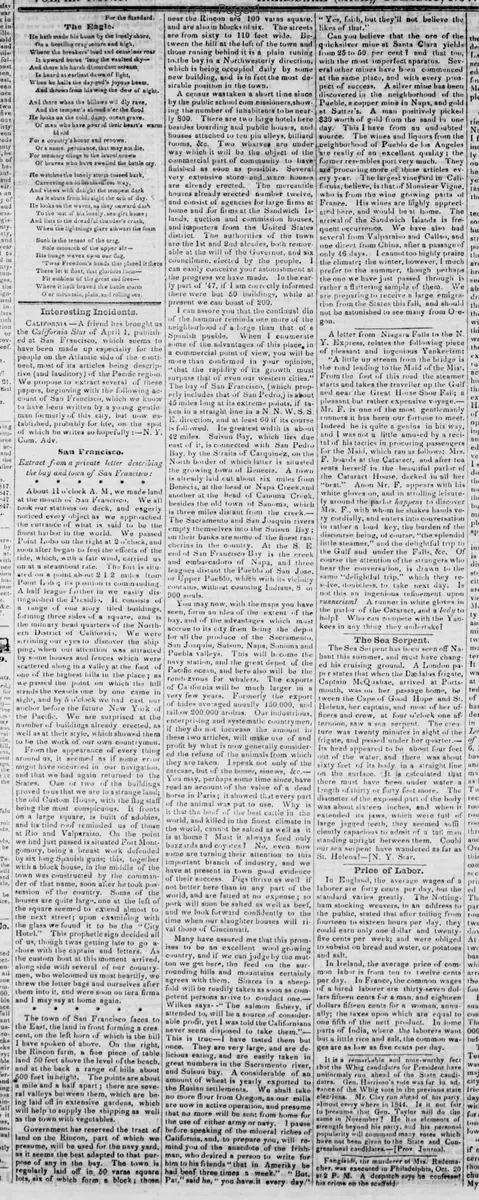
California—A friend has brought us the California Star of April 1, published at San Francisco, which seems to have been made up especially for the people on the Atlantic side of the continent, most of its articles being descriptive (and laudatory) of the Pacific region. We propose to extract several of these papers, beginning with the following account of San Francisco, which we know to have been written by a young gentleman formerly of this city, but now established, probably for life, on the spot of which he writes so hopefully:—N. Y. Com. Adv.
San Francisco.
Extract from a private letter describing the bay and town of San Francisco:
About 10 o'clock A. M, we made land at the mouth of San Francisco. We all took our stations on deck, and eagerly noticed every object as we approached the entrance of what is said to be the finest harbor in the world. We passed Point Lobo on the right at 2 o'clock, and soon after began to feel the effects of the tide, which, with a fair wind, carried us on at a steamboat rate. The fort is situated on a point about 2 1/2 miles from Point Lobo; its position is commanding. A half league further in we easily distinguished the Presidio. It consists of a range of one story tiled buildings, forming three sides of a square, and is the military head quarters of the Northeastern District of California. We were straining our eyes to discover the shipping, when our attention was attracted by some houses and fences which were scattered along in a valley at the foot of one of the highest hills in the place; as we passed the point on which the hill stands the vessels one by one came in sight, and by 5 o'clock we had cast our anchor before the future New York of the Pacific. We are surprised at the number of buildings already erected, as well as at their style, which showed them to be the work of our own countrymen. From the appearance of every thing around us, it seemed as if some error might have occurred in our navigation, and that we had again returned to the States. One or two of the buildings proved to us that we are in a strange land; the old Custom House, with the flag staff being the most conspicuous. It fronts on a large square, is built of adobies, and its tiled roof reminded us of those at Rio and Valparaiso. On the point we had just passed is situated Fort Montgomery, being a breast work defended by six long Spanish guns; this, together with a block house, in the middle of the town was constructed by the commander of that name, soon after he took possession of the country. Some of the houses are quite large. one at the left of the square seemed to extend almost to the next street; upon examining with the glass we found it to be the "City Hotel." This prophetic sign decided all of us, though 'twas getting late to go a-shore with the captain and letters. As the custom boat at this moment arrived, along side with several of our countrymen, who welcomed us most heartily, we threw the letter bags and ourselves after them into it, and were soon on terra firma and I may say at home again.
The town of San Francisco faces to the East, the land in front forming a crescent, on the left horn of which is the hill I have spoken of above. On the right, the Rincon farm, a fine piece of table land 50 feet above the level of the beach, and at the back a range of hills about 500 feet in height. The points are about a mile and a half apart; there are several valleys between them, which are being laid off in extensive gardens, which will help to supply the shipping as well as the town with vegetables. Government has reserved the tract of land on the Rincon, part of which we presume, will be used for the navy yard, as it seems the best adapted to that purpose of any in the bay. The town is regularly laid off in 50 varas square lots, six of which form a block; those near the Rincon are 100 varas square, and are also in blocks of six. The streets are from sixty to 110 feet wide. Between the hill at the left of the town and those running behind it is a plain running to the bay in a Northwesterly direction, which is being occupied daily by some new building, and is in fact the most desirable position in the town.
A census was taken a short time since by the public school commissioners, showing the number of inhabitants to be nearly 800. There are two large hotels here besides boarding and public houses, and houses attached to ten pin alleys, billiard rooms, &c. Two wharves are under way which it will be the object of the Commercial part of community to have finished as soon as possible. Several very extensive store and ware houses are already erected. The mercantile houses already erected number twelve, and consist of agencies for large firms at home and for firms at the Sandwich Islands, auction and commission houses, and importers from the United States district. The authorities of the town are the 1st and 2nd alcaldes, both removable at the will of the Governor, and six councilmen, elected by the people. I can easily conceive your astonishment at the progress we have made. In the early part of '47, if I am correctly informed there were but 50 buildings, while at present we can boast of 200. I can assure you that the continual din of the hammer reminds one more of the neighborhood of a forge than that of a Spanish pueblo. When I enumerate some of the advantages of this place in a commercial point of view, you will be more than confirmed in your opinion, "that the rapidity of its growth must surpass that of even our western cities."
The bay of San Francisco, (which properly includes that of San Pedro.) is about 45 miles long at its extreme points, if taken in a straight line in a N N. W. S. S. E. direction, and at least 60 if its course is followed. Its greatest width is about 42 miles. Suisun Bay, which lies due east of it, is connected with San Pedro Bay, by the Straits of Carquinez, on the North border of which latter is situated the growing town of Benicia. A town is already laid out about six miles from Benicia, at the head of Napa Creek, and another at the head of Sonoma Creek, besides the old town of Sonoma, which is three miles distant from the creek. The Sacramento and San Joaquin rivers empty themselves into the Suisun Bay; on their banks are some of the finest rancherias in the country. At the S. E end of San Francisco Bay is the creek and embarcadero of Napa, and three leagues distant the Pueblo de San Jose, or Upper Pueblo, which with its vicinity contains, without counting Indians, 800 or 900 souls.
You may now, with the maps you have seen, form an idea of the extent of the bay, and of the advantages which must accrue to its city from being the depot for all the produce of the Sacramento, San Joaquin, Suisun, Napa, Sonoma and Pueblo valleys. This will become the navy station, and the great depot of the Pacific ocean, and here also will be the rendezvous for whalers. The exports of California will be much larger in a very few years. Formerly the export of hides averaged annually 150,000, and tallow 200,000 arrobas. Our industrious, enterprising and systematic countrymen, if they do not increase the amount in these two articles, will make use of and profit by what is now generally considered the refuse of the animals from which they are taken. I speak not only of the carcass, but of the bones, sinews, &c. You may, perhaps some time since, have read an account of the value of a dead horse in Paris; it showed that every part of the animal was put to use. Why is it that the beef of the best cattle in the world, and killed in the finest climate in the world, cannot be salted as well as it is at home? Must it always feed only buzzards and coyotes? No, even now some are turning their attention to this important branch of industry, and we have at present in town good evidence of their success. Pigs thrive as well if not better here than in any part of the world, and are fatted at no expense; so pork will soon be salted as well as beef, and we look forward confidently to the time when our slaughter houses will rival those of Cincinnati.
Many have assured me that this promises to be an excellent wool growing country, and if we can judge by the mutton we get here, the feed on the surrounding hills and mountains certainly agrees with them. Shares in a sheep-fold will be readily taken as soon as competent persons arrive to conduct one.— Wilkes says- "The salmon fishery, if attended to, will be a source of considerable profit, yet I was told the Californians never seem disposed to take them."- This is true-I have tasted them but once. They are very large, and are delicious eating, and are easily taken in great numbers in the Sacramento river, and Suisun bay. A considerable amount of wheat is yearly exported to the Russian settlements. We shall take no more flour from Oregon, as our mills are now in active operation, and presume that no more will be sent from home for the use of either army or navy. I pause before speaking of the mineral riches of California, and, to prepare you, will remind you of the anecdote of the Irishman, who desired a person to write for him to his friends "that in Ameriky he had beef three times a week." "But, Pat," said he, "you have it every day" "Yes, faith, but they'll not believe the likes of that."
Can you believe that the ore of the quicksilver mine at Santa Clara yields from 25 to 50 per cent? and that too, with the most imperfect apparatus. Several other mines have been commenced at the same place, and with every prospect of success. A silver mine has been discovered in the neighborhood of the Pueblo, a copper mine in Napa, and gold at Sutter's. A man positively picked $30 worth of gold from the sand in one day. This I have from an undoubted source. The wines and liquors from the neighborhood of Pueblo de los Angeles are really of an excellent quality; the former resembles port very much. They are procuring more of these articles every year. The largest vineyard in California, I believe, is that of Monsieur Vigne, who is from the wine growing parts of France. His wines are highly appreciated here, and would be at home. The arrival of the Sandwich Islands is frequent occurrence. We have also had several from Valparaiso and Callao, and one direct from China, after a passage of only 46 days. I cannot too highly praise the climate; the winter, however, I much prefer to the summer, though perhaps the one we have just passed through is rather a flattering sample of them. We are preparing to receive a large emigration from the States this fall, and should not be astonished to see many from Oregon.
What sub-type of article is it?
What themes does it cover?
What keywords are associated?
What entities or persons were involved?
Where did it happen?
Story Details
Key Persons
Location
San Francisco, California
Event Date
Early Part Of '47 To Present (1848)
Story Details
A traveler arrives by ship at San Francisco bay, describes the harbor, Presidio, Fort Montgomery, town layout with 800 residents and 200 buildings, rapid growth, commercial establishments, bay extent, surrounding towns and rivers, agricultural and export potential including hides, beef, pork, wool, salmon, wheat, and mineral resources like quicksilver, silver, copper, and gold at Sutter's, predicting it as Pacific depot.