Thank you for visiting SNEWPapers!
Sign up free
Story
July 5, 1830
Lynchburg Virginian
Lynchburg, Virginia
What is this article about?
A grand dinner in Cincinnati on June 19 honored Senator David Barton, featuring toasts praising the Union, Henry Clay, and criticizing President Jackson's veto of the Maysville Road Bill. Barton defended his Senate speeches amid political turmoil, with enthusiastic support for opposition to the administration.
Clipping
OCR Quality
88%
Good
Full Text
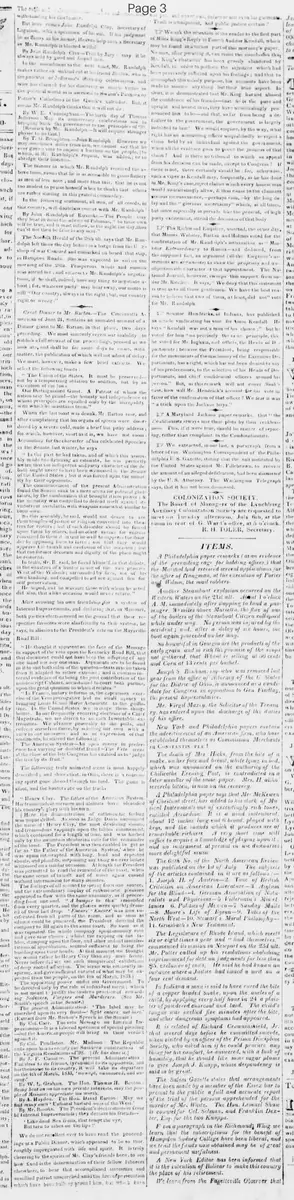
Great Dinner to Mr. Barton.—The Cincinnati American of June 21, contains an animated account of a Dinner given to Mr. Barton, in that place, two days preceding. We most sincerely regret our inability to publish a full account of the proceedings, pressed as we now are, and shall be for some days to come, with matter, the publication of which will not admit of delay. We must, however, make a few brief extracts. We select the following toasts
"The Union of the States. It must be preserved—not by a temporizing oblation to sedition, but by an execution of the laws"
Our Distinguished Guest. A Patriot of whom the nation may be proud—the honesty and independence of whose principles are equalled only by the intrepidity with which he maintains them."
When the last toast was drunk, Mr. Barton rose, and after complaining that his organs of speech were disordered by a severe cold, made a brief but pithy address; for which, however, short as it is, we have not room.
Accounting for the character of his celebrated Speeches in the Senate last winter, he says
"In the part he had taken, and of which this assembly made too flattering an estimate, he was perfectly aware that the belligerent and party character of the debate ought never to have been witnessed in the Senate of the United States; but it was forced upon the minority by their opponents.
The commencement of the present Administration found the Senate sunk to a mere arena for political gladiators, by the combination that brought it into power, & the minority was compelled to defend itself against its victorious assailants, with weapons somewhat similar to their own.
So this assembly, he said, would not desire to see their temples of justice or religion converted into theatres for rioters; but if such disorder should be forced upon them by others, and no other means for redress remained to them it might be well to suppress the disorder by opposing force to force; not that many would approve the tumult and confusion of the occasion: but that the former decorum and dignity of the place might be restored.
In truth, Mr. B said, he found himself, in that debate, in the situation of a hunter among the vast prairies West of the Wabash; surrounded by fires, not of his own kindling, and compelled to set fire against fire for self preservation.
He hoped, and he was sure those with whom he acted did also, that a like occasion would never return
After avowing his own friendship for a system of Internal Improvements, and declaring, that, in Missouri, both parties electioneered on the ground that their respective favorites were also friendly to that system, he says, in allusion to the President's veto on the Maysville Road Bill
"He thought it apparent on the face of the Message in support of the veto upon the Kentucky Road Bill, that that document could not have been the offspring of any one mind nor any one man. Arguments are to be found in it to suit both sides of the question—texts may be taken from it adapted to either extreme, and it contains internal evidence of its being the joint contribution of the nondescript Cabinet, accustomed to court both parties, upon the great question to which it relates."
"In France, history informs us, the capricious exercise of the Veto prerogative had no small agency in bringing Louis 16 and Marie Antoinette to the guillotine. In the United States we manage these things better. In our frequently recurring elections of a Chief Magistrate, we are driven to no such lamentable extremities. We advance peaceably to the polls, and redress ourselves there, by selecting our men with a view to our measures and as an expression of that sentiments, he offered the following
The American System—An open enemy in preference to a varying or doubtful friend—The Veto scene at the close of the late Congress has enabled us to judge the tree by its fruit"
The following truly animated scene is most happily described; and shows that, in Ohio, there is a redeeming spirit gone abroad through the land. The game is afoot, and the hunters are on the track.
"Henry Clay. The father of the American System His transcendent services and abilities have identified his country's glory with his own."
[Here the demonstration of enthusiastic feeling was unparalleled. As soon as Judge Davis announced the name of 'Henry Clay,' the most deafening shouts, and tremendous rappings upon the tables commenced, which continued for a length of time, and was hushed only by the numerous stentorian calls for the remainder of the toast. The President was then enabled to get as far as 'the Father of the American System,' when he was again interrupted with long, loud and repeated shouts, and plaudits, surpassing any thing we ever before witnessed on a similar occasion. At length the President was permitted to read the remainder of the toast, when the same scene of tumult and of noise again ensued without intermission for many minutes.
The feelings of all seemed to spring from one source, and the extraordinary display of enthusiastic pleasure appeared to flow with the same unanimity, as if proceeding from one soul. "A bumper to this" resounded from every quarter, and the glasses were quickly drained of their last drop. 'Encore! Encore!' was now vociferated from all parts of the room, and as soon as silence could be procured, the President directed the company to fill again to the same toast. So soon as it was repeated, the whole company spontaneously rose and gave nine cheers; whilst the rapping on the tables, stamping upon the floor, and other ardent manifestations of approbation, seemed sufficient to bring the building upon their heads. At that moment we thought we would rather be Henry Clay than any man living.
Never before did we see such unequivocal exhibitions of deep rooted affection. The scene was eminently inspiring, and gave sufficient earnest of what may be expected from the people, on the 4th of March, 1833.
The appointing power under our Government. To be directed only by the rule of individual merit; which is not meant to justify the modern practice of rewarding Seducers, Forgers and Murderers. (See Mr. Smith's speech in the Senate.)
The present Administration. 'The label may be inscribed upon its very front—'light enters not here.' (Extract from Mr. Barton's Speech in the Senate)
By Col. Carr. The veto Message on Internal Improvement—It is a labored specimen of special pleading—but the American people will bring in their verdict against it.
By Col. Pendleton. Mr. Madison: The Republic calls upon him to rectify the Southern construction of the Virginia Resolutions of '98. [He has done it.]
By J. F. Conway. The present Administration Faithless to its friends, tyrannical to its opponents, and burdensome to its country, it will take its departure on the 4th of March, 1833, 'unwept, unhonored, and unsung.'
By W. L. Graham. The Hon. Thomas H. Benton Being bent on his own private interests, may the people of Missouri appreciate his worth.
By A. Hayden. The Hon. David Barton: May we find many such 'Universal bastard sons of the West.'
By Mr. Brooks. The President's declarations in favor of internal Improvements; they deceive his friends—Like dead Sea fruits, that tempt the eye But turn to ashes on the lips!
We do not recollect ever to have read the proceedings at a Public Dinner, which appeared to be so thoroughly impregnated with life and spirit. It is truly cheering to the spirits of Mr. Clay's friends here, to see how fixed is the determination of their fellow laborers elsewhere, to bear that accomplished statesman and unsullied patriot unscorched amid the fires of persecution which have been hurled around him, but which have not even singed the hem of his garment.
Truth is omnipotent, and public justice certain
"The Union of the States. It must be preserved—not by a temporizing oblation to sedition, but by an execution of the laws"
Our Distinguished Guest. A Patriot of whom the nation may be proud—the honesty and independence of whose principles are equalled only by the intrepidity with which he maintains them."
When the last toast was drunk, Mr. Barton rose, and after complaining that his organs of speech were disordered by a severe cold, made a brief but pithy address; for which, however, short as it is, we have not room.
Accounting for the character of his celebrated Speeches in the Senate last winter, he says
"In the part he had taken, and of which this assembly made too flattering an estimate, he was perfectly aware that the belligerent and party character of the debate ought never to have been witnessed in the Senate of the United States; but it was forced upon the minority by their opponents.
The commencement of the present Administration found the Senate sunk to a mere arena for political gladiators, by the combination that brought it into power, & the minority was compelled to defend itself against its victorious assailants, with weapons somewhat similar to their own.
So this assembly, he said, would not desire to see their temples of justice or religion converted into theatres for rioters; but if such disorder should be forced upon them by others, and no other means for redress remained to them it might be well to suppress the disorder by opposing force to force; not that many would approve the tumult and confusion of the occasion: but that the former decorum and dignity of the place might be restored.
In truth, Mr. B said, he found himself, in that debate, in the situation of a hunter among the vast prairies West of the Wabash; surrounded by fires, not of his own kindling, and compelled to set fire against fire for self preservation.
He hoped, and he was sure those with whom he acted did also, that a like occasion would never return
After avowing his own friendship for a system of Internal Improvements, and declaring, that, in Missouri, both parties electioneered on the ground that their respective favorites were also friendly to that system, he says, in allusion to the President's veto on the Maysville Road Bill
"He thought it apparent on the face of the Message in support of the veto upon the Kentucky Road Bill, that that document could not have been the offspring of any one mind nor any one man. Arguments are to be found in it to suit both sides of the question—texts may be taken from it adapted to either extreme, and it contains internal evidence of its being the joint contribution of the nondescript Cabinet, accustomed to court both parties, upon the great question to which it relates."
"In France, history informs us, the capricious exercise of the Veto prerogative had no small agency in bringing Louis 16 and Marie Antoinette to the guillotine. In the United States we manage these things better. In our frequently recurring elections of a Chief Magistrate, we are driven to no such lamentable extremities. We advance peaceably to the polls, and redress ourselves there, by selecting our men with a view to our measures and as an expression of that sentiments, he offered the following
The American System—An open enemy in preference to a varying or doubtful friend—The Veto scene at the close of the late Congress has enabled us to judge the tree by its fruit"
The following truly animated scene is most happily described; and shows that, in Ohio, there is a redeeming spirit gone abroad through the land. The game is afoot, and the hunters are on the track.
"Henry Clay. The father of the American System His transcendent services and abilities have identified his country's glory with his own."
[Here the demonstration of enthusiastic feeling was unparalleled. As soon as Judge Davis announced the name of 'Henry Clay,' the most deafening shouts, and tremendous rappings upon the tables commenced, which continued for a length of time, and was hushed only by the numerous stentorian calls for the remainder of the toast. The President was then enabled to get as far as 'the Father of the American System,' when he was again interrupted with long, loud and repeated shouts, and plaudits, surpassing any thing we ever before witnessed on a similar occasion. At length the President was permitted to read the remainder of the toast, when the same scene of tumult and of noise again ensued without intermission for many minutes.
The feelings of all seemed to spring from one source, and the extraordinary display of enthusiastic pleasure appeared to flow with the same unanimity, as if proceeding from one soul. "A bumper to this" resounded from every quarter, and the glasses were quickly drained of their last drop. 'Encore! Encore!' was now vociferated from all parts of the room, and as soon as silence could be procured, the President directed the company to fill again to the same toast. So soon as it was repeated, the whole company spontaneously rose and gave nine cheers; whilst the rapping on the tables, stamping upon the floor, and other ardent manifestations of approbation, seemed sufficient to bring the building upon their heads. At that moment we thought we would rather be Henry Clay than any man living.
Never before did we see such unequivocal exhibitions of deep rooted affection. The scene was eminently inspiring, and gave sufficient earnest of what may be expected from the people, on the 4th of March, 1833.
The appointing power under our Government. To be directed only by the rule of individual merit; which is not meant to justify the modern practice of rewarding Seducers, Forgers and Murderers. (See Mr. Smith's speech in the Senate.)
The present Administration. 'The label may be inscribed upon its very front—'light enters not here.' (Extract from Mr. Barton's Speech in the Senate)
By Col. Carr. The veto Message on Internal Improvement—It is a labored specimen of special pleading—but the American people will bring in their verdict against it.
By Col. Pendleton. Mr. Madison: The Republic calls upon him to rectify the Southern construction of the Virginia Resolutions of '98. [He has done it.]
By J. F. Conway. The present Administration Faithless to its friends, tyrannical to its opponents, and burdensome to its country, it will take its departure on the 4th of March, 1833, 'unwept, unhonored, and unsung.'
By W. L. Graham. The Hon. Thomas H. Benton Being bent on his own private interests, may the people of Missouri appreciate his worth.
By A. Hayden. The Hon. David Barton: May we find many such 'Universal bastard sons of the West.'
By Mr. Brooks. The President's declarations in favor of internal Improvements; they deceive his friends—Like dead Sea fruits, that tempt the eye But turn to ashes on the lips!
We do not recollect ever to have read the proceedings at a Public Dinner, which appeared to be so thoroughly impregnated with life and spirit. It is truly cheering to the spirits of Mr. Clay's friends here, to see how fixed is the determination of their fellow laborers elsewhere, to bear that accomplished statesman and unsullied patriot unscorched amid the fires of persecution which have been hurled around him, but which have not even singed the hem of his garment.
Truth is omnipotent, and public justice certain
What sub-type of article is it?
Historical Event
Biography
What themes does it cover?
Justice
Triumph
Deception
What keywords are associated?
Political Dinner
David Barton
Henry Clay
Maysville Road Veto
Internal Improvements
American System
Senate Debates
What entities or persons were involved?
David Barton
Henry Clay
Andrew Jackson
Thomas H. Benton
Where did it happen?
Cincinnati
Story Details
Key Persons
David Barton
Henry Clay
Andrew Jackson
Thomas H. Benton
Location
Cincinnati
Event Date
June 19
Story Details
A dinner honored Senator David Barton with toasts supporting the Union and Henry Clay, criticizing President Jackson's veto on internal improvements. Barton defended his Senate debates as defensive against administration aggression, likening it to fighting fire with fire, and expressed hope for no recurrence.