Thank you for visiting SNEWPapers!
Sign up free
Editorial
June 29, 1879
New York Dispatch
New York, New York County, New York
What is this article about?
Editorial criticizes the practice of printing names of subordinate Masonic lodge members in grand lodge proceedings, arguing it wastes space, fails to prevent impostors effectively, and recommends telegraph verification for charity seekers instead. References North Carolina's 1878 proceedings as example.
Clipping
OCR Quality
95%
Excellent
Full Text
DOES IT PAY?
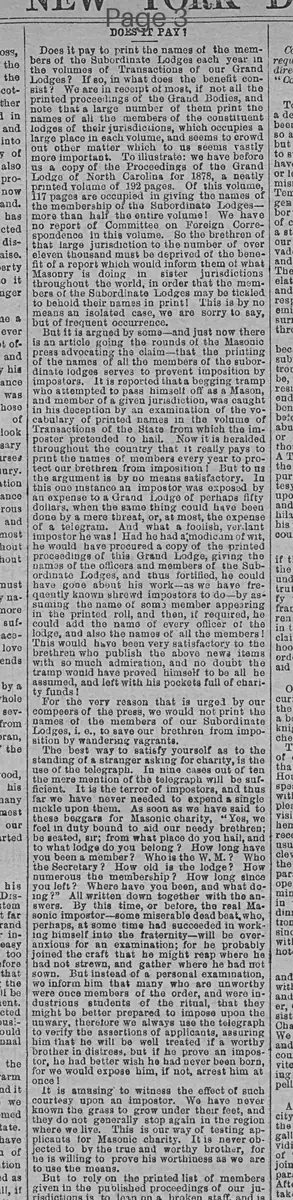
Does it pay to print the names of the members of the Subordinate Lodges each year in the volumes of Transactions of our Grand Lodges? If so, in what does the benefit consist? We are in receipt of most, if not all the printed proceedings of the Grand Bodies, and note that a large number of them print the names of all the members of the constituent lodges of their jurisdictions, which occupies a large place in each volume, and seems to crowd out other matter which to us seems vastly more important. To illustrate: we have before us a copy of the Proceedings of the Grand Lodge of North Carolina for 1878, a neatly printed volume of 192 pages. Of this volume, 117 pages are occupied in giving the names of the membership of the Subordinate Lodges—more than half the entire volume! We have no report of Committee on Foreign Correspondence in this volume. So the brethren of that large jurisdiction to the number of over eleven thousand must be deprived of the benefit of a report which would inform them of what Masonry is doing in sister jurisdictions throughout the world, in order that the members of the Subordinate Lodges may be tickled to behold their names in print! This is by no means an isolated case, we are sorry to say, but of frequent occurrence. But it is argued by some and just now there is an article going the rounds of the Masonic press advocating the claim—that the printing of the names of all the members of the subordinate lodges serves to prevent imposition by impostors. It is reported that a begging tramp who attempted to pass himself off as a Mason and member of a given jurisdiction, was caught in his deception by an examination of the vocabulary of printed names in the volume of Transactions of the State from which the impostor pretended to hail. Now it is heralded throughout the country that it really pays to print the names of members every year to protect our brethren from imposition! But to us the argument is by no means satisfactory. In this one instance an impostor was exposed by an expense to a Grand Lodge of perhaps fifty dollars, when the same thing could have been done by a mere threat, or, at most, the expense of a telegram. And what a foolish, verdant impostor he was! Had he had a 'modicum of wit,' he would have procured a copy of the printed proceedings of this Grand Lodge, giving the names of the officers and members of the Subordinate Lodges, and thus fortified, he could have gone about his work—as we have frequently known shrewd impostors to do—by assuming the name of some member appearing in the printed roll, and then, if required, he could add the name of every officer of the lodge, and also the names of all the members! This would have been very satisfactory to the brethren who publish the above news items with so much admiration, and no doubt the tramp would have proved himself to be all he assumed, and left with his pockets full of charity funds! For the very reason that is urged by our compeers of the press, we would not print the names of the members of our Subordinate Lodges, i. e., to save our brethren from imposition by wandering vagrants. The best way to satisfy yourself as to the standing of a stranger asking for charity, is the use of the telegraph. In nine cases out of ten the mere mention of the telegraph will be sufficient. It is the terror of impostors, and thus far we have never needed to expend a single nickel upon them. As soon as we have said to these beggars for Masonic charity, "Yes, we feel in duty bound to aid our needy brethren; be seated, sir; from what place do you hail, and to what lodge do you belong? How long have you been a member? Who is the W. M.? Who the Secretary? How old is the lodge? How numerous the membership? How long since you left? Where have you been, and what doing?" All written down together with the answers. By this time, or before, the real Masonic impostor—some miserable dead beat who, perhaps, at some time had succeeded in working himself into the fraternity—will be over-anxious for an examination; for he probably joined the craft that he might reap where he had not strewn, and gather where he had not sown. But instead of a personal examination, we inform him that many who are unworthy were once members of the order, and were industrious students of the ritual, that they might be better prepared to impose upon the unwary, therefore we always use the telegraph to verify the assertions of applicants, assuring him that he will be well treated if a worthy brother in distress, but if he prove an impostor, he had better wish he had never been born, for we would expose him, if not, arrest him at once! It is amusing to witness the effect of such courtesy upon an impostor. We have never known the grass to grow under their feet, and they do not generally stop again in the region where we live. This is our way of testing applicants for Masonic charity. It is never objected to by the true and worthy brother, for he is willing to prove his worthiness as we are to use the means. But to rely on the printed list of members given in the published proceedings of our jurisdictions is to lean on a broken staff, and is just what all the shrewd impostors traveling and imposing on the fraternity most desire. Instead of the printed names being a benefit to the craft, they are a benefit to the impostor, and therefore a positive injury to the craft. Better far that the space thus occupied should be given to a well-written report, or some other matter of real value to the fraternity.—Freemason's Monthly.
Does it pay to print the names of the members of the Subordinate Lodges each year in the volumes of Transactions of our Grand Lodges? If so, in what does the benefit consist? We are in receipt of most, if not all the printed proceedings of the Grand Bodies, and note that a large number of them print the names of all the members of the constituent lodges of their jurisdictions, which occupies a large place in each volume, and seems to crowd out other matter which to us seems vastly more important. To illustrate: we have before us a copy of the Proceedings of the Grand Lodge of North Carolina for 1878, a neatly printed volume of 192 pages. Of this volume, 117 pages are occupied in giving the names of the membership of the Subordinate Lodges—more than half the entire volume! We have no report of Committee on Foreign Correspondence in this volume. So the brethren of that large jurisdiction to the number of over eleven thousand must be deprived of the benefit of a report which would inform them of what Masonry is doing in sister jurisdictions throughout the world, in order that the members of the Subordinate Lodges may be tickled to behold their names in print! This is by no means an isolated case, we are sorry to say, but of frequent occurrence. But it is argued by some and just now there is an article going the rounds of the Masonic press advocating the claim—that the printing of the names of all the members of the subordinate lodges serves to prevent imposition by impostors. It is reported that a begging tramp who attempted to pass himself off as a Mason and member of a given jurisdiction, was caught in his deception by an examination of the vocabulary of printed names in the volume of Transactions of the State from which the impostor pretended to hail. Now it is heralded throughout the country that it really pays to print the names of members every year to protect our brethren from imposition! But to us the argument is by no means satisfactory. In this one instance an impostor was exposed by an expense to a Grand Lodge of perhaps fifty dollars, when the same thing could have been done by a mere threat, or, at most, the expense of a telegram. And what a foolish, verdant impostor he was! Had he had a 'modicum of wit,' he would have procured a copy of the printed proceedings of this Grand Lodge, giving the names of the officers and members of the Subordinate Lodges, and thus fortified, he could have gone about his work—as we have frequently known shrewd impostors to do—by assuming the name of some member appearing in the printed roll, and then, if required, he could add the name of every officer of the lodge, and also the names of all the members! This would have been very satisfactory to the brethren who publish the above news items with so much admiration, and no doubt the tramp would have proved himself to be all he assumed, and left with his pockets full of charity funds! For the very reason that is urged by our compeers of the press, we would not print the names of the members of our Subordinate Lodges, i. e., to save our brethren from imposition by wandering vagrants. The best way to satisfy yourself as to the standing of a stranger asking for charity, is the use of the telegraph. In nine cases out of ten the mere mention of the telegraph will be sufficient. It is the terror of impostors, and thus far we have never needed to expend a single nickel upon them. As soon as we have said to these beggars for Masonic charity, "Yes, we feel in duty bound to aid our needy brethren; be seated, sir; from what place do you hail, and to what lodge do you belong? How long have you been a member? Who is the W. M.? Who the Secretary? How old is the lodge? How numerous the membership? How long since you left? Where have you been, and what doing?" All written down together with the answers. By this time, or before, the real Masonic impostor—some miserable dead beat who, perhaps, at some time had succeeded in working himself into the fraternity—will be over-anxious for an examination; for he probably joined the craft that he might reap where he had not strewn, and gather where he had not sown. But instead of a personal examination, we inform him that many who are unworthy were once members of the order, and were industrious students of the ritual, that they might be better prepared to impose upon the unwary, therefore we always use the telegraph to verify the assertions of applicants, assuring him that he will be well treated if a worthy brother in distress, but if he prove an impostor, he had better wish he had never been born, for we would expose him, if not, arrest him at once! It is amusing to witness the effect of such courtesy upon an impostor. We have never known the grass to grow under their feet, and they do not generally stop again in the region where we live. This is our way of testing applicants for Masonic charity. It is never objected to by the true and worthy brother, for he is willing to prove his worthiness as we are to use the means. But to rely on the printed list of members given in the published proceedings of our jurisdictions is to lean on a broken staff, and is just what all the shrewd impostors traveling and imposing on the fraternity most desire. Instead of the printed names being a benefit to the craft, they are a benefit to the impostor, and therefore a positive injury to the craft. Better far that the space thus occupied should be given to a well-written report, or some other matter of real value to the fraternity.—Freemason's Monthly.
What sub-type of article is it?
Masonic Policy
Impostor Prevention
What keywords are associated?
Masonic Proceedings
Member Names
Impostors
Charity Verification
Grand Lodges
Telegraph Examination
What entities or persons were involved?
Grand Lodge Of North Carolina
Freemason's Monthly
Editorial Details
Primary Topic
Critique Of Printing Subordinate Lodge Member Names In Grand Lodge Proceedings
Stance / Tone
Opposed To Printing Names, Advocates Telegraph Verification For Charity Applicants
Key Figures
Grand Lodge Of North Carolina
Freemason's Monthly
Key Arguments
Printing Member Names Occupies Excessive Space In Proceedings, Crowding Out Important Reports Like Foreign Correspondence
Such Lists Do Not Effectively Prevent Impostors, As They Can Study And Assume Identities From The Lists
A Single Case Of Exposure Via Printed List Is Outweighed By The Cost And Ineffectiveness Compared To Using Telegraph
Threat Of Telegraph Examination Deters Impostors Without Expense
Detailed Questioning And Telegraph Verification Is A Reliable Method To Test Masonic Charity Applicants