Thank you for visiting SNEWPapers!
Sign up free
Palladium Of Virginia And The Pacific Monitor
Lewisburg, Greenbrier County, West Virginia
What is this article about?
A Fellow Citizen opposes a petition to attach part of Greenbrier County to Pocahontas County, arguing it would reduce Greenbrier's territory (140 sq mi), population (210 inhabitants), revenue ($240 annually), and political influence, while Pocahontas gains without benefiting Greenbrier; highlights future canal advantages if retained.
Clipping
OCR Quality
Full Text
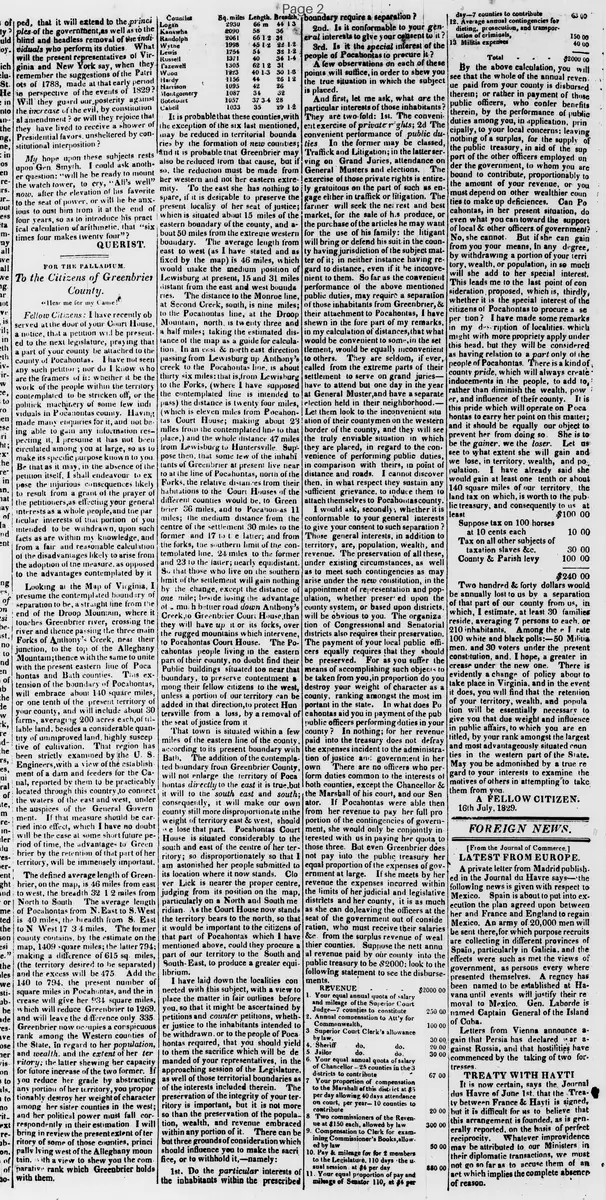
To the Citizens of Greenbrier County.
"Hear me for my Cause"
Fellow Citizens: I have recently observed at the door of your Court House, a notice, that a petition will be presented to the next legislature, praying that a part of your county be attached to the county of Pocahontas. I have not seen any such petition; nor do I know who are the framers of it: whether it be the work of the people within the territory contemplated to be stricken off, or the politic machinery of some few individuals in Pocahontas county. Having made many enquiries for it, and not being able to gain any information respecting it, I presume it has not been circulated among you at large, so as to make its specific purpose known to you.
Be that as it may, in the absence of the petition itself, I shall endeavor to expose the injurious consequences likely to result from a grant of the prayer of the petitioners, as affecting your general interests as a whole people, and the particular interests of that portion of you intended to be withdrawn, upon such facts as are within my knowledge, and from a fair and reasonable calculation of the disadvantages likely to arise from the adoption of the measure, as opposed to the advantages contemplated by it.
Looking at the Map of Virginia, I presume the contemplated boundary of separation to be, a straight line from the end of the Droop Mountain, where it touches Greenbrier river, crossing the river and thence passing the three main Forks of Anthony's Creek, near their junction, to the top of the Alleghany Mountain; thence with the same to unite with the present eastern line of Pocahontas and Bath counties. This extension of the boundary of Pocahontas, will embrace about 140 square miles, or one tenth of the present territory of your county, and will include about 30 farms, averaging 200 acres each, of tillable land, besides a considerable quantity of unimproved land, highly susceptible of cultivation. That region has been strictly examined by the U. S. Engineers, with a view of the establishment of a dam and feeders for the Canal, reported by them to be practicably located through this country, to connect the waters of the east and west, under the auspices of the General Government. If that measure should be carried into effect, which I have no doubt will be the case at some short future period of time, the advantages to Greenbrier by the retention of that part of her territory, will be immensely important.
The defined average length of Greenbrier, on the map, is 46 miles from east to west, the breadth 32 1/2 miles from North to South. The average length of Pocahontas from N. East to S. West is 40 miles, the breadth from S. East to N. West 17 3/4 miles. The former county contains, by the estimate on the map, 1409 square miles; the latter 794; making a difference of 615 sq. miles, (the territory desired to be separated) and the excess will be 475. Add the 140 to 794, the present number of square miles in Pocahontas, and the increase will give her 934 square miles, which will reduce Greenbrier to 1269, and will leave the difference only 335.
Greenbrier now occupies a conspicuous rank among the Western counties of the State, in regard to her population, and wealth, and the extent of her territory; the latter showing her capacity for future increase of the two former. If you reduce her grade by abstracting any portion of her territory, you proportionally destroy her weight of character among her sister counties in the west; and her political power must fall correspondingly in their estimation. I will bring in review the present extent of territory of some of those counties, principally lying west of the Alleghany mountain, with a view to show you the comparative rank which Greenbrier holds with them.
It is probable that these counties, with the exception of the six last mentioned, may be reduced in territorial boundaries by the formation of new counties; And it is probable that Greenbrier may also be reduced from that cause, but if so, the reduction must be made from her western and not her eastern extremity. To the east she has nothing to spare, if it is desirable to preserve the present locality of her seat of justice; which is situated about 15 miles of the eastern boundary of the county, and about 50 miles from the extreme western boundary. The average length from east to west (as I have stated and as fixed by the map) is 46 miles, which would make the medium position of Lewisburg at present, 15 and 31 miles distant from the east and west boundaries.
The distance to the Monroe line, at Second Creek, south, is nine miles; to the Pocahontas line, at the Droop Mountain, north, is twenty three and a half miles; taking the estimated distance of the map as a guide for calculation. In an east and north east direction passing from Lewisburg up Anthony's creek to the Pocahontas line, is about thirty six miles: that is, from Lewisburg to the Forks, (where I have supposed the contemplated line is intended to pass) the distance is twenty four miles, (which is eleven miles from Pocahontas Court House; making about 23 miles from the contemplated line to that place,) and the whole distance 47 miles from Lewisburg to Huntersville. Suppose then, that some few of the inhabitants of Greenbrier at present live near to at the line of Pocahontas, north of the Forks, the relative distances from their habitations to the Court Houses of the different counties would be, to Greenbrier 36 miles, and to Pocahontas 11 miles; the medium distance from the centre of the settlement 30 miles to the former and 17 to the latter; and from the forks, the southern limit of the contemplated line, 24 miles to the former and 23 to the latter; nearly equidistant.
So that those who live on the southern limit of the settlement will gain nothing by the change, except the distance of one mile; beside losing the advantage of a much better road down Anthony's Creek to Greenbrier Court House, than they will have up it or its forks, over the rugged mountains which intervene, to Pocahontas Court House. The Pocahontas people living in the eastern part of their county, no doubt find their Public buildings situated too near that boundary, to preserve contentment among their fellow citizens to the west, unless a portion of our territory can be added in that direction, to protect Huntersville from a loss, by a removal of the seat of justice from it. That town is situated within a few miles of the eastern line of the county, according to its present boundary with Bath. The addition of the contemplated boundary from Greenbrier County, will not enlarge the territory of Pocahontas directly to the east it is true, but it will to the south east and south; consequently, it will make our own county still more disproportionate in the weight of territory east and west, should we lose that part. Pocahontas Court House is situated considerably to the south and east of the centre of her territory; so disproportionately so that I am astonished her people submitted to its location where it now stands. Clover Lick is nearer the proper centre, judging from its position on the map, particularly on a North and South meridian. As the Court House now stands the territory bears to the north, so that it would be important to the citizens of that part of Pocahontas which I have mentioned above, could they procure a part of our territory to the South and South-East, to produce a greater equilibrium.
I have laid down the localities connected with this subject, with a view to place the matter in fair outlines before you, so that it might be ascertained by petitions and counter petitions, whether justice to the inhabitants intended to be withdrawn, or to the people of Pocahontas required, that you should yield to them the sacrifice which will be demanded of your representatives, in the approaching session of the Legislature, as well of those territorial boundaries as of the interests included therein. The preservation of the integrity of your territory is important, but it is not more so than the preservation of the population, wealth, and revenue embraced within any portion of it. There can be but three grounds of consideration which should influence you to make the sacrifice, or to withhold it,--namely:
1st. Do the particular interests of the inhabitants within the prescribed boundary require a separation?
2d. Is it conformable to your general interests to give your consent to it?
3d. Is it the special interest of the people of Pocahontas to procure it?
A few observations on each of these points will suffice, in order to show you the true situation in which the subject is placed.
And first, let me ask, what are the particular interests of those inhabitants? They are two-fold: 1st. The convenient exercise of private rights; 2d. The convenient performance of public duties. In the former may be classed, Traffick and Litigation; in the latter serving on Grand Juries, attendance on General Musters and elections. The exercise of those private rights is entirely gratuitous on the part of such as engage either in traffick or litigation. The farmer will seek the nearest and best market, for the sale of his produce, or the purchase of the articles he may want for the use of his family: the litigant will bring or defend his suit in the county having jurisdiction of the subject matter of it; in neither instance having regard to distance, even if it be inconvenient to them. So far as the convenient performance of the above mentioned public duties, may require a separation of those inhabitants from Greenbrier, and their attachment to Pocahontas, I have shown in the fore part of my remarks. In my calculation of distances, that what would be convenient to some, in the settlement, would be equally inconvenient to others. They are seldom, if ever, called from the extreme parts of their settlement to serve on grand juries--have to attend but one day in the year at General Muster, and have a separate election held in their neighborhood.--Let them look to the inconvenient situation of their countrymen on the western border of the county, and they will see the truly enviable situation in which they are placed, in regard to the convenience of performing public duties, in comparison with theirs, in point of distance and roads. I cannot discover then, in what respect they sustain any sufficient grievance, to induce them to attach themselves to Pocahontas county.
I would ask, secondly: whether it is conformable to your general interests to give your consent to such separation? Those general interests, in addition to territory, are, population, wealth, and revenue. The preservation of all these, under existing circumstances, as well as to meet such contingencies as may arise under the new constitution, in the appointment of representation and population, whether preserved upon the county system, or based upon districts, will be obvious to you. The organization of Congressional and Senatorial districts also requires their preservation. The payment of your local public officers equally requires that they should be preserved. For as you suffer the means of accomplishing such objects to be taken from you, in proportion do you destroy your weight of character as a county, ranking amongst the most important in the state. In what does Pocahontas aid you in payment of the public officers performing duties in your county? In nothing; for her revenue paid into the treasury does not defray the expenses incident to the administration of justice and government in her own
There are no officers who perform duties common to the interests of both counties, except the Chancellor and the Marshall of his court, and our Senator. If Pocahontas were able then from her revenue to pay her full proportion of the contingencies of government, she would only be conjointly interested with us in paying her quota to those three. But even Greenbrier does not pay into the public treasury her equal proportion of the expenses of government at large. If she meets by her revenue the expenses incurred within the limits of her judicial and legislative districts and her county, it is as much as she can do, leaving the officers at the seat of the government out of consideration, who must receive their salaries &c. from the surplus revenue of wealthier counties. Suppose the net annual revenue paid by our county into the public treasury to be $2000: look to the following statement to see the disbursements.
REVENUE
$2000 00
1. Your equal annual quota of salary and mileage of the Superior Court Judge--7 counties to constitute $25000
2. Annual compensation to Att'y for Commonwealth, 100 00
3. Superior Court Clerk's allowance by law, 300 00
4. Sheriff do. do. 20 00
5. Jailor do. do. 30 00
6. Your equal annual quota of salary of Chancellor - 25 counties in the 3 districts to contribute 67 00
7. Your proportion of compensation to the Marshall of this district at $5 per day allowing 40 days attendance on court, per year- 10 counties to contribute 20 00
8. Two commissioners of the Revenue at $150 each, allowed by law 300 00
9. Compensation to Clerk for examining Commissioner's Books, allowed by law 50 00
10. Pay & mileage for 2 members to the Legislature, 110 days the usual session: at $4 per day 680 00
11. Your equal proportion of pay and mileage of Senator 110, at $4 per day-7 Counties to contribute
12. Average annual contingencies for dieting, prosecution, and transportation of criminals, 150 00
13. Militia expenses 40 00
Total $2000 00
By the above calculation, you will see that the whole of the annual revenue paid from your county is disbursed therein; or rather in payment of those public officers, who confer benefits therein, by the performance of public duties among you, in application, principally, to your local concerns: leaving nothing of a surplus, for the supply of the public treasury, in aid of the support of the other officers employed under the government, to whom you are bound to contribute, proportionably to the amount of your revenue, or you must depend on other wealthier counties to make up deficiencies. Can Pocahontas, in her present situation, do even what you can toward the support of local and other officers of government? No, she cannot. But if she can gain from you your means, in any degree, by withdrawing a portion of your territory, wealth, or population, in so much will she add to her special interest.
This leads me to the last point of consideration proposed, which is, thirdly, whether it is the special interest of the citizens of Pocahontas to procure a separation? I have made some remarks in my description of localities, which might with more propriety apply under this head, but they will be considered as having relation to a part only of the people of Pocahontas. There is a kind of county pride, which will always create inducements in the people, to add to, rather than diminish the wealth, power, and influence of their county. It is this pride which will operate on Pocahontas to carry her point on this matter: and it should be equally our object to prevent her from doing so. She is to be the gainer, we the loser. Let us see to what extent she will gain and we lose, in territory, wealth, and population. I have already said she would gain at least one tenth or about 140 square miles of our territory, the land tax on which, is worth to the public treasury, and consequently to us at least $100 00
Suppose tax on 100 horses at 10 cents each 10 00
Tax on all other subjects of taxation slaves &c. 30 00
County & Parish levy 100 00
$240 00
Two hundred and forty dollars would be annually lost to us by a separation of that part of our county from us, in which, I estimate, at least 30 families reside, averaging 7 persons to each, or 210 inhabitants. Among them I rate 100 white and black polls:--50 Militia men, and 30 voters under the present constitution, and, I hope, a greater increase under the new one. There is evidently a change of policy about to take place in Virginia, and in the event it does, you will find that the retention of your territory, wealth, and population will be essentially necessary to give you that due weight and influence in public affairs, to which you are entitled, by your rank amongst the largest and most advantageously situated counties in the western part of the State.
May you be admonished by a true regard to your interests to examine the motives of others in attempting to take them from you.
A FELLOW CITIZEN:
16th July, 1829.
What sub-type of article is it?
What themes does it cover?
What keywords are associated?
What entities or persons were involved?
Letter to Editor Details
Author
A Fellow Citizen
Recipient
To The Citizens Of Greenbrier County
Main Argument
the letter opposes the petition to attach part of greenbrier county to pocahontas county, arguing that it would harm greenbrier's territory, population, wealth, revenue, and political influence without sufficient benefits to the affected inhabitants or overall interests, while primarily benefiting pocahontas through county pride and equilibrium.
Notable Details